Loading video…
Sound

original sound - physicalai.robot
physicalAI humanoid · Original audio
0:00–:––
Playing this video’s own audio, so you’ll hear the creator over the sound.
The video succeeds by framing a niche technical product as a sophisticated engineering tool rather than a toy, using clear, high-quality visuals to demystify complex robotics concepts.
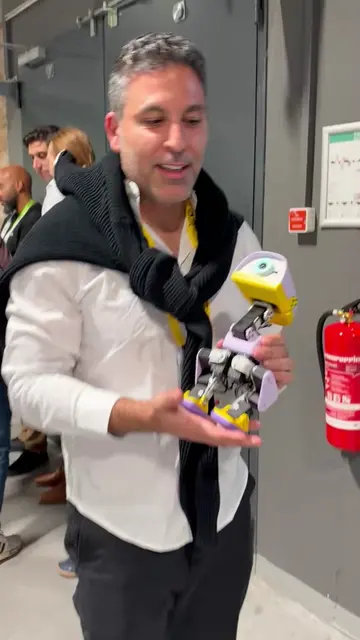
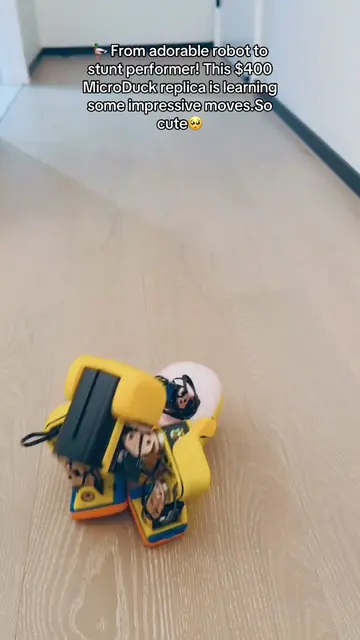
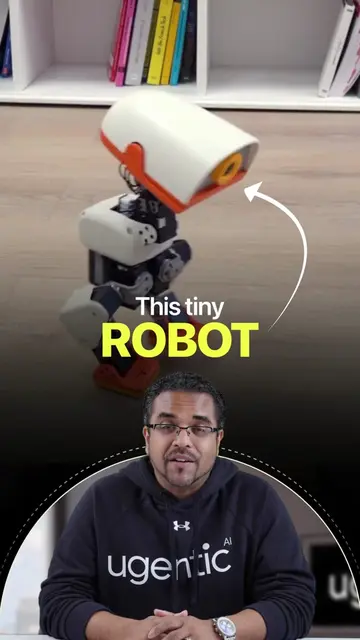
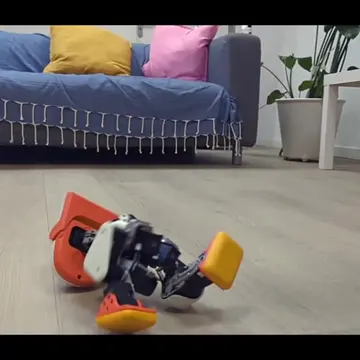
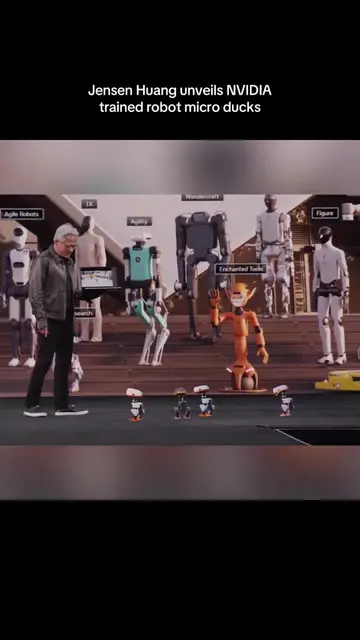
The video introduces MicroDuck, a small bipedal robot, highlighting its technical specifications and engineering capabilities. It explains how the robot uses reinforcement learning and simulation to perform complex tasks, while clarifying the open-source status of its software versus its hardware design.
MicroDuck looks like a cute desk toy. The hardware tells a different story. At just 25 cm tall and around 780 g, this small robotic duck packs a surprising amount of engineering into its body. Here’s what’s inside: • 15 motors controlling its legs, head, neck and beak • Rockchip RK3566 processor • 1 GB RAM and 32 GB storage • A camera for visual input • An 8-microphone array for audio input That combination gives MicroDuck the hardware for movement, vision and voice interaction in a compact form. What caught my attention is the number of moving parts packed into such a small robot. Coordinating the legs, neck, head and beak requires more than making a few motors move. The robot needs to manage multiple joints while responding to its surroundings. Small robots like this are also interesting because they bring robotics closer to everyday environments. A compact platform can be easier to place on a desk, carry around and use for experiments than a full-sized humanoid. Of course, the hardware specs alone don't tell us how well it performs. Real-world tests would help answer questions about walking stability, voice recognition, response time and battery life. Still, MicroDuck is a good reminder that you don't need a human-sized robot to explore the engineering behind embodied AI. Would you keep a robotic duck on your desk if it could move, see and talk to you?
MicroDuck is not a toy.
Introduction to MicroDuck as an engineering platform
Breakdown of hardware components and sensors
Explanation of reinforcement learning and trained behaviors
Overview of the sim-to-real development pipeline
Clarification on open-source software versus hardware design
MicroDuck: (a) ACTS — it is the subject of the video, its hardware and software capabilities are demonstrated, and it is shown performing various tasks like walking and grasping. Removing it would change the video entirely. Rockchip RK3566: (a) ACTS — it is identified as the processor running the robot. MuJoCo: (a) ACTS — it is identified as the simulation software used to train the robot's policies.
Playing this video’s own audio, so you’ll hear the creator over the sound.
Promotes 1 product. Create free account to see more.
Outliers and viral hits: their videos on Overshot, all time.
Open-source biped robot for developers and researchers experimenting with physical AI
Views and creators: posted in the last 30 days (English videos). Videos: all time.