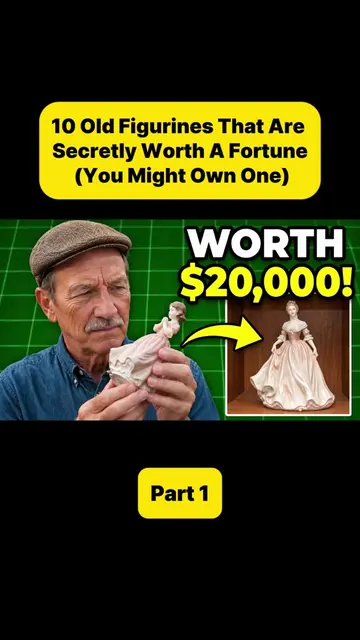
Number three, the German half dolls. Little porcelain half figures, a lady from the waist up that sat on a pin cushion or a powder box on grandmother's dresser. Made in Germany in the 20s and 30s by houses like Dressel and Kister. Look at her arms. Arms molded flat against the body, she is common, usually a few tens of dollars. Arms sculpted out away from the body, the fingers separated, and she is the money. 100 to 300 and up. The finest Dressel and Kister ladies into the thousands. Arms away were harder to mold and easier to break, so very few lived. Your test tonight, the arms first, then the base for an incised number and the word Germany. The loss I see most is one of these swept into a box of sewing notions and sold for a dollar with the pin cushion still pinned to her waist. Number two, Hummel again, on purpose, because the early ones are a different item wearing the same face. At number seven you had the common one, this is the other. A large piece from that first crown era, 1935 to 1949, is one of the great sleepers left in an American house. Take the Merry Wanderer. In a common later mark he is a 50 dollar figure. In an early crown or a full B, he is brought several times that and the large display sizes far more. Documented sales of the very best early Hummels have reached the low 20,000s. Your test tonight, turn it over for the crown, then notice the size, because with the early ones the bigger the piece, the harder collectors chase it. The loss I see most is the big dusty one on the top shelf, sold cheap because it was in the way. And number one, the figurine nearly every one of you already owns without thinking about it. A common Hummel, a Precious Moments, a pretty lady Dalton. Common Hummels are honestly 15 to 75 dollars, common Precious Moments 5 to 20. Fame is not value. I said that about the teacups. The figure the whole world recognizes is almost never worth the most, because the whole world already has one. The value was never in the famous name on the front, it was always in the details on the bottom. The early crown, the crossed swords, smooth under the glaze, the arms free of the waist. The figure everybody owns is modest, and the fortune hides in the 10 percent nobody turns over. Let me tell you about a man named Dale. In 2014 he set a milk crate on my counter. His wife had died the spring before. 59 Hummels in that crate, one for nearly every birthday and anniversary of a 38 year marriage. His daughters wanted to run the whole shelf to the church sale in a laundry basket. He would not let them and could not say why. I put down a felt pad and we turned them over one at a time. Most were what you would expect, later pieces worth a lunch a piece. But two small plain ones he had pushed to the back were bought by a young bride in the 50s, and both carried the full B. Those two were worth more than the other 57 together. Not a fortune, real money, and it was the last thing her hands ever arranged on that shelf. He was the one who could not clear it. That instinct was right the whole time. Now let me be honest the way I promised. Most of what is on most shelves is worth about what a decent lunch costs. I will never tell you what your particular figure is worth from across a table I cannot see. What I will tell you is which marks are worth stopping for, and that anything making your heart jump goes in front of a reputable dealer or certified appraiser in person before you sell. A chip on the base halves the price, so handle the good ones like eggs until you know. And two of my own, because these cost families more than the pickers do. Never wash a figurine in a sink and never in a dishwasher. Hot water and detergent lift the paint, dull the glaze, and take gold trim clean off.