Loading video…
All breakouts
12.2Talking HeadContrarian hookSaaS
Hook
I thought I could get away with not knowing Haskell
@skliang200
1.2K followers · usually 1.2K views a post
Views
14.0K
Likes
205
Comments
6
Shares
4
Why it worked
The video provides high-value, niche technical education in a concise, accessible format, which appeals strongly to the programming community.
Summary
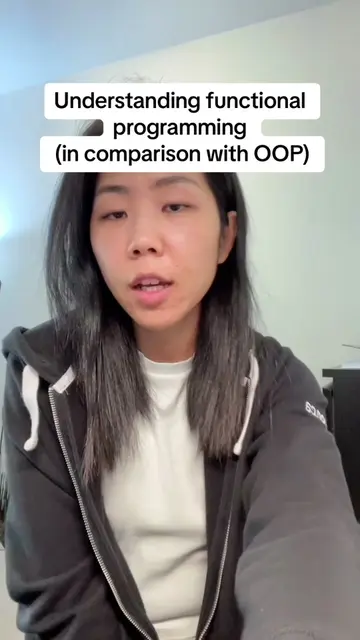
The creator explains the mechanics of function application and currying in the Haskell programming language. She contrasts the behavior of space-based function application with the use of the dollar sign operator.
Structure
- 1Introduction to learning Haskell
- 2Explaining function calls and currying
- 3Comparing space vs parentheses syntax
- 4Defining space as a high-priority operator
- 5Explaining the $ operator as a low-priority alternative
On-screen text
Function application in Haskell
Transcript
I thought I could get away with not knowing Haskell. Turns out I can't, so I went to read a tutorial about it, like the basic stuff, and it is actually kind of interesting. So the way function calls work in Haskell is you give a function name, then you pass in the arguments, all with space in between. You can understand it as a function with a list of arguments, but the way it actually works is that the function takes the first argument, returns another function, then this function takes the second argument. So essentially there's currying happening at every function call. You can also put the arguments in between parentheses, but now it means a very different thing. Now this function only takes one argument and this big tuple of your arguments. Like the white space in between is almost like an operator. It has a meaning, it's a function application, and it has the highest priority in execution. If we see this white space as a function application operator and it's left binding, means any value is from left to right, the left one takes the higher priority. And there is a $ operator which is like reverse white space. So instead of white space you put a $ in there, then it becomes right binding and it takes the lowest precedence. For example, I have a function that takes one argument. If I say this function, then I pass 1+1 to it, because it's a white space in between it, it actually takes the first one, apply this function to the one, then try to plus one on top of it. Whereas if I put $ between, it actually reverses the whole thing. It becomes left binding and it takes lowest precedence, which means the plus will be evaluated first. So we are now applying this function to the value of 2, which is the result of 1+1.
Original caption
The day that I submit to Haskell has finally come #functionalprogramming #haskell #Tech #programming #programminglanguage #computerscience #computerengineering
More from @skliang200
More breakout videos from this creator.