Loading video…
All breakouts
8.1Talking HeadBefore / After hookAI Tools
Hook
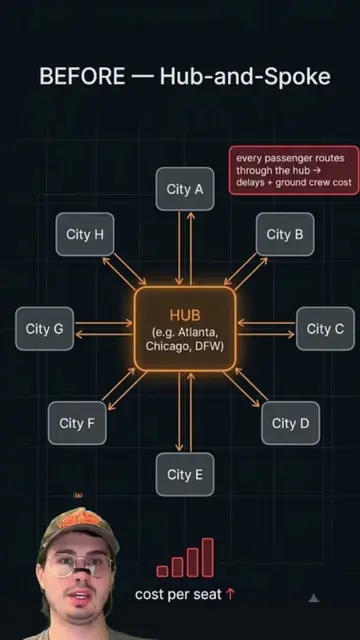
BEFORE — One fixed bitrate ladder for every title
@thedataandaiguy
7.5K followers · usually 5.7K views a post
Views
16.0K
Likes
692
Comments
42
Shares
14
Why it worked
The video explains a complex technical process in a clear and visually engaging way, using diagrams and relatable examples. It highlights a tangible benefit (better quality, less bandwidth) that resonates with a broad audience interested in streaming technology.
Summary
This video explains Netflix's per-title encoding pipeline, which optimizes video quality and bandwidth by analyzing each title individually using the VMAF metric. This approach avoids the inefficiencies of a fixed bitrate ladder, leading to better picture quality and reduced bandwidth usage.
Structure
- 1Problem: Fixed bitrate ladder for all content
- 2Consequences: Overspending/underspending on bandwidth
- 3Solution: Netflix's per-title encoding pipeline
- 4Process: Encoding at multiple bitrates, VMAF metric, finding sweet spots
- 5Result: Custom ladder per title, better quality, less bandwidth
Product placement
Netflix is discussed as the subject of the video, explaining its per-title encoding pipeline and the VMAF metric it developed. The video uses diagrams to illustrate the process and its benefits.
On-screen text
BEFORE — One fixed bitrate ladder for every title
Fixed Bitrate Ladder
235 kbps
560 kbps
1750 kbps
3000 kbps
5800 kbps
Action movie —
fast motion,
complex
backgrounds
under-spent,
looks bad
same settings
same settings
Animated film —
flat colors,
smooth gradients
over-spent,
wasted bits
HOW — Per-title encoding pipeline
New title ingested
encode at
many bitrates
x resolutions
Encoding Grid
bitrate / resolution
bitrate / resolution
bitrate / resolution
bitrate / resolution
bitrate / resolution
bitrate / resolution
bitrate / resolution
bitrate / resolution
bitrate / resolution
bitrate / resolution
bitrate / resolution
bitrate / resolution
score every output
VMAF — perceptual quality metric
(built and open-sourced by Netflix)
find sweet spots on
quality-vs-bitrate curve
optimal points
assemble
Custom Ladder
for THIS title
THE PAYOFF —
Custom ladder wins on both axes
per-title ladder
chosen rungs
better quality at
lower bitrate
fixed ladder
~20% less bandwidth
• often better picture
VMAF quality
bitrate (kbps)
Original caption
Netflix doesn't compress every movie the same way. 🍿📺 An action movie with explosive motion and a Pixar cartoon with smooth, flat colors require completely different amounts of bandwidth to look good. So around 2015, Netflix stopped using a one-size-fits-all setting. They built a pipeline to measure the visual quality of every single title (using a metric called VMAF) to build a custom streaming recipe for that exact show. The clever part isn't the encoder itself. It's the decision to measure first, and pick second. #Netflix #StreamingTech #VideoEngineering #SoftwareDev #TechExplained
More from @thedataandaiguy
More breakout videos from this creator.