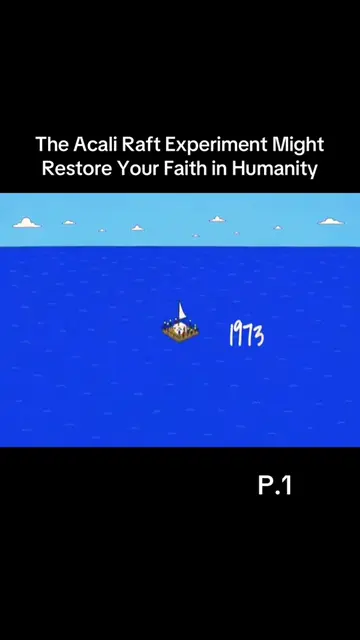
at last the beast unmasked. The film footage of that same moment exists. It shows a group of people calmly cutting up a fish for dinner. That gap between what the camera saw and what he needed to see is confirmation bias in its purest form. He'd spent 40 years trying to prove humans were violent. By then, he couldn't stop seeing violence, even when it wasn't there. The camera recorded dinner. His notebook recorded monsters. The crew meanwhile had started holding quiet conversations of their own, not about each other, about whether they should throw Santiago overboard and whether it could look like an accident. They talked it through and decided against it, which, given everything, was remarkably generous. The experiment was supposed to make strangers turn on one another. Instead, it united them against the man running it. The Atlantic wasn't finished with them. First, the rudder broke. The diver, a professional, hired for exactly this, geared up to fix it. Genovese blocked her. A woman, he declared, was not going overboard. He took her equipment, which didn't fit, and went into the open ocean himself, having never dived in his life. He nearly drowned. The rudder stayed broken. That night, while he slept, she slipped into the black water alone and fixed it in five minutes. By morning, he was calling it mutiny. The storm warnings came. A major system, dead ahead. Maria, the captain, made the only sane call: find shelter or the raft doesn't survive. Genovese overruled her. He stripped her of command, mid-ocean, and installed himself as captain. Reasoning that a storm was precisely the pressure that might crack someone open, he was gambling 11 lives on the hope of witnessing a breakdown. The experiment had fully inverted. The subjects were protecting each other and the scientist had become the hazard. The hurricane never came. It veered away at the last moment. And then, a freighter on the horizon, bearing straight at them, full speed. Genovese's response was to panic and run around the deck screaming. It was Maria, the captain he'd fired days earlier, who stepped forward, organized the flares and distress signals, and got the freighter to change course at the last moment. Nobody ever argued about who the captain was again. For the last stretch of the voyage, Genovese vanished below deck. No more questionnaires, no more meetings. He said he was ill. Not everyone on board believed him. Above his head, the crew swam, cooked, laughed. Later, participants said this was when their friendship turned into something like family. The experiment's best data was collected in the total absence of its scientist. The outside world had already rendered its verdict. Newspapers seizing on the hookups, branded the whole thing "The Sex Raft." His university publicly disavowed the project before the raft even touched land. And somewhere in those final days, alone in that cabin, Genovese made a remarkable admission in his journal. The man holding the pen, he built a trap to catch the monster inside human beings. It caught one. The strangest part? It didn't happen at sea. 45 years later, in 2018, a filmmaker tracked down the surviving crew members and built a full-size replica of the Acali. All seven surviving crew members came back. Standing on that deck again, in the same place where they'd been trapped in the same toilet they couldn't stand under, several of them said the same startling thing. They missed it. Not the hardship, the simplicity. 11 people, one problem, and nothing left to perform. So, Hobbes or Rousseau? Here's the answer: One raft, one anecdote, not a law. But as anecdotes go, it's a beautiful one. Because it was designed, rigged, and personally sabotaged by a man betting everything on the beast, and the beast never showed. Stripped people of comfort, privacy, and escape. Give them a real problem and nowhere to run. What surfaced wasn't the war he promised. It was trust. Ten strangers stepped back onto land as friends. Only one person came back believing humanity had failed.