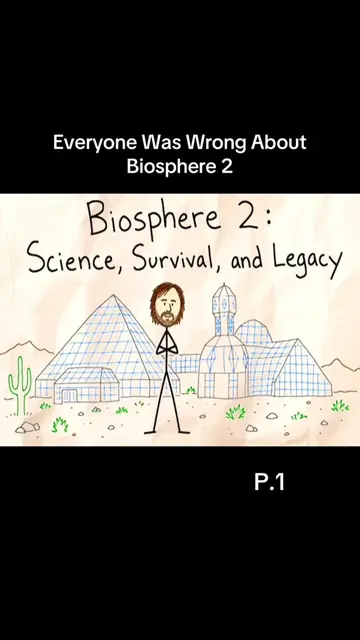
to build the thing and watch it nearly suffocate the people inside. A result nobody could have gotten any other way. Because nobody had ever built the thing that produces it. In January of 1993, they pumped liquid oxygen in to keep the crew safe. And yes, that means the world wasn't self-sustaining. On its own terms, as a sealed system, it didn't hold. But it didn't work as a space colony and it taught us nothing. Our two completely different sentences. The newspapers ran the first one. The scientists kept publishing the second. Now the other failure. The human one. And this is where John Allen comes back. Because the crew was breaking apart. Not the way you'd expect. Not eight starving people turning on each other. It split cleaner than that. Right down the middle. Four on one side, four on the other. And the fault line wasn't food or romance. It was him. During the crisis, Allen ran things from outside. From mission control. And he ran them tight. Micromanaging every decision the crew made inside. And four of the biospherians were loyal to that. The other four had a different feeling. And you can understand it. They were the ones actually in there, in the thin air, doing the surviving. They thought they should get to decide. They were, as one of them put it, in another world. It got bitter. When one of the project's own designers testified honestly to the outside scientific committee about how bad things had gotten inside, against Allen's wishes, refusing to sugarcoat it. Allen reportedly told him that betrayal is punished in the lowest depths of hell. That's the line that starts to explain why the outside world landed on the word cult. A charismatic founder, total loyalty expected. A leader who talks about the project like a man handing down damnation. From the outside, with the oxygen failing and the crew fracturing, it was an easy story to tell. Elite bunker, not science. Cult in a greenhouse. Reporters even fixated on one small carbon scrubber the crew had installed, claiming the whole thing was faked. And the funder was spooked. Ed Bass looked at the chaos and decided Allen had to go. So he brought in someone to run it with a harder hand, an investment banker, fresh from Goldman Sachs, named Steve Bannon. Yes, that one. Bannon pushed out Allen's group and took the project in a different direction entirely. The dream as Allen had built it was over. And the mockery hardened into the history books. Biosphere 2, failure. The story wasn't over. The story didn't end there. Because the building he'd fought to make didn't get torn down. The University of Arizona took it over. And they did the thing that tells you what something is actually worth. They kept using it. Not as a monument, but as a laboratory. To this day, scientists run experiments inside that glass on exactly the questions Allen built it to ask. How sealed living systems behave. How ecosystems respond to stress. What happens to a world under pressure. The largest closed environment ever built is still doing science. And the discoveries from that near-suffocating first mission, the soil, the microbes, the CO2 vanishing into the concrete, those didn't get laughed out of the record. They got studied. The failure that made the front pages became the findings that made the papers. So look at what the man was actually mocked for. Not for lying. He gave up a fortune rather than do the profitable, but dishonest thing. Not for faking science. The science outlived every joke made about it. He was mocked because his sealed world couldn't hold its own air for two years. He was right that it was worth building. He was wrong that it would hold. Would it hold? The mockery could never account for. Someone had to build one sealed himself inside and find out. In his own lungs. What nobody could have told him. That was never a failure to avoid. That was the experiment. Sometimes the failure is the data. O2: 14.7%. CO2: 0.30%.