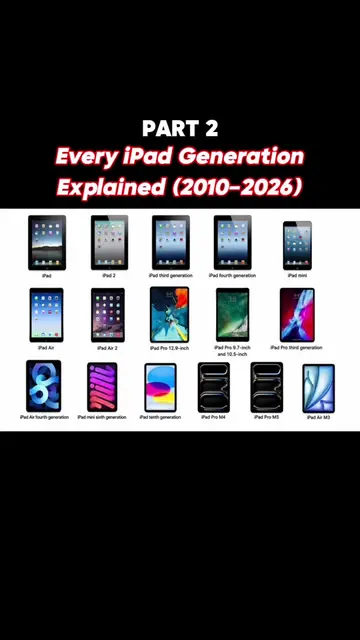
The video effectively leveraged a chronological narrative, showcasing the iterative improvements and design shifts in Apple's iPad line. By highlighting key features and user reactions at each stage, it created a compelling story of technological evolution that resonated with a tech-interested audience.
Summary
This video chronicles the evolution of Apple's iPad line from its inception in 2010 to projected models in 2026. It highlights key design changes, processor upgrades, and new features like Retina displays, cameras, Touch ID, and the Apple Pencil, showcasing how each generation built upon the last to meet user demands and expand the tablet's capabilities.
Structure
1Introduction of the first iPad in 2010 with its groundbreaking features and initial reception.
2Evolution of the iPad 2 in 2011, focusing on design improvements and performance boosts.
3The introduction of the Retina display with the iPad 3 in 2012, significantly enhancing visual quality.
Original caption
#ipad #apple #Tech
More from @officialmtclips
More breakout videos from this creator.
4The rapid release of the iPad 4 later in 2012, featuring a new chip and connector, causing some user frustration.
5The launch of the smaller iPad mini in 2012, catering to a different user preference.
6The redesign and renaming to iPad Air in 2013, emphasizing its thinness and lightness.
7The introduction of Touch ID and the A8X chip with the iPad Air 2 in 2014, setting a new standard for performance and security.
8The expansion into larger screen sizes with the iPad Pro in 2015, along with the Apple Pencil and Smart Keyboard.
9Continued advancements in the iPad Pro line with improved processors, cameras, and display technologies.
10The introduction of the iPad mini 6 in 2021, adopting the full-screen design and A15 Bionic chip.
11The redesign of the base iPad models in 2021 and 2022, incorporating features from higher-end models.
12Future projections for the iPad line, including expected features and design changes.
Product placement
Apple: ACTS - it generates and edits content, and its interface is operated. Removing it would change what happens in the video.
On-screen text
PART 1
Every iPad Generation Explained (2010-2026)
Transcript
April 3rd 2010
9.7 inch screen, Apple's brand new A4 chip, 16-64 GB storage, 30 pin dock connector and a starting price of $499. No cameras, no multitasking, no flash support. Jobs called it magical and revolutionary. The internet called it a big iPad touch. And here's the thing though, it kind of was a big iPad touch. And that turned out to be exactly what millions of people wanted. It was lighter than any laptop at the time, the battery lasted 10 hours, and it ran virtually any iPhone app already on the market. Apple described it as sitting between a smartphone and a laptop, better than both at the things people actually do. Browsing, email, reading, video. That framing was right. People bought it, used it, and genuinely loved it within a year. Within a year, the question wasn't whether the iPad would survive, it was how fast it could evolve. iPad 2, March 2011. Apple didn't mess around. The iPad 2 came in 33% thinner than the original, lost nearly a quarter pound in weight, gained front and rear cameras for the first time and kept the same starting price. The A5 chip delivered roughly twice the processing power and nine times the graphics performance of the A4, that's a generational leap in a single update. Apple also introduced a smart cover alongside it, a magnetic case that folded into a stand and woke the iPad when opened. It sounds minor, it wasn't. That accessory became iconic and the design principle behind it influenced how people thought about iPad accessories for years. The iPad 2 sold in massive numbers and held its position in Apple's lineup all the way to 2014. iPad third generation, March 2012. Apple made a choice that would define the iPad for the next decade. They shipped the Retina display. Four times the pixel density of the iPad 2, 3.1 million pixels total, a resolution so sharp that text looked printed. If you grew up leading on the original iPad and then picked up the iPad 3, the difference was genuinely shocking. Sharper edges on fonts, images that held detail when you zoomed in, video that looked like film. The display also came with a 5 megapixel rear camera, 1080p video capable, and for the first time, 4G LTE support on cellular models. iPad fourth generation, October 2012. Apple looked at the iPad 3, a device they had shipped in March, and decided it needed to be replaced before the year was out. The iPad 4 brought the A6X chip, which doubled CPU and GPU performance over the A5X in the iPad 3. It also introduced the Lightning connector, replacing the 30 pin dock that had been around since the original iPod. If you were someone who bought the iPad 3 in the spring and then watched Apple drop a significantly faster version in the fall with a connector that made all your accessories obsolete, yeah, that was a rough one. Apple knew it too. The pace slowed down considerably after this. iPad mini, also October 2012. This is where things got interesting. Apple announced the first iPad mini released in November 2nd, and immediately gave people a reason to question whether they needed the full-size tablet at all. 7.9 inch screen, about half a pound, thin enough to hold in one hand for hours. It used an A5 chip and ran the same iPad OS, but the display wasn't Retina. It was the same resolution as the iPad 2, crammed into a smaller screen. Some reviewers docked it for that, but a lot of people genuinely didn't care. They wanted the smaller size. Apple had built something that fit perfectly into that use case. iPad Air, November 2013. Apple gave the full-size iPad a new name and a completely new identity. The iPad Air was 28% thinner than the iPad 4, 43% lighter, with significantly reduced bezels and an A7 chip, the same processor that was in the iPhone 5S. It weighed just under a pound. Apple also set at launch that the iPad Air was the lightest full-size tablet ever made, thinner than pretty much everything on the market, including many flagship phones. It also added something that changed how people thought about tablet security: Touch ID. Fingerprint authentication right on the home button. And the A8X chip, delivered 40% faster CPU and 2.5x faster graphics over the A8X in the iPad Air. The iPad Air 2 was so good that it stayed in production for years and remained a legitimate recommendation well into the second half of the decade. Around the same period, the mini line kept iterating too. The iPad mini 2 and 2013 finally got the Retina display. The mini 3 in 2014 added Touch ID. Most refinements, nothing that changed the core proposition of the smaller iPad, but each one was meaningfully better than the last. iPad Pro 12.9 inch, November 2015. The first iPad Pro had a 12.9 inch screen, bigger than any iPad before it, bigger than some laptops. It shipped alongside two accessories that defined what the iPad Pro could do: the Apple Pencil and the Smart Keyboard. The Pencil had incredibly low latency and pressure sensitivity designed for drawing and handwriting. The A9X chip was legitimately fast. Apple claimed that it outperformed most portable PCs in CPU and graphics tasks, and benchmarks backed that up. Creatives, architects, musicians, doctors, designers, they all found use cases that hadn't existed before. At $800 and $999 starting, it wasn't cheap, but it was serious hardware. The iPad Pro 9.7 inch and 10.5 inch, 2016 and 2017. The iPad Pro line continued to evolve, offering more power and features for professionals. The 9.7 inch model brought True Tone display technology, adjusting the screen's color temperature to match ambient light, and the 10.5 inch model offered a ProMotion display with a 120Hz refresh rate for smoother scrolling and responsiveness. iPad Pro 11 inch and 12.9 inch (2018). These models ditched the home button entirely, opting for Face ID and a full-screen design. They also introduced USB-C connectivity, replacing the Lightning port. The Apple Pencil 2 was also released, magnetically attaching to the iPad for charging and pairing. iPad Pro 11 inch and 12.9 inch (2020). These models featured a faster A12Z Bionic chip, improved cameras with a LiDAR scanner for enhanced augmented reality experiences, and support for the new Magic Keyboard with a trackpad. iPad Pro 11 inch and 12.9 inch (2021). The M1 chip arrived, bringing desktop-class performance to the iPad Pro. These models also featured Thunderbolt/USB 4 ports, Liquid Retina XDR displays with mini-LED technology for better contrast and brightness, and support for the Apple Pencil 2. iPad Pro 11 inch and 12.9 inch (2022). The M2 chip brought even more power, with features like Apple Pencil hover, allowing users to see a preview of where the Pencil will touch the screen before making contact. iPad Air 4, October 2020. The iPad Air 4 was a significant redesign, adopting the full-screen aesthetic of the iPad Pro, with thinner bezels and a USB-C port. It featured an A14 Bionic chip, the same as in the iPhone 12 series, and brought Touch ID to the power button. iPad Air 5, March 2022. The iPad Air 5 got the M1 chip, bringing it closer to the iPad Pro in terms of performance, along with 5G connectivity and a new center-stage front camera for better video calls. iPad mini 6, September 2021. The iPad mini 6 was a major redesign, adopting the full-screen look of the iPad Air 4 and iPad Pro, with thinner bezels and a USB-C port. It also featured an A15 Bionic chip, the same as in the iPhone 13 series, and brought Touch ID to the power button. iPad 9th generation, September 2021. The standard iPad got a refresh with a faster A13 Bionic chip, a better 12 megapixel front camera with center stage, and support for the first-generation Apple Pencil. iPad 10th generation, October 2022. The base iPad received a significant redesign, adopting the full-screen aesthetic of the iPad Air and Pro, with thinner bezels and a USB-C port. It featured an A14 Bionic chip and moved Touch ID to the power button. It also got a landscape front camera. iPad 11th generation, Fall 2024. The 11th generation iPad is expected to feature the M2 chip, a larger 11 inch display, and a redesigned chassis. iPad 12th generation, Fall 2026. The 12th generation iPad is rumored to feature a larger 12.9 inch display, a new A18 chip, and a redesigned chassis.
 36 videos29 creators