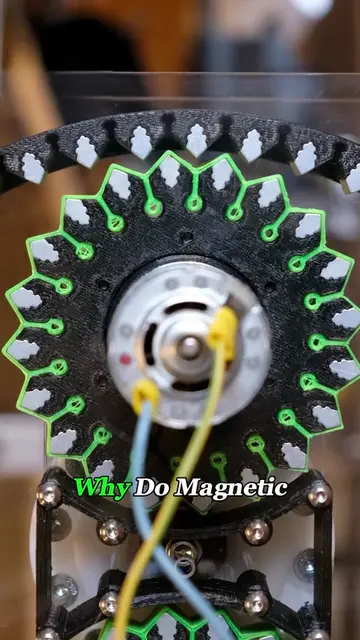
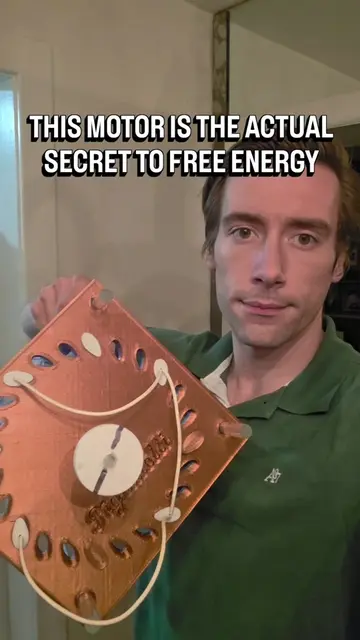
Turkish inventor Muammer Yildiz's permanent magnet motor that powers itself and by extension a home indefinitely with no fuel or batteries, effectively providing free electricity. He has patented the design and demonstrated prototypes claiming up to 250 watts output for a 20x40 centimeter device and 5KW production unit. Reality check: such devices would violate the first law of thermodynamics, energy conservation, unless a hidden power source exists. He reportedly spent eight years developing this device, nicknamed BSMH, obtained a TÜV safety certificate and a patent. He says it only needs a brief 12.5 volt battery push to run indefinitely. According to reports, after an eight-second boost, it runs on its internal magnets alone, using about 20% of its output to sustain itself and delivering the rest to external loads. Such a claim, calling it a perpetual motion machine based on permanent magnets, is sensational. Technically, converting permanent magnet forces into continuous power runs into key issues. First, permanent magnets store a fixed amount of magnetic potential energy; they don't generate energy. Over a complete cycle, any pushes and pulls cancel out, and any motion must be sustained by external work. Witnessing all normal generators use magnets but also require a source of motion like wind, steam, or fuel, any practical device that has frictional and electrical losses, even air resistance and bearing friction, that quickly sap its energy. Thus, the consensus is that proposals like this are universally dismissed by physicists. Even strong neodymium magnets store only a fixed amount of magnetic energy. They don't generate energy. They can convert stored magnetic energy into kinetic energy, but only until they reach an equilibrium. And then, it will slow down. Rigorously, the consensus is that proposals like this are impossible in an isolated system. In contrast, physical estimates show that even neodymium magnets store only on the order of 10 to 3 joules per kilogram. To produce 1 kilowatt continuously for one hour, 3.6 megajoules, would require thousands of kilograms of magnets. Thus, Yildiz's machine contains hidden power, or it will slow down. "No new energy source exists." Permanent magnets just store a fixed amount of magnetic potential energy. They don't generate energy. They can convert stored magnetic energy into kinetic energy, but only until they reach an equilibrium, and then it will slow down. Technically, converting permanent magnet forces into continuous power runs into key issues. First, permanent magnets store a fixed amount of magnetic potential energy; they don't generate energy. Over a complete cycle, any pushes and pulls cancel out, and any motion must be sustained by external work. Witnessing all normal generators use magnets but also require a source of motion like wind, steam, or fuel, any practical device that has frictional and electrical losses, even air resistance and bearing friction, that quickly sap its energy. Thus, the consensus is that proposals like this are universally dismissed by physicists. Even strong neodymium magnets store only on the order of 10 to 3 joules per kilogram. To produce 1 kilowatt continuously for one hour, 3.6 megajoules, would require thousands of kilograms of magnets. Thus, Yildiz's machine contains hidden power, or it will slow down. "No new energy source exists." Permanent magnets just store a fixed amount of magnetic potential energy. They don't generate energy. They can convert stored magnetic energy into kinetic energy, but only until they reach an equilibrium, and then it will slow down. Technically, converting permanent magnet forces into continuous power runs into key issues. First, permanent magnets store a fixed amount of magnetic potential energy; they don't generate energy. Over a complete cycle, any pushes and pulls cancel out, and any motion must be sustained by external work. Witnessing all normal generators use magnets but also require a source of motion like wind, steam, or fuel, any practical device that has frictional and electrical losses, even air resistance and bearing friction, that quickly sap its energy. Thus, the consensus is that proposals like this are universally dismissed by physicists. Even strong neodymium magnets store only on the order of 10 to 3 joules per kilogram. To produce 1 kilowatt continuously for one hour, 3.6 megajoules, would require thousands of kilograms of magnets. Thus, Yildiz's machine contains hidden power, or it will slow down. "No new energy source exists." Permanent magnets just store a fixed amount of magnetic potential energy. They don't generate energy. They can convert stored magnetic energy into kinetic energy, but only until they reach an equilibrium, and then it will slow down. Technically, converting permanent magnet forces into continuous power runs into key issues. First, permanent magnets store a fixed amount of magnetic potential energy; they don't generate energy. Over a complete cycle, any pushes and pulls cancel out, and any motion must be sustained by external work. Witnessing all normal generators use magnets but also require a source of motion like wind, steam, or fuel, any practical device that has frictional and electrical losses, even air resistance and bearing friction, that quickly sap its energy. Thus, the consensus is that proposals like this are universally dismissed by physicists. Even strong neodymium magnets store only on the order of 10 to 3 joules per kilogram. To produce 1 kilowatt continuously for one hour, 3.6 megajoules, would require thousands of kilograms of magnets. Thus, Yildiz's machine contains hidden power, or it will slow down. "No new energy source exists."