Loading video…
All videos
Hook
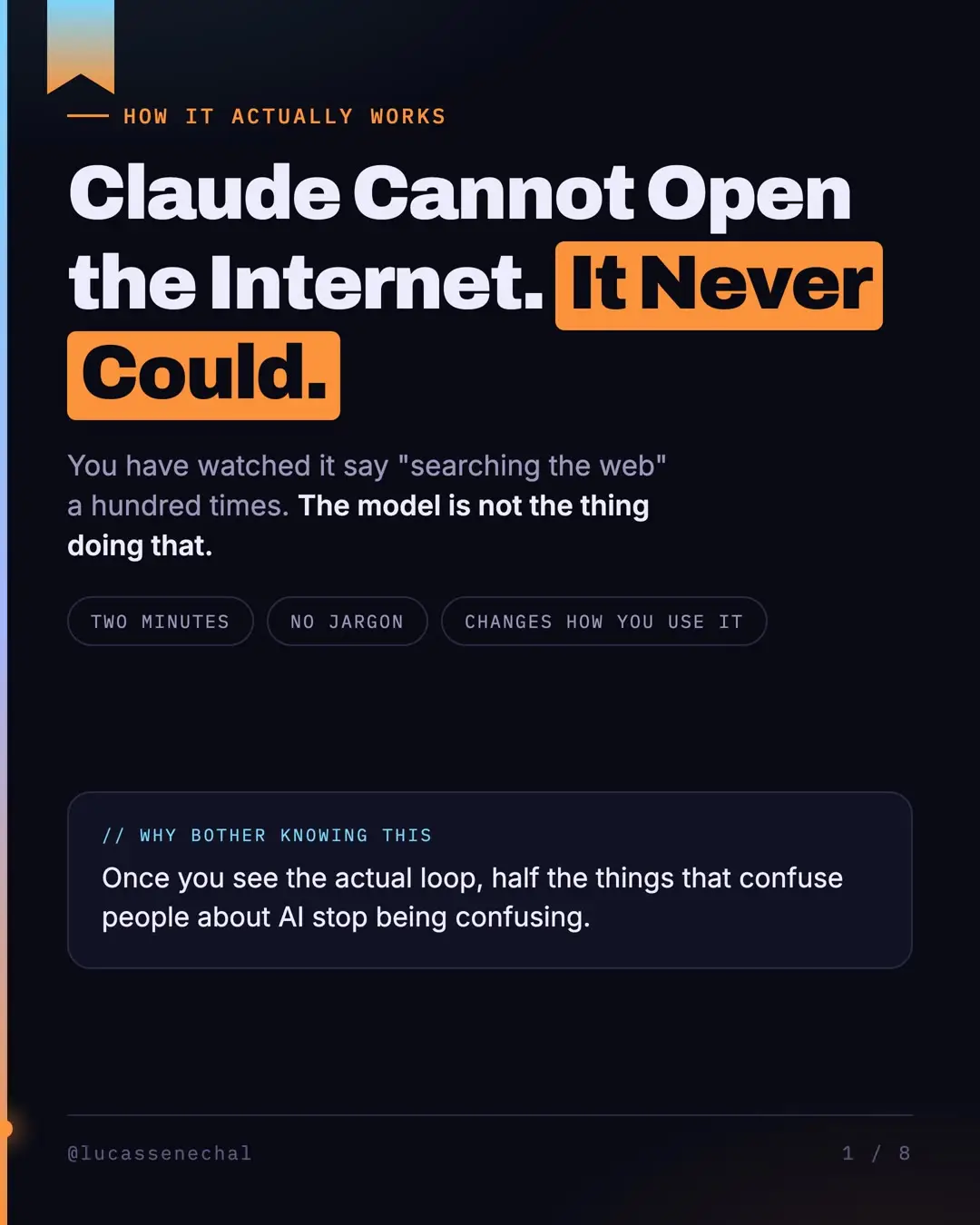
HOW IT ACTUALLY WORKS Claude Cannot Open the Internet. It Never Could.
Posted Aug 2, 2026Photo post · 8 slidesby @lucassenechal
Views
15.2K
Likes
99
Comments
0
Shares
6
Engagement
0.7%
of views
65.4xthis account’s usual viewsOutlier
This video15.2KUsual views151
The product
The Busy Owner's AI Guide: Zero to First Agent in 15 Minutes
lucassenechal.com/go/tt ↗This video promotes it, but we haven’t matched it to a product page yet, so there are no product figures.
The creator
Why it worked
The content demystifies a common misconception about AI, providing a clear, step-by-step explanation of how AI models interact with external tools. This educational value, combined with a clear call to action for a relevant guide, likely resonated with the target audience.
What happens
This slideshow explains that AI models like Claude cannot access the internet directly but instead rely on external tools to perform searches. It breaks down the process into three steps: the model writing a note to a tool, the software executing the task, and the model receiving the result to formulate an answer. The creator, Lucas Sennechal, offers a guide to help business owners implement AI.
The breakdown
Original caption
Claude cannot open the internet. It never could, and knowing that changes how you use it. When you see "searching the web" on screen, the model isn't doing that. The model does exactly one thing: it reads text and writes text back. No hands, no connection to anything. So what happens when you ask about today's weather in Amsterdam? It doesn't know, because it was trained months ago. But it knows a search tool exists, because the application told it. So it writes a small note that says run web_search, query "Amsterdam weather right now." Nothing has happened yet. That note is just text. The note lands in Claude's infrastructure, which is ordinary software running on real servers, and that software can make requests like any other program. It runs the search, turns the results back into plain text, and hands it to the model. The model reads it, picks out twenty-one degrees and cloudy, and writes your answer. Read, write, read, write. That's the whole loop, and every tool works this way — your calendar, your CRM, your files. Which explains three things. Why it makes things up when it has no tool to reach for. Why connectors matter far more than people think. And why what it can reach is a bigger decision than which model you picked. #AI #ClaudeAI #AITools