Loading video…
All videos Locked — part of Pro; create a free account to start.Open on TikTokPro
No preview available yet
Views
26.3K
Likes
479
Comments
2
Shares
8
Engagement
1.9%
of views
3.4xthis account’s usual viewsOutlier
This video26.3KUsual views7.6K
The product
Not selling anything
No product promoted
We didn’t find a product being promoted in this video. Its hook, format and structure below still show why it took off.
Browse products winning on TikTokThe creator
We’re still analyzing this post.
Original caption
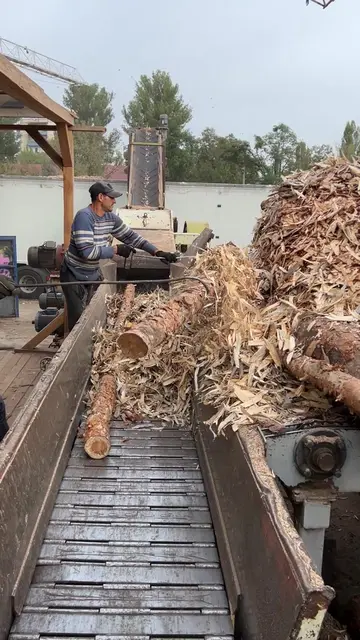
Long before timber becomes lumber, paper, engineered wood, or renewable energy, it passes through industrial equipment built to process enormous volumes of raw material with remarkable consistency. This operation begins as a large log is guided into a commercial wood chipper by powerful hydraulic feed rollers that maintain complete control over its movement. As the timber reaches the high-speed cutting drum, the transformation happens almost instantly. Solid wood is reduced to a continuous stream of uniform wood chips, demonstrating a level of precision and efficiency that modern industrial forestry depends on every day. Commercial wood chippers are an essential part of the North American timber industry, supporting everything from commercial logging and sawmill operations to biomass processing and forest management. Rather than allowing usable material to go to waste, these machines convert logs and timber into valuable wood fiber that supplies pulp and paper mills, biomass energy facilities, engineered wood manufacturers, and countless other forest products industries. They are also widely used during land clearing projects, right-of-way maintenance, storm cleanup, and commercial tree processing, where reliable equipment is required to handle demanding workloads under constantly changing conditions. The performance of a high-capacity industrial wood chipper is the result of carefully integrated engineering. Hydraulic infeed systems regulate the speed of every log entering the machine while the heavy rotating drum maintains consistent cutting momentum under continuous load. Every mechanical component, from the feed rollers to the drive systems, is designed to maximize throughput while minimizing unnecessary wear. This balance between power, durability, and precision allows operators to process large-diameter logs efficiently throughout long production shifts while maintaining stable material flow and dependable performance. Heavy equipment like this represents the practical side of industrial innovation. Whether the focus is forestry machinery, industrial wood chippers, logging equipment, timber harvesting, commercial sawmills, industrial manufacturing, biomass energy, wood recycling, factory process technology, or advanced material handling systems, the process showcases how engineering transforms raw timber into resources used across multiple industries. Watching a massive log disappear into the machine and emerge as clean, consistent wood fiber is a satisfying reminder that the world's most productive industrial operations rely on precision, reliability, and continuous mechanical efficiency rather than spectacle alone.