Loading video…
Sound

original sound - floriangadsby
Florian Gadsby · Original audio
0:00–:––
Playing this video’s own audio, so you’ll hear the creator over the sound.
Hook
Posted Aug 12, 2026Video · 2:45by @floriangadsby
We didn’t find a product being promoted in this video. Its hook, format and structure below still show why it took off.
Browse products winning on TikTokThe video provides a clear, step-by-step demonstration of a specific pottery technique, offering practical advice and addressing common challenges. The creator's personal reflection on their learning journey adds a relatable and authentic element, making the content engaging and valuable for aspiring potters.
The video demonstrates the process of pulling handles for pottery, emphasizing the importance of control and consistency. It explains common mistakes, such as squeezing too hard or too gently, and how to avoid them to ensure the handles are strong and well-formed. The creator also shares their personal journey of learning this technique.
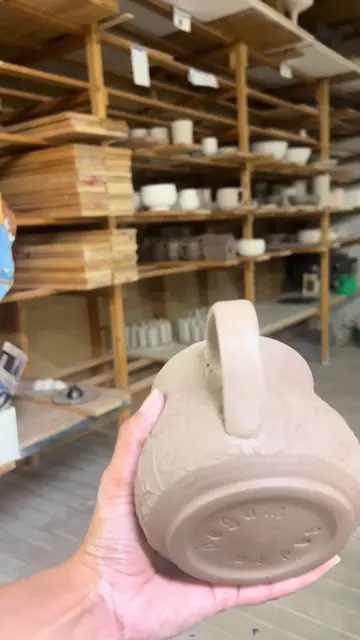
It’s been a while since I’ve done any handle pulling but what a joy it is to be back at it, although in this never-ending heatwave it’s a more finicky process than it normally is. Together with being a process that’s all about your control in terms of how you handle the clay, it’s also a process that’s incredibly sensitive to temperature and the condition of the clay itself. For instance, if you attached handles when the cup is too soft, the walls of the vessel will distort and you’ll very easily destroy the mug. If the cup is too hard, then the likelihood that the handle cracks as it dries is far higher, as there’s a greater disparity in the levels of moisture in the two contrasting parts. Of course, both of those facts are exacerbated if the handle lengths/blanks you’re creating are either too soft or too firm, for example if the blacks are too soft, then it can be practically impossible to form them further without them ripping of sagging and losing their shapes. At the same time, if they’re too hard, which can happen if you leave the blanks exposed for too long, or if you leave them on a wooden surface that wicks out moisture from one side of them, you’ll have a troublesome time getting them to have a smooth, flowing shape, as firm clay is stubborn and needs more pressure and water, which again, raises the chances that you’ll rip the handle off. Now, both of those facts can be exacerbated if the mug itself is too soft or too dry, which means in total you’re trying to monitor so many variables so that you’re pulling the handles in that perfect moment, whilst attaching them to a cup that’s precisely the right-level of leather hard. All of that is of course information you can only really learn through practice and it’s why this technique can be punishing at the beginning as you have to ruin pots in order to learn the materials limits. Equally, potters trying this for the first time will often be able to make pretty decent pots, which makes it feel extremely disappointing when you attach scruffy handles onto them. This is why I think it’s often a skill that’s quickly abandoned but you’ve just got to get through those teething pains!
Pulling handles using this method is all about control.
Demonstrating handle pulling technique
Explaining common mistakes and their consequences
Showing proper attachment and shaping methods
Discussing storage and acclimatization of clay
Highlighting the importance of speed and consistency
Reflecting on the learning curve and personal growth
Playing this video’s own audio, so you’ll hear the creator over the sound.
Outliers and viral hits: their videos on Overshot, all time.