Loading video…
All breakouts
94.5Talking HeadHow-To hookEducation
Hook
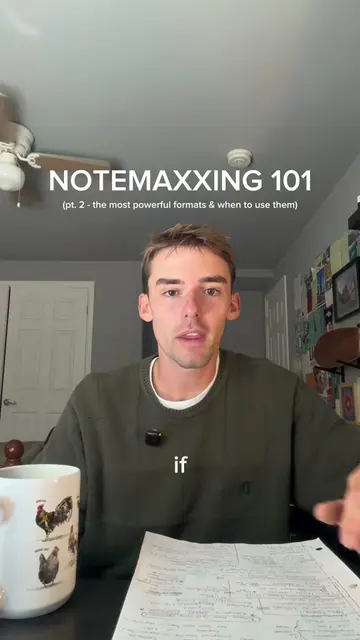
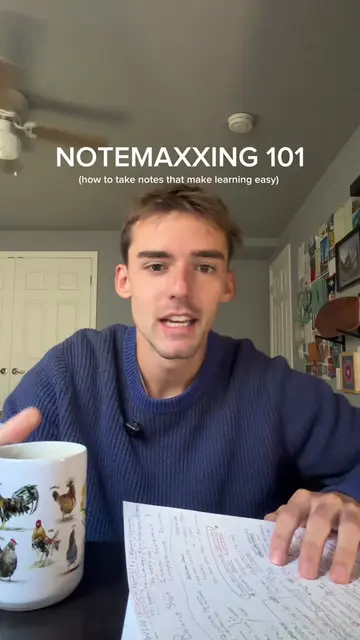
NOTEMAXXING 101 (pt. 3 - how to take better notes during lectures)
@gmoney.learns
34.0K followers · usually 8.6K views a post
Views
806.1K
Likes
132.0K
Comments
172
Shares
4.3K
Why it worked
The video provides practical, actionable strategies for note-taking, catering to different lecture styles and learning needs. The clear breakdown into three distinct methods, supported by visual examples, makes the information easy to digest and apply.
Summary
This video, part three of a series on note-taking, introduces three strategies for effective note-taking during lectures. It covers the skeleton notes method for professors who provide outlines, the two-pass method for lectures where information is dense, and annotated examples for complex or difficult subjects.
Structure
- 1Introduction to note-taking strategies
- 2Skeleton notes method
- 3Two-pass method
- 4Annotated examples method
- 5Conclusion and call to follow
On-screen text
NOTEMAXXING 101
(pt. 3 - how to take better notes during lectures)
Setting for annotating on PowerPoint ^^
Setting for annotating on PowerPoint ^^
Ex. PASS 1
Ex. PASS 2
The 2-Pass Method
Transcript
If you don't have a strategy for how you're taking your notes, you're probably wasting a lot of your time with them. And I know that because I did it myself. So this is part three of teaching you how to take notes that make learning easier and give you back your time. Part one was all just about general rules of thumb for taking notes. Part two is the different note-taking formats. And now in this part three, I want to talk about the three most useful strategies for taking notes during lectures. Because it's back to school season and you might need that. First is going to be the skeleton notes method. This is if you have a professor that provides you with some form of outline, but they're always adding in information on top of that outline, and then translating it into your words along the way. If this falls apart, professor inevitably, we all inevitably have just where they talk at you for hours. And when that happens, I would use the two pass method. You write down everything that they say the first time, you're basically transcribing. Then you do a second pass through your notes, you're cleaning them up with everything I talked about in Nomaxing one and two. And those both were great unless you have classes where you need to solve anything that is complex or difficult. In that case, I would do annotated examples. Give them the examples that they give you in the textbook or if you find them online, write them down and break them down in your own language with little annotations, what you're doing at each step and why. If you find this helpful, follow for more. And I'll be back tomorrow as always.
Original caption
my personal fav is a combination of number 2 and 3 if you couldn’t tell from the photos 🧑🍳 good luck w the back to school grind 💯💯 reach out if there’s anything I can help with and be back tomorrow as always :)
More from @gmoney.learns
More breakout videos from this creator.