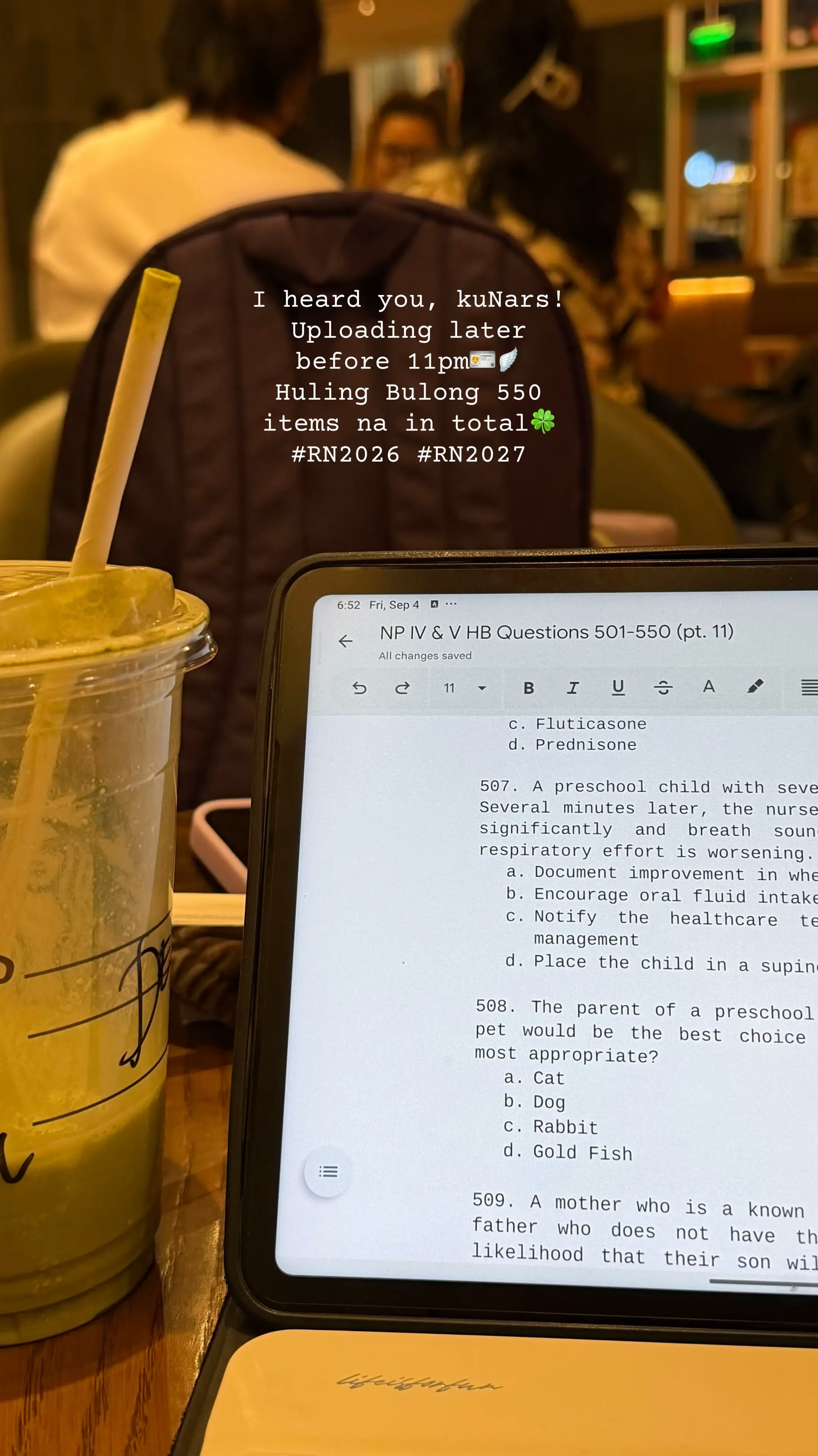
On-screen text
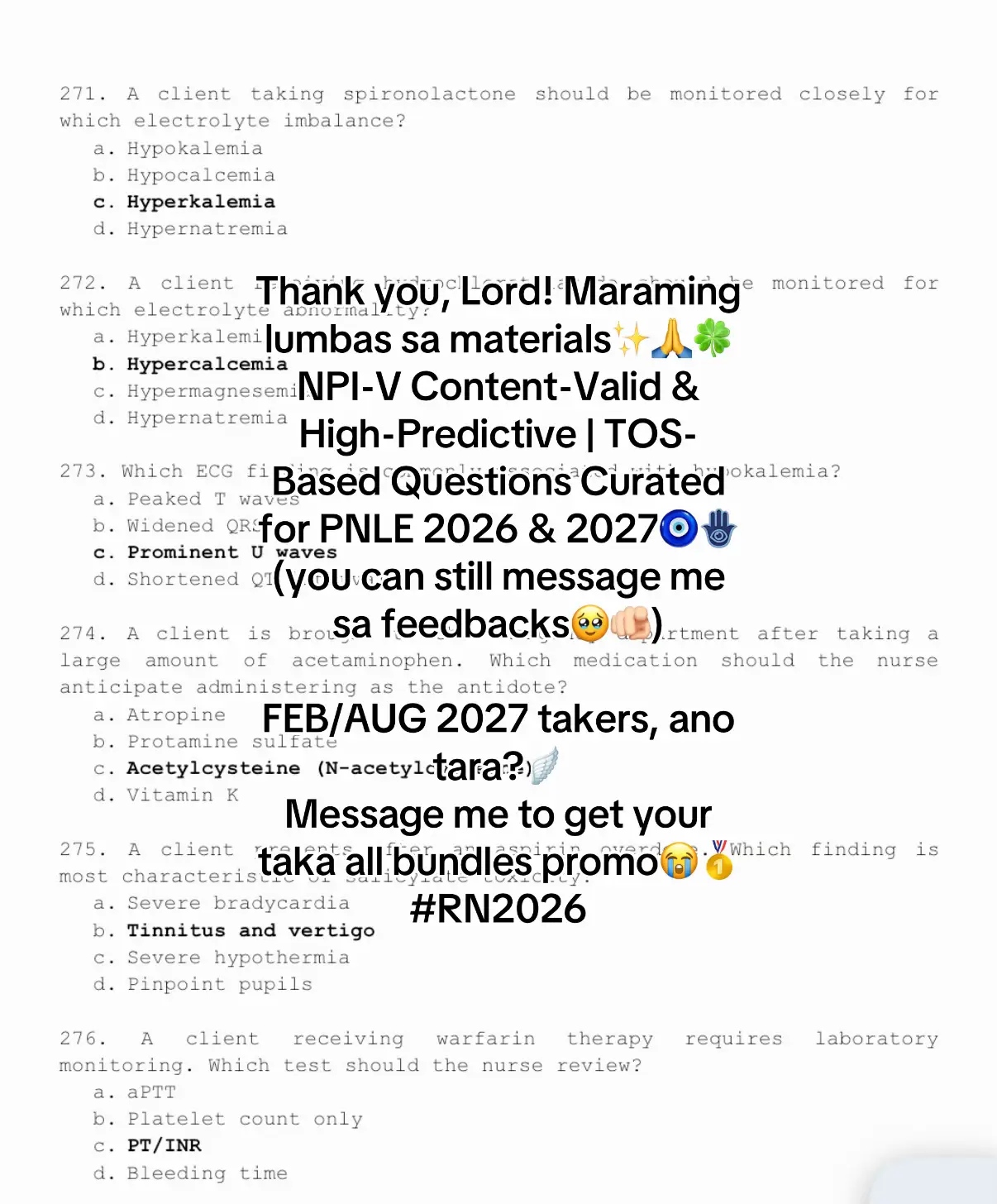
271. A client taking spironolactone should be monitored closely for which electrolyte imbalance?
a. Hypokalemia
b. Hypocalcemia
c. Hyperkalemia
d. Hypernatremia
272. A client for which electrolyte abnormality?
a. Hyperkalemia
b. Hypercalcemia
c. Hypermagnesemia
d. Hypernatremia
273. Which ECG finding?
a. Peaked T wave
b. Widened QRS complex
c. Prominent U wave
d. Shortened QT interval
274. A client is brought to the ER after taking a large amount of acetaminophen. Which medication should the nurse anticipate administering as the antidote?
a. Atropine
b. Protamine sulfate
c. Acetylcysteine (N-acetylcysteine)
d. Vitamin K
275. A client was admitted for an aspiration of a foreign body. Which finding is most characteristic of aspiration?
a. Severe bradycardia
b. Tinnitus and vertigo
c. Severe hypothermia
d. Pinpoint pupils
276. A client receiving warfarin therapy requires laboratory monitoring. Which test should the nurse review?
a. APTT
b. Platelet count only
c. PT/INR
d. Bleeding time
469. A nurse is providing health teaching to a client asking about risk factors for laryngeal carcinoma. Which factor has the strongest association with this malignancy?
a. Chronic consumption of spicy foods
b. Cigarette smoking
c. High dietary calcium intake
d. Sedentary lifestyle
470. A client underwent a total laryngectomy with advanced laryngeal carcinoma. Which statement accurately describes the client's postoperative respiratory anatomy?
a. The client can breathe normally through both the nose and mouth.
b. The client will breathe through a permanent tracheal stoma.
c. The client will breathe through the mouth but not the nose.
d. The client will require a temporary nasotracheal airway.
471. A client with a tracheostomy is experiencing difficulty breathing. The nurse should assess for which of the following?
a. Impaired verbal communication
b. Disturbed body image
c. Ineffective airway clearance
d. Imbalance nutrition: less than body requirements
472. The nurse is caring for a client 24 hours after a total laryngectomy who has refused mashed potatoes. A client receiving lithium 12 hours after total laryngectomy with thick secretions and increasing respiratory effort.
a. A client 3 hours after cleft palate repair who refuses mashed potatoes
b. A client receiving lithium
c. A client 12 hours after total laryngectomy with thick secretions and increasing respiratory efforts
d. A client with laryngeal cancer
473. A nurse is preparing to feed an infant following repair of a cleft lip and palate. Which feeding utensil is most appropriate?
a. Straw
b. Spoon
c. Cup
d. Standard feeding bottle with a large nipple
474. The nurse is reinforcing dietary instructions to the parents of a child who has undergone cleft palate repair. Which food selection indicates appropriate understanding?
a. Potato chips
b. Toasted bread
c. Mashed potatoes
d. Crackers
475. A child is being monitored after surgical repair of a cleft palate. Which postoperative complication should the nurse remain particularly vigilant for because of the surgical site and its communication with the oral cavity?
a. Infection
b. Hyperglycemia
c. Drainage retention
d. Deep vein thrombosis
Thank you, Lord! Maraming lumbas sa materials 🙏✨
NPI-V Content-Valid & High-Predictive | TOS-Based Questions Curated For PNLE 2026 & 2027
(you can still message me for feedbacks)
FEB/AUG 2027 takers, ano
Message me to get your
taka all bundles promo
#RN2026