Loading video…
All breakouts
61.4Text-HeavyStory Open hookFinance
Hook
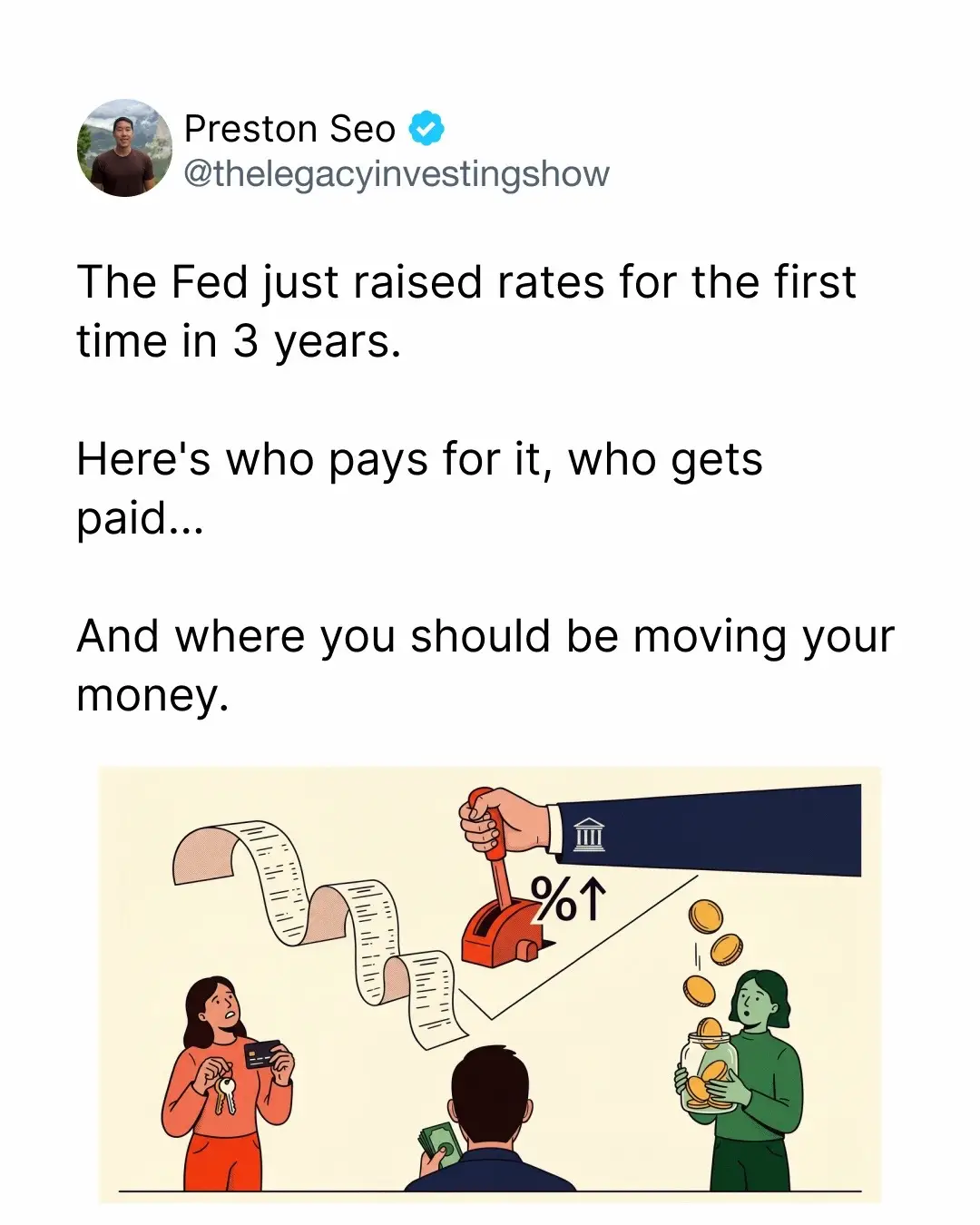
The Fed just raised rates for the first time in 3 years.
@thelegacyinvestingshow
2.5M followers · usually 1.8K views a post
Views
108.1K
Likes
1.2K
Comments
29
Shares
295
Why it worked
The content provides timely and actionable financial advice directly related to a major economic event, presented in a clear, step-by-step format that is easy to digest and share.
Summary
This slideshow explains the recent Federal Reserve rate hike, detailing who is affected, how it impacts various financial markets like bonds and mortgages, and provides advice on where to move money. It advises paying off credit card debt, holding onto low fixed-rate loans, and considering investments in energy and gold, while cautioning against selling stocks.
Structure
- 1Fed raises rates, explains impact
- 2Market reaction and forecasts
- 3Who pays and who gets paid
- 4Investment advice for stocks, energy, gold
- 5Actionable steps for personal finance
- 6Final advice on future hikes
Call to action
Save this. Send it to someone still waiting on a cut.
On-screen text
The Fed just raised rates for the first time in 3 years.
Here's who pays for it, who gets paid...
And where you should be moving your money.
What happened: a quarter point, to 3.75% to 4%.
The vote was 12 to 0.
Fed Chair said it plainly:
"Inflation is too high and has been for too long."
The Fed's own forecast has inflation at 3.7% this year...
And doesn't get back to 2% until 2029.
And they told us what comes next.
12 of 18 officials see one more hike this year. Four see two more.
Their median forecast has rates no lower at the end of 2027 than they are now.
The first cut in their projections is 2028.
Don't build your next move around a cut arriving soon.
The bond market already priced it in.
The 2-year Treasury is at 4.74%, above the Fed's new rate.
Traders expect more hikes, not fewer.
The 10-year crossed 5%.
Mortgage rates follow that number more than they follow the Fed.
That's why the 30-year is sitting around 7%.
Now who pays?
Credit cards move first.
Prime just went to 7%, and card rates are built on top of prime.
On a card charging 21%, a $6,000 balance costs you $1,260 a year.
The hike adds another $15 to that.
Mortgages depend on which one you have.
Fixed rate? Nothing changed. Keep it.
A 3% loan while inflation runs 3.7% means your debt shrinks in real terms every year.
HELOC or ARM? Those reset.
Your next payment goes up.
Buying? Every quarter point costs you for 30 years.
On a $400,000 loan, going from 7% to 7.25% is about $67 more a month.
Over the life of the loan that's about $24,000.
Which brings up the question I get most:
Should you wait?
Everyone waits for cuts. When cuts come, so does everyone else.
That's what happened in 2020 and 2021.
Rates fell, bidding wars started, prices ran.
Today you're bidding against fewer people.
You can negotiate on price. The rate you can change later.
Stocks. Don't panic sell.
Since 1994, the S&P averaged a 6.7% gain in the 12 months after a first hike.
Usually down the first few months.
2022 was the one loser.
Selling now locks in the worst part.
Now who gets paid. Banks first.
They pay you 0.01% on checking and charge 7% on a mortgage or 21% on a card.
High-yield savings pays around 4%.
A 2-year Treasury pays 4.74% with no state income tax.
Cash in checking is on the wrong side of that gap.
Energy is next.
WTI crude is around $98 because of the Iran war.
Higher rates don't stop you from filling your tank.
When oil sits near $100, energy revenue rises a lot faster than costs.
That's why energy holds up in a hike cycle.
Then gold. Most people miss this.
Gold is supposed to fall when rates rise. It pays no yield.
Since the hike, it's up 2.5% to $4,390.
My read: a 4% rate against 3.7% inflation leaves almost nothing real.
When the market doubts the Fed, money leans into gold.
What to do, in this order:
Pay off the card balance. 21% you stop losing.
Keep your low fixed-rate loans. Never trade 3% for 7%.
Move idle cash into a 4% savings account or short T-bills. Keep it short.
Don't sell stocks because of the hike.
Add to energy and hard assets, gold included.
Buy property only if it works at 7% with reserves. A refinance is a bonus.
Another hike is on the table this year.
Cycles rarely stop at one.
Sit on your hands, or move to where the money is going.
Save this. Send it to someone still waiting on a cut.
Original caption
Fed Chair Kevin Warsh said inflation has been "too high for too long." The Fed's own forecast doesn't get back to 2% until 2029, and 12 of 18 officials see another hike this year. The 2-year Treasury is at 4.74% and the 10-year crossed 5%. Don't build your next move around a cut arriving soon. Who pays: anyone with a card balance, a HELOC, an ARM, or a mortgage they haven't locked yet. Who gets paid: banks, energy, and gold. So, in order: 1. Pay off the card balance. 2. Keep your low fixed-rate loans. 3. Move idle cash into a 4% savings account or short T-bills. 4. Don't sell stocks because of the hike. 5. Add to energy and hard assets, gold included. 6. Buy property only if it works at 7%. Which number are you starting with? Drop it in the comments.
More from @thelegacyinvestingshow
More breakout videos from this creator.