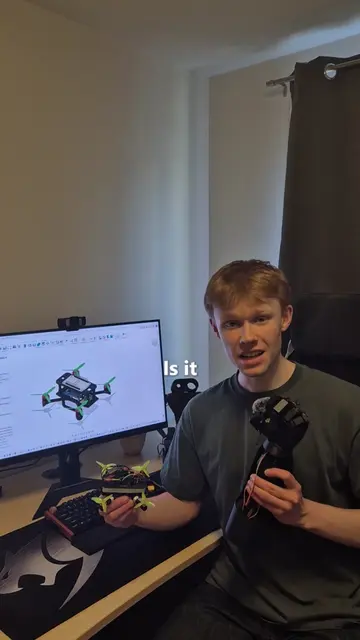
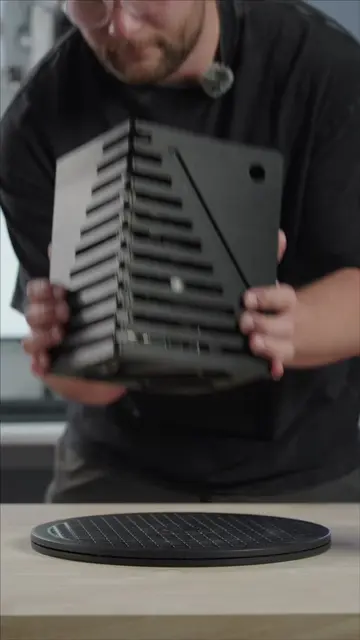
This is the Blackbird, the world's fastest electric-powered drone. But it's not just the fastest electric drone. It's faster than any electric-powered vehicle ever made, outpacing the fastest cars, the fastest manned aircraft, and the magnetic levitation trains in Japan. Over the last two years, I've spent hundreds of hours designing, building, and testing to try and answer one question: How fast can a drone really go? G'day, my name's Ben, and this is the story of how I built the world's fastest drone. I'm going to show you the complete process, from the first concepts to the final design you see today. This project started in June 2024. I'd just watched Luke and Mike Bell's video on how they built the world's fastest drone, achieving 480 km/h with their drone, the Peregrine V2. I really believed I could build something faster, so I decided to give it a crack. It was eight months before I actually started to build anything. In that eight months, I'd done a lot of thinking, several CAD models, a bit of testing, and built a completely useless prototype that landed on its motors. By now, the world record had already increased. A Swiss guy named Sammy had smashed the old record with an incredibly unique design, hitting 557 km/h. I started to realize I was never going to design the perfect drone on the first go. I had to just go build something and see what would happen. I finally settled on a design and printed it out. It turned to spaghetti. No worries though, I tried again, and pretty soon it was starting to look like a drone. This thing was an absolute pain to build. When I designed it, I tried to pack all the electronics in as tight as possible. I didn't leave myself any space to work. Eventually, I squeezed everything in and taped it together ready for the first test flight. I didn't glue the frame together yet, as once it was glued, it would be impossible to replace any of the parts if anything broke. It was time for the first flight, and I did what any logical person would do and stabbed the pointy bit into the ground instead of printing a launchpad. The first flight was uneventful, but I had a persistent shaking that no amount of PID tuning would get rid of. Eventually, I looked at the black box logs and found the cause: a large spike in vibrations around 50 Hz. This is caused by frame resonance, and the best way to deal with this is to add a notch filter to the gyro, telling the flight controller to ignore this frequency. After this and a couple of other tricks, I finally managed to get a steady hover and a few small punch-outs. Excited, I glued the frame together and headed down to the sketchiest drone flying location in all of Melbourne: Police Paddocks. I'm actually a bit nervous walking through here because last time there was a creepy man that followed me through the bushes and then pulled his pants down, and so I'm on high alert. Hopefully, we'll make it there in one piece. I did make it there in one piece. The drone, however, wasn't so lucky. I'd just spent many flights making sure the drone was tuned perfectly. So why did this happen all of a sudden? Well, it turns out when I glued the frame together, it made the structure significantly stiffer, meaning all the parameters I'd set earlier were completely unsuitable. Not to worry though, the damage was minor, so I patched it up, readjusted the tune, and tried again. After this, it was semi-successful, easily hitting over 300 km/h. But this is when I realized I had a problem. Almost every speed run I tried, the video kept cutting out as I flew past myself. The first time it happened, I almost lost the drone. Oh shit, nothing. I think I can't really see it. It's it's it's so high. I tried all sorts of things, including new voltage regulators and even separate batteries powering my video transmitter. The video kept cutting out as I flew past myself. Most of the time when the video cut out, I was still able to land safely. But on one occasion, as the video cut out, I looked directly into the sun and was blinded. Many people suggested I should change to an analog system, and that was just a nightmare. Turns out there's a few tricks to getting analog to work well, and I didn't know any of them. Apart from the video problem, the drone was now flying pretty well. The only issue was an oscillation that showed up over 400 km/h. I decided to implement the suggestion from someone on the internet to try and fix it. So, I've turned my D-gain to zero. I'm going to go for another run. Let's see how it goes this time.