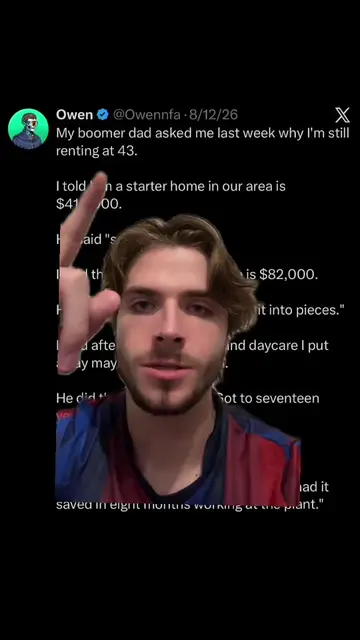
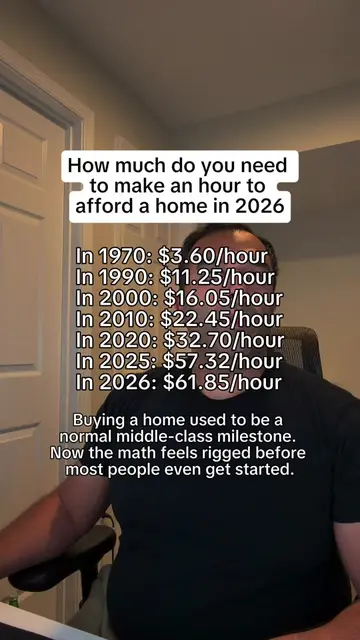
In some ways the game is rigged. Yes. I mean, I- if- yes if, if you look at, I mean, again, I just, I think so much of housing because, you know, this happened, I think it was during the presidential campaign, maybe it was right before. But I was talking to some family members over Thanksgiving and, you know, just a sort of a younger friend of my wife's, they were like 5 or 6 years behind us, they were just about to get married. And this, this young woman, successful engineer, makes a higher salary than most Americans, she just sort of like tossed out there that, you know, when her parents' generation was coming up, it was like possible to own a house and to raise a family and not be worried that much about things. And my thought was, "Okay, you're an engineer, you make way more money than 75% of people your age, maybe 90% of people your age, and you think that it is like this ridiculous unachievable objective to have literally what your parents had," which is a decent job, a nice house and a safe place. Like, at that, at that literally that same, that same dinner, like an- another guy, another friend of my wife's was talking about this, and he, you know, South Indian family, grew up, you know, his parents immigrated, he was born and raised in San Diego, and he was like, "You know, when I was growing up in Oceanside," this is like a suburb of San Diego where there a lot of Marines live in Oceanside, it's close to Camp Pendleton, "When I was growing up, all of my, like the kids that I played with, that I rode bikes with, that I was, you know, playing street hockey with and football with, all of those kids were the sons of enlisted Marines in Oceanside, California." And then we went and looked at like Oceanside, California rents, again this is a couple years ago, rents and housing prices, like every house was north of a million dollars on the street this guy grew up in. And enlisted Marine, frankly, most Marine officers could not afford to buy a million dollar house. So like, does the socialism thing scare me? Yes. Is it the wrong solution? Yes. But one thing I try to persuade my fellow Republicans of is, socialism is the alternative if we don't have a pathway to give people a sense that the system is not rigged and that the American dream is attainable. That's like our job, that's what we have to do. I'm not saying Rome was built in a day, it's not gonna be easy to undo some of these economic trends, but man, we ran the experiment. We ran the experiment of offshoring all of our industrial jobs, of becoming a services and finance economy, and allowing Wall Street to come in and buy every asset of modern life and turn it into an investable, you know, line goes up asset. And what has that done? It's created a generation of kids who kind of are attracted to socialism. You have to fix that problem. Well, with kids that do feel, and you're correct and I, I, I agree with you, the system is rigged. Kids feel like there are no options other than to burn it down, and that's the problem, because they feel very frustrated. And this is part of our job is to provide an option that isn't burn it down, but is not just doing the same things that we've done for the past 40 years. They're also terrified about the future because of AI, because they feel like jobs are gonna be taken away, and there will be no place for people that have education in very specific, like very specific jobs are gonna just be irrelevant. They're gonna be completely wiped out by AI. There is a huge fear over this. So I, I, let me kind of give my own, my own spin on this. Yes. I was talking to a CEO, not of an AI company but of a tech company, and he's one of the few CEO, CEOs that's sort of right of center, and I was like, "Well, you know, what do you think? Do you think AI is gonna come and take all the jobs?" And his basic take was, the real historical analogy is the Industrial Revolution, and, you know, did it, the Industrial Revolution displace or change a lot of jobs? Yes, it also created a lot of jobs that didn't exist before. So he was like, "My concern here is not that 50% of Americans are gonna be unable to find a job."