Loading video…
All breakouts
12.2OtherHow-To hookEducation
Hook
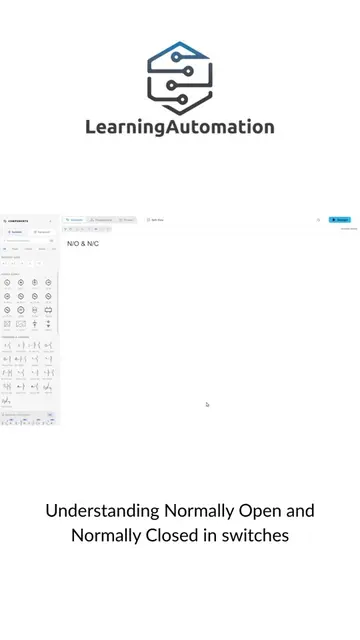
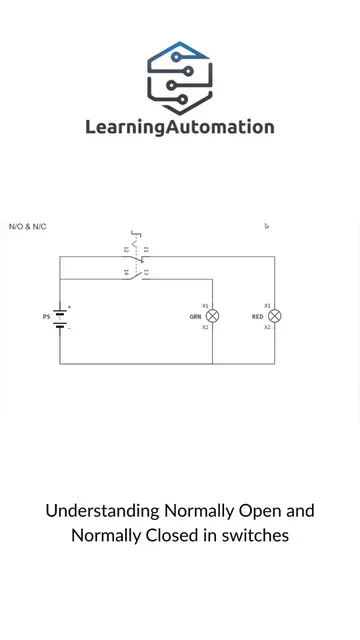
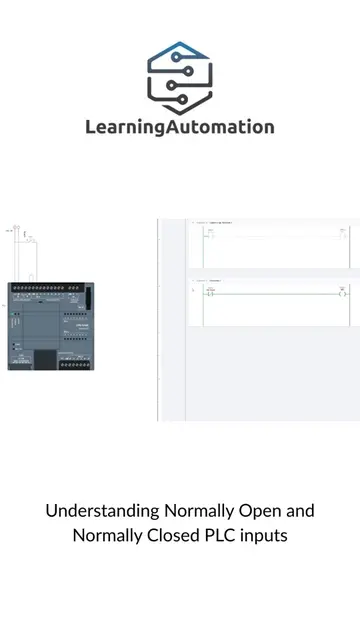
In the previous videos, we've looked at normally open and normally closed in switches and sensors.
@learningautomation
20.4K followers · usually 2.7K views a post
Views
24.7K
Likes
1.7K
Comments
19
Shares
93
Why it worked
The video provides high-quality, clear educational content on a technical subject, using visual aids that make complex electrical logic easy to understand.
Summary
This video explains the fundamental operation of electrical relays, detailing how their coils and contacts function to control circuits. It further connects these physical relay operations to the logical concepts of true/false states used in PLC programming.
Structure
- 1Introduction to relay components
- 2Explanation of coil and armature function
- 3Demonstration of contact states
- 4Logical mapping of relay states
- 5Historical context of relay-based control
On-screen text
LearningAutomation
N/O & N/C
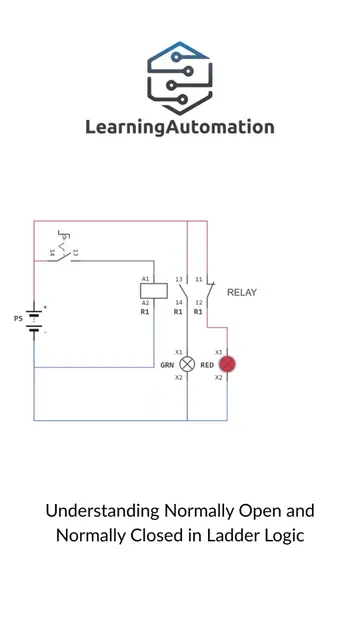
Understanding Normally Open and Normally Closed in Relays
Coil
A1
R1
Contacts
13
14
11
12
R1
R1
RELAY
N/C (touching)
N/O (apart)
N/O Does Not Conduct
N/C Conducts
N/O Conducts
N/C Does Not Conduct
TRUE
FALSE
Transcript
In the previous videos, we've looked at normally open and normally closed in switches and sensors. Hopefully, by now, you are familiar with the terms normally open and normally closed. Next, we will look at normally open and normally closed contacts within relays. This is a really important step to understanding how PLCs work. So when we look at PLC logic, it makes much more sense and is easier to understand. A relay is an electromagnetic device that has a few key components. Most notably are the coil and the contacts. Firstly, the coil is an electromagnet. When the coil receives power, it creates a magnetic field which attracts an armature. The armature moves and it physically changes the contact positions, just like pressing a switch. Secondly, the contacts. Just like we explored with switches, the relay has contacts which physically open and close to make or break an electrical circuit. Relays will often contain both normally open and normally closed contacts and may contain one to four sets of contacts within a single device. When the relay coil power is lost, the electromagnet is de-energized and the armature returns back to its normal position via a spring, which in turn returns the relay contacts back to its resting position too. So, when the relay is de-energized, the normally closed contacts touch and this allows an electrical circuit to be completed through these contacts and the normally open contacts are apart. This means the red lamp is illuminated as that circuit is complete and the green lamp is extinguished as that circuit is broken. When the relay is energized, the contacts change over. The normally open contacts are now closed and complete the electrical circuit and the normally closed contacts are now open, breaking the circuit that was previously made. Now, the green lamp has a completed circuit and is illuminated and the red lamp circuit is broken, the red lamp is extinguished. This is important to remember. Coil de-energized, normally closed conducts, normally open does not conduct. Coil energized, normally closed does not conduct, normally open does conduct. I'll repeat that. Coil de-energized, normally closed conducts, normally open does not conduct. Coil energized, normally closed does not conduct, normally open does conduct. When we look into PLC programming, we will be using coils and contacts within the ladder logic, albeit they are not physical devices. The principle is the same. Relays became the original devices that allowed machine logic. In our example here, we simply have a single relay controlling the status of two lamps. As control systems became more complex, engineers started thinking in terms of logic states. When we talk about items being on or off, energized or de-energized, or illuminated or extinguished, we refer to them in logical terms as true and false. If the relay is true, meaning energized, then green lamp is true, illuminated, and the red lamp is false, extinguished. When the relay is false, de-energized, then the green lamp is false and the red lamp is true. This is a very simple bit of logic. Expand this within a machine to include relays that represent specific parts of the machine and control other components, then you're starting to build a machine controlled by relay logic. Machines with relay logic changed manufacturing. Machine control panels started becoming larger and larger, containing thousands of relays for more and more complex control systems. These machines were programmed through wiring and modifications were done through rewiring. This made modifications difficult and led to messy control panels. And if there was a fault, it was extremely difficult to fault find and rectify. Something else was needed to improve these systems. And the PLC, the programmable logic controller, became that device that solved these issues.
Original caption
003 In the previous videos, we explored Normally Open (NO) and Normally Closed (NC) within switches and sensors. This time, we move onto relays. It might seem like another simple lesson, but this is where things start becoming really interesting. Relays were the building blocks of machine control systems long before PLCs existed. They allowed machines to make decisions using physical contacts and logic. Understanding how a relay coil changes contact states is one of the key foundations to understanding PLC programming later on. A simple rule to remember: ⚡ Coil de-energised: • Normally Closed conducts • Normally Open does not conduct ⚡ Coil energised: • Normally Closed does not conduct • Normally Open conducts That same principle follows us into PLC ladder logic too. Although PLC contacts and coils become software instructions rather than physical devices, the thinking stays exactly the same. This is why I’ve deliberately gone through these lessons in stages: Switches → Sensors → Relays → PLCs Build the fundamentals first, and the more advanced topics suddenly become much easier to understand. Many people want to jump straight into PLC programming, but often the basics are what make everything else click. #Automation #PLCs #ControlSystems #IndustrialAutomation #Engineering
More from @learningautomation
More breakout videos from this creator.