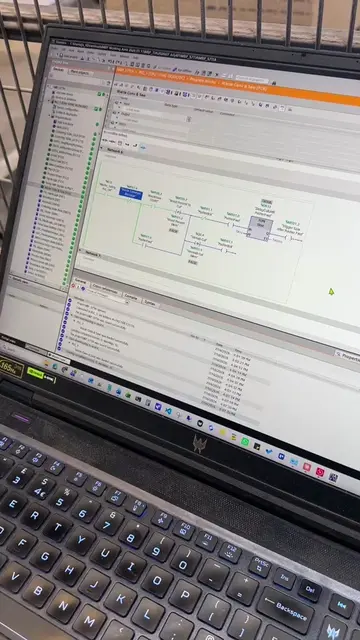
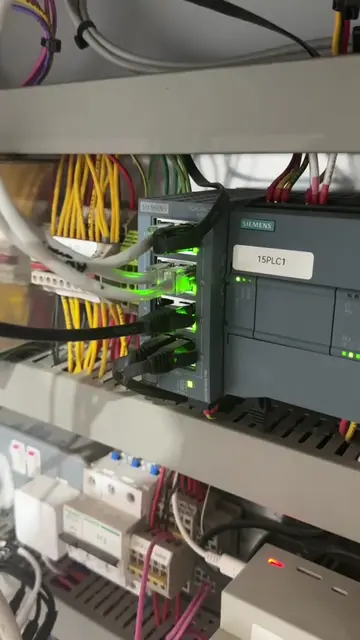
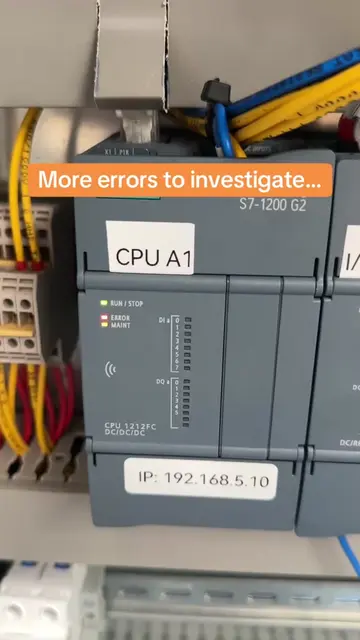
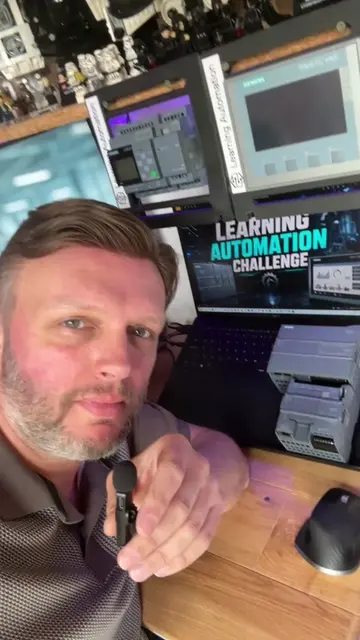
Let me take you on a little tour of a machine to give you an insight of what is expected of a controls, automation and robotics engineer. This project has quite a lot going on with different systems that's needed to be integrated. The system has been built around this robot which does some heavy lifting. This ABB robot will lift 350 kilograms and reaches 3.1 meters. In the control panel we can see a Siemens S7-1200 PLC with additional input and output modules and a network switch for Profinet communications with other devices. This is the main PLC which connects devices together and obtains data when needed. This also controls when the robot can move, when saws operate, relays signals to conveyors and controls a printer that will print product data directly on the product. A SICK safety CPU with safety inputs and outputs plus a non-safety output card, that's the grey one. As there's multiple machines involved, this contains the logic to decide when the machine is safe or not. A couple of Phoenix Contact safety relays to enable the integrated machines when all the safety conditions are met. A Raspberry Pi which is storing production data obtained via a barcode scanner. Operators scan the QR codes on job sheets and this stores it. It's running an SQL Lite database and a Snap7 script that listens for a signal from the PLC. When it gets that signal, it sends the first row of data from the database to the PLC and that's the data for the next product the robot will run. So the PLC then passes that data to the robot to give position offsets for its movements. On the front is an additional screen. Originally this was used for testing the signals for the Raspberry Pi to ensure the data was correct at the right point in the sequence. But I decided to mount it to the front of the panel so the operator can see the data in the database list and check they've loaded the right products in the right order. Then there's the main operator HMI. This is a Siemens KTP 700 7-inch touchscreen, so there's quite a bit of screen design involved too. Then there's this conveyor system that was custom made for this job by an external company. The main panel is integrated and sends a few signals over and back via relays. The conveyor control panel has a Delta PLC with some Delta inverters. This has required additional programming modifications too for proper operation with the rest of the machine. The ABB robot control panel communicates with the Siemens PLC via Profinet, so is connected via just an Ethernet cable. There are some hardwired devices wired directly to the robot such as the solenoid valves for the vacuum gripper. At the end of the line is the conveyor operator panel. Again, this is a Delta HMI and has required a few modifications too. And here is the print head that Inkjet prints data directly to the side of the product including job number and dimensions. You can see an orange module in the bottom of the panel. This is a remote input/output module called IO-Link. This is mounted to another piece of equipment that's undergoing mechanical modifications with a fabricator. So the sensors have been removed and are just safely stored in the bottom of the panel until that work is complete. The IO-Link module only needs 24 volts and an Ethernet cable so reduces wiring between the PLC and the sensors on the other piece of the machine which is located over the other side of the cell. Lots going on. Programming required for Siemens PLC and HMI done in TIA Portal. Delta PLC and HMI done with ISPSoft and DOPSoft. Rapid robot programming done in RobotStudio. Raspberry Pi programming with Python. SICK safety programming with Flexi Soft. Lots of control wiring required and interface signals using relays where Profinet comms was not possible. And you need to know it all. This variety of integration has both been a dream and a nightmare. Hope you found that insightful and informative. Let me know if you have any questions.