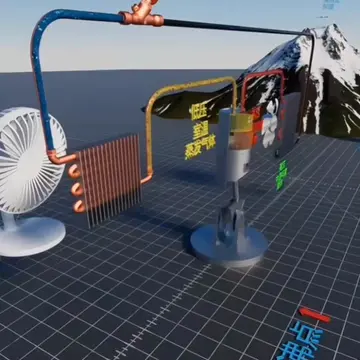
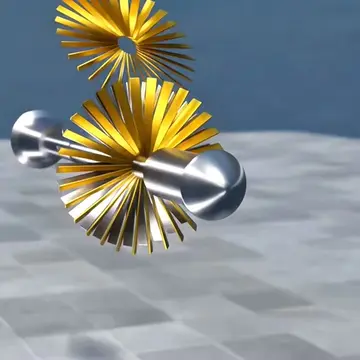
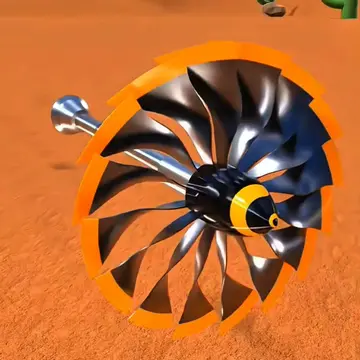
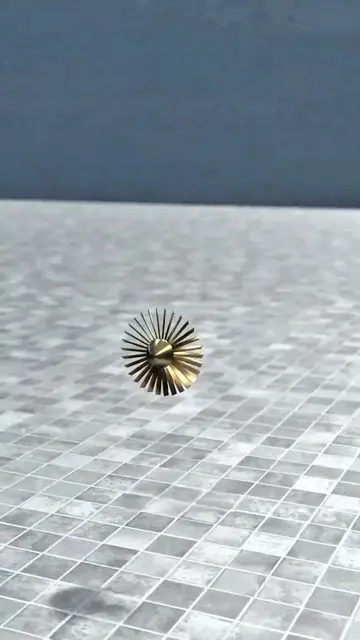
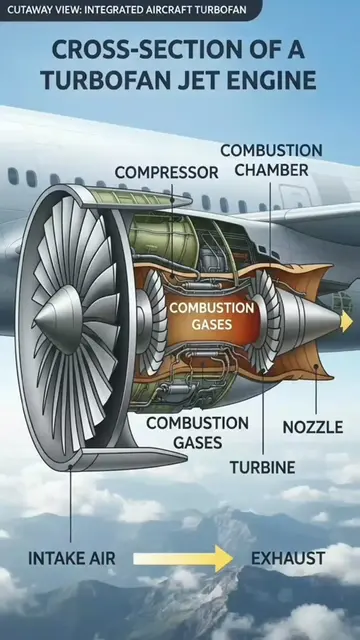
A metal tube with three sets of fan blades. One end sucks in air, the other shoots out flames. It looks ordinary, but how can it produce dozens of tons of thrust? A turbojet engine may seem simple enough that even a teenager could build one by hand. Start with a fan. When it spins, it pushes air backward and generates thrust. Congratulations, you've converted the fan's mechanical energy into the kinetic energy of the airflow. But the thrust is too small. So, you cleverly place a metal casing around the fan and add more rows of blades. Yet when you spin the fan again, the thrust doesn't increase much. You soon discover the problem. After the airflow passes through the first row of blades, its direction changes. The new airflow direction is nearly parallel to the angle of the second row of blades. So it can barely drive them efficiently. To solve this, you insert stationary guide veins between the rotating blades. When the airflow leaves the first stage, these stator veins redirect it, guiding it towards the second stage at the most efficient angle. Repeating this arrangement allows each stage to compress the air more effectively. So fans alone still cannot generate enough thrust. You add another series of blades with gradually decreasing diameters, enclosed by a casing that also narrows inside. When you start the engine again, each stage squeezes the air into a progressively smaller space. The air becomes and compressed. Its temperature rises to several hundred degrees Celsius. Now, imagine adding a combustion chamber behind this stream of hot, high-pressure air, equipped with a ring of fuel injectors. When the injectors spray fuel into the chamber, the fuel instantly ignites in the hot air, releasing a tremendous amount of heat, raising the temperature to over 1,000 degrees Celsius. The air heats up, expands dramatically, and rushes toward the exhaust at high speed, producing far greater thrust. However, this power plant still depends on the front fan and an electric motor powered by batteries. If the electricity is cut off, the engine can no longer provide a continuous supply of high-pressure air, and the whole thing stops. You make another improvement. Behind the combustion chamber, you install another set of blades, turbine blades similar in appearance to the compressor blades at the front. The hot gases traveling at hundreds of meters per second strike and then spin the turbine. Then you connect the turbine and the front compressor to the same shaft, and the turbine continuously supplies high-pressure air to the combustion chamber. You've completed a complete self-sustaining cycle. But there's another problem. The system is so efficient that the gases leaving the combustion chamber can exceed 2,000 degrees Celsius. A temperature the turbine blades can just barely withstand. With that, the engine can operate reliably for long periods. Congratulations, you've just hand-built a turbo engine. One path enters the combustion chamber and mixes with fuel. The other flows through passages outside, like a cooling blanket. This cooling air flow lowers the temperature reaching the turbine to around 1,600 degrees Celsius. A temperature the turbine blades can just barely withstand. With that, the engine can operate reliably for long periods.