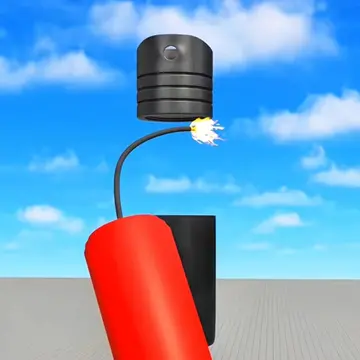
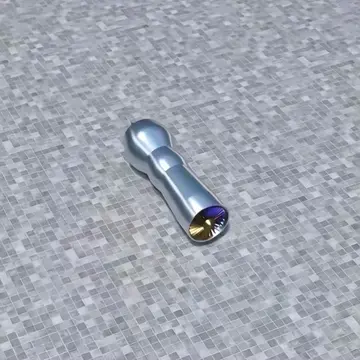
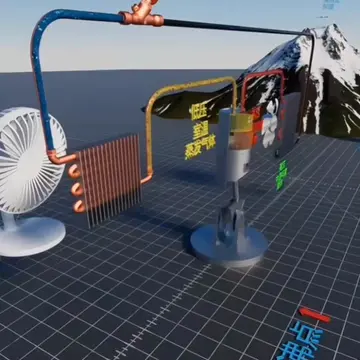
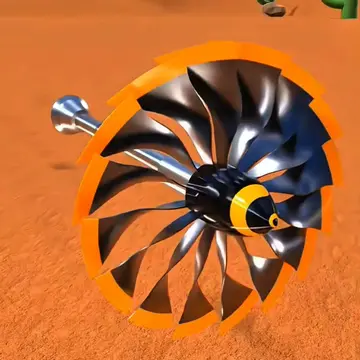
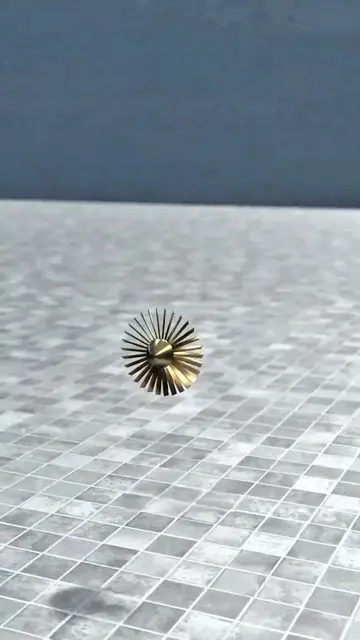
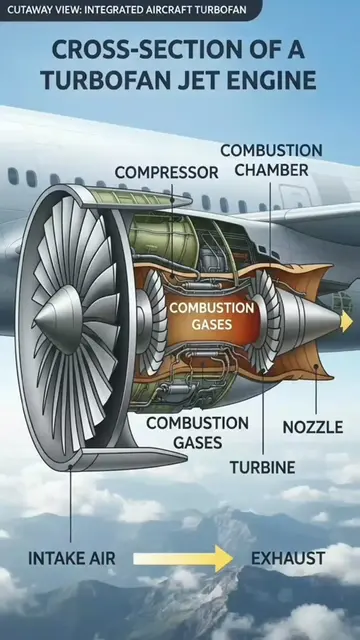
You take some fan blades and attach them to an iron pipe. One end sucks in air, the other end shoots out flames. How can this simple thing produce tens of tons of thrust? It's such a basic piece of engineering that even a 14-year-old could build it by hand. Here's how it works. If you blow on a little windmill, it spins. The harder you blow, the faster it turns. Congratulations. You've just discovered that blowing air can create thrust. To get more power, you take a pipe and put a fan inside one end. When the fan spins, it pushes air out the other end. Then you add more stages of fan blades. But when you try spinning multiple stages, you find that the thrust actually gets weaker. You figure out the problem. After the air passes the first fan, it starts spinning and swirling. It hits the next fan blade at a bad angle, almost parallel to them. So it can't push effectively. Between each pair of spinning fan blades, you add a set of fixed blades, stators, facing the opposite direction, like little fences. These straighten the swirling air and redirect it so it hits the next fan blade at the perfect angle. Efficiency instantly doubles. But fan power alone is still limited. So you add another set of blades behind the fan that gradually get smaller. And you make the pipe narrower, step by step. Each stage squeezes the air into a tighter space. After several stages of compression, the air becomes extremely dense. Pressure rises to several atmospheres, and temperature climbs to hundreds of degrees. Next, you add a combustion chamber at the end of this high-pressure area. You install fuel nozzles around the inside wall. The high-pressure air rushes in, mixes with sprayed fuel, and ignites instantly from the heat. The temperature jumps from hundreds of degrees to over 1,000 degrees Celsius. The air expands violently like a wild beast, shooting out the back at high speed and creating massive thrust. And this iron pipe engine has one big weakness. The front fans are driven by an external electric motor. Once the battery dies, the fans stop. No more compressed air reaches the combustion chamber. The flame goes out. No problem for a smart person like you. You add another set of turbine blades behind the combustion chamber. The hot, high-speed gas hits these turbine blades first, spinning them. The turbine then sends power back through a long shaft to drive the front compressor fans. Now the system is self-sustaining. The burning gas spins the turbine, and the turbine drives the compressor, which keeps feeding air to keep the fire going. A perfect cycle is born. But there's a new problem. The gas coming out of the combustion chamber is over 2,000 degrees Celsius, hot enough to melt the turbine blades. So you add cooling channels in the combustion chamber walls and inside the turbine blades. Some of the compressed air is routed around the outside of the combustion chamber and sprayed out through tiny holes in the blades. This creates a thin, cool air blanket that protects the blades, lowering the temperature they actually experience down to a level the metal can handle. The engine can now run stably for a long time. Congratulations. You've just hand-built a turbojet engine, the kind even a 14-year-old could make.