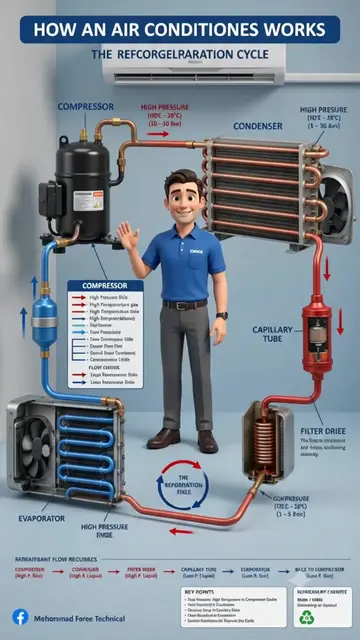
You spent two and a half years in school and still never fully understood how an air conditioner works. Today, you'll learn it in just 3 minutes. Imagine spraying water on your skin. You instantly feel cooler. If you replace the water with alcohol, the cooling effect becomes even stronger. That's because when a liquid evaporates into a gas, it absorbs heat from its surroundings. Alcohol evaporates faster than water because it has a lower boiling point, so it removes heat more efficiently. So, is there a substance with an even lower boiling point that can absorb heat even faster? Smart you, think of refrigerant, such as Freon, which boils at around -29.8 degrees Celsius under normal pressure. But you can't spray Freon directly on your body. It evaporates so quickly that it could freeze and injure your skin. So, what can you do? You pour Freon into a copper container. As the Freon evaporates inside, it absorbs heat from the copper, making the container cold. Then you blow air over the container with a fan, and cool air comes out. Congratulations, you've invented a simple one-time air conditioner. However, a new problem appears. Freon evaporates so quickly that it soon completely turns into gas and is gone. The system would be far too expensive to use. So, you come up with another idea. Why not collect the gaseous Freon and reuse it? First, you seal the container so the refrigerant cannot escape, but only liquid can evaporate and absorb heat. So the gas must be turned back into liquid. How can you liquefy a gas? You notice that gas cylinders store fuel as liquid, and water condenses on the outside of a cold soda can. You realize gases can become liquid when they are compressed or cooled. So you use a compressed gas. Squeeze the gaseous Freon. Compressing it creates a lot of heat. The compressed refrigerant may become hotter than 80 degrees Celsius, making it difficult to liquefy. No problem. You add cooling coils and a fan after the compressor to remove the heat. The high-pressure gas cools down to about 45 degrees Celsius and condenses back into liquid. Congratulations, you've invented the condenser. You might wonder, why Freon boils at -30 degrees Celsius, why at 45 degrees Celsius? The answer is pressure. Increasing pressure raises a liquid's boiling point. For example, water boils at 100 degrees Celsius at sea level, but at a lower temperature on mountains because air pressure is lower there. Under higher pressure, Freon's boiling point rises to above 50 degrees Celsius. When the refrigerant cools below that temperature, it becomes liquid again. Now you have warm, high-pressure liquid refrigerant. Sending it directly indoors won't work because it is still warmer than room temperature. You have another idea. If increasing pressure raises the boiling point, lowering the pressure should lower it. So you pass the liquid refrigerant through a narrow tube called an expansion valve. As the pressure suddenly drops, the refrigerant's boiling point falls to around 5 degrees Celsius. Now you send this low-pressure refrigerant into another set of coils inside the room. The room temperature is much higher than 5 degrees Celsius, so the refrigerant evaporates quickly, absorbing heat from the indoor air and producing cold air. This part is called the evaporator. Finally, the refrigerant gas returns to the compressor. The cycle starts over again. To improve efficiency, you add fins to both the evaporator and condenser coils. You also replace the fixed narrow tube with an automatic expansion valve for better temperature control. Congratulations, you've invented the modern air conditioner.