Imagine
attaching several sets of fan blades inside a metal tube.
One end sucks in air while the other blasts out flames.
How can something this simple produce dozens of tons of thrust?
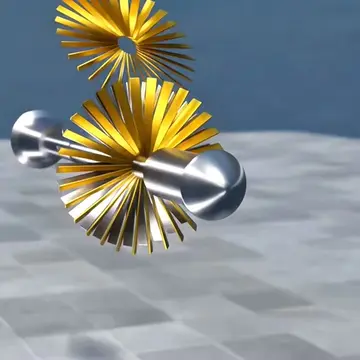
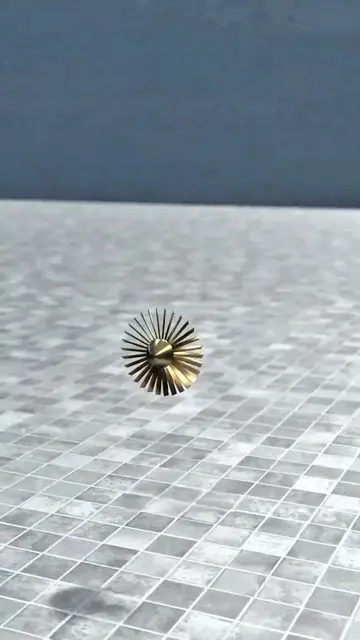
With a simple pinwheel.
Blow on it and it spins.
Blow harder and it spins even faster.
Congratulations, you've discovered that moving air can create force.
To make more thrust, you put the fan inside a metal tube.
When the fan spins, it pulls air in from one end and shoots it out the other.
Then you add more rows of fan blades, expecting even more power.
But when you test it, the thrust actually becomes weaker.
Looking closely, you find the problem.
The first row of blades makes the air flow spin.
By the time it reaches the second row, the air is hitting the blades at the wrong angle, almost parallel to them, so they can barely do any useful work.
The solution is simple: between every two rows of rotating blades, you install a row of stationary guide vanes facing the opposite direction.
Like a row of fences, they straighten it, so it strikes the next set of blades at the perfect angle.
Efficiency immediately improves, but fans alone still can't produce enough thrust.
So behind them, you install several stages of compressor blades.
Each stage slightly narrows the diameter of the tube, squeezing the air into smaller and smaller space.
After several stages, the air reaches several hundred times atmospheric pressure.
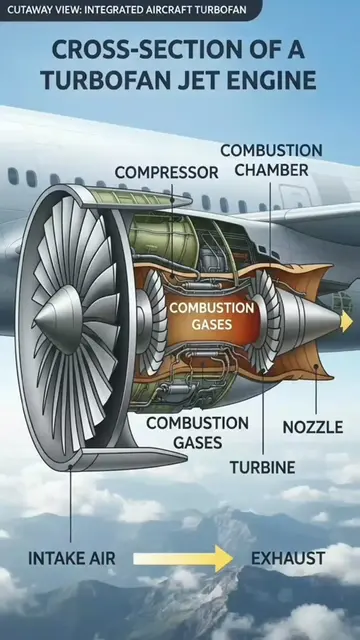
Next, you connect a combustion chamber behind the compressor.
Fuel nozzles spray a fine mist of fuel into the hot compressed air.
The heat ignites the fuel instantly with a loud roar.
The temperature jumps from a few hundred degrees Celsius to over 1000 degrees Celsius.
The burning gases expand violently and rush towards the exhaust at tremendous speed, finally producing serious thrust.
However, there's still a problem.
The compressor at the front is powered by an external electric motor.
Once the battery runs out, the compressor stops spinning, and no more compressed air enters the combustion chamber.
It goes out.
But you solve this.
Behind the combustion chamber, you install a turbine.
The hot exhaust gases spin the turbine, which is connected by a long shaft to the compressor at the front.
Now the turbine powers the compressor.
The compressor feeds air into the combustion chamber, and the combustion chamber produces hot gases that spin the turbine.
It's a perfect self-sustaining cycle.
You've invented the turbojet engine, the classic engine used in early fighter jets.
But turbojets are fast, but they burn huge amounts of fuel.
So you make one final improvement.
You add a much larger fan at the front, with a diameter far bigger than the engine core.
The incoming air splits into two streams.
One stream enters the engine core, where it's compressed, mixed with fuel, burned, and accelerated through the turbine, and exhaust.
The other stream bypasses the core, flowing through a large outer passage called the bypass duct.
The front fan is divided into two sections.
The larger blades push air through the bypass duct, while the inner blades feed the engine core.
Most of the engine's thrust, around 70 to 80%, now comes from the bypass air.
This provides lower fuel consumption and much less noise.
The two streams merge at the back, creating an engine with lower thrust, lower fuel consumption, and less noise.
Congratulations, you've invented the turbofan engine, the type of engine used on most modern passenger aircraft and many military aircraft today.