Loading video…
All breakouts
3.5Text-HeavyOther hookAI Tools
Hook
ML Tut follow @sambit.ai.tech VECTOR DATABASES
@sambit.ai.tech
5.4K followers · usually 687 views a post
Views
2.4K
Likes
71
Comments
0
Shares
18
SoundTikTok sound · King
Why it worked
The post effectively breaks down a complex technical topic into easily digestible visual chunks, making it highly shareable and informative for a technical audience interested in AI and data management.
Summary
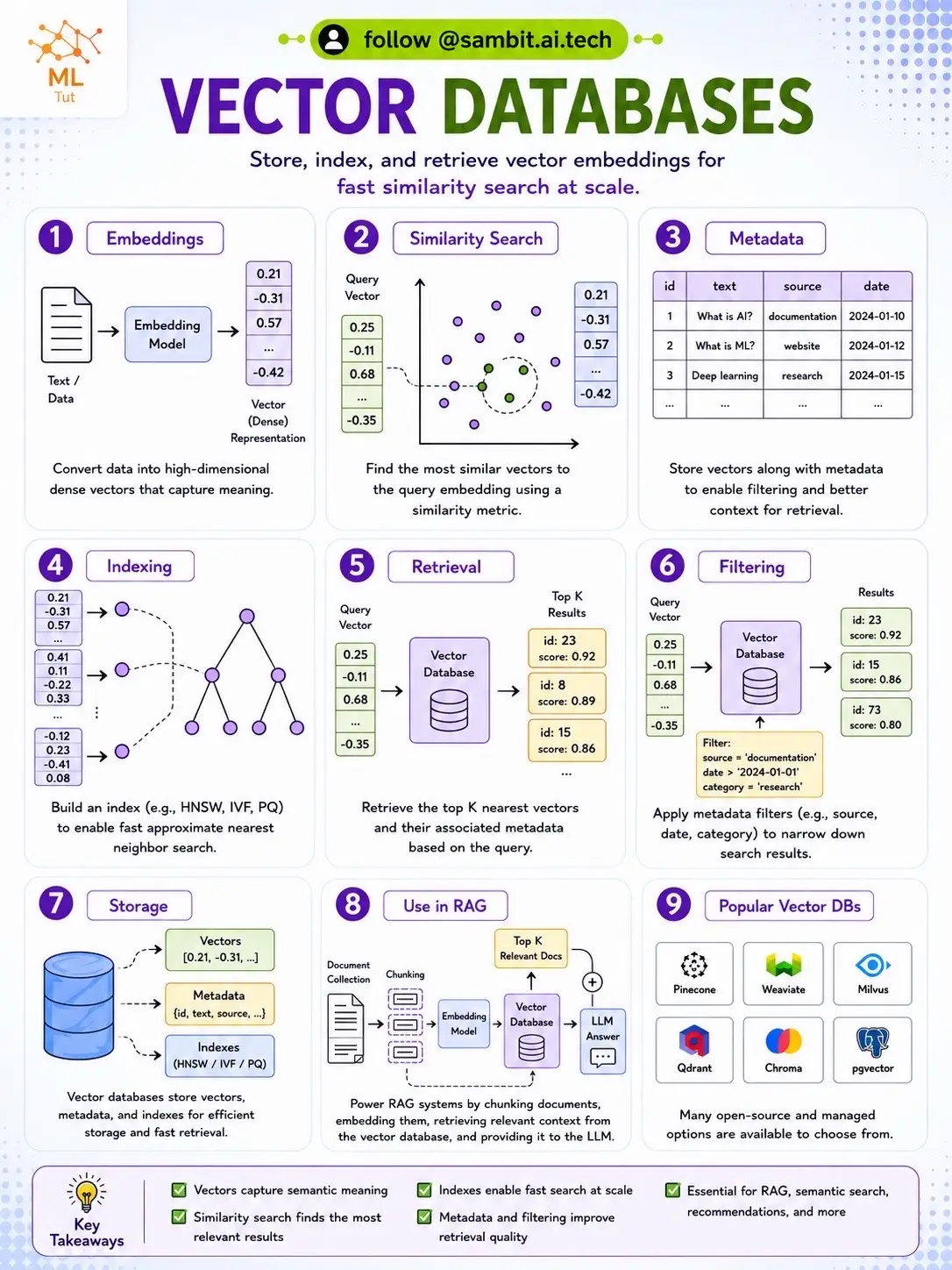
This is a text-heavy infographic explaining the concept of Vector Databases. It breaks down the process into nine key steps, including embeddings, similarity search, metadata, indexing, retrieval, filtering, storage, use in RAG, and popular vector databases. The infographic also highlights key takeaways about the benefits of using vector databases.
Structure
- 1Introduction to Vector Databases
- 2Embeddings and Similarity Search
- 3Metadata and Indexing
- 4Retrieval and Filtering
- 5Storage and RAG Implementation
- 6Popular Vector Databases and Key Takeaways
On-screen text
ML
Tut
follow @sambit.ai.tech
VECTOR DATABASES
Store, index, and retrieve vector embeddings for
fast similarity search at scale.
1 Embeddings
Text /
Data
Embedding
Model
Vector
(Dense)
Representation
Convert data into high-dimensional
dense vectors that capture meaning.
0.21
-0.31
0.57
-0.42
2 Similarity Search
Query
Vector
0.25
-0.11
0.68
-0.35
Find the most similar vectors to
the query embedding using a
similarity metric.
3 Metadata
id
text
source
date
What Is AI?
documentation
2024-01-10
What Is ML?
website
2024-01-12
Deep learning
research
2024-01-15
Store vectors along with metadata
to enable filtering and better
context for retrieval.
4 Indexing
0.21
0.41
-0.11
0.33
-0.12
0.23
-0.41
0.08
Build an index (e.g., HNSW, IVF, PQ)
to enable fast approximate nearest
neighbor search.
5 Retrieval
Query
Vector
0.25
-0.11
0.68
-0.35
Vector
Database
Top K
Results
id: 23
score: 0.92
id: 8
score: 0.89
id: 15
score: 0.86
Retrieve the top K nearest vectors
and their associated metadata
based on the query.
6 Filtering
Query
Vector
0.25
-0.11
0.68
-0.35
Vector
Database
Results
id: 23
score: 0.92
id: 15
score: 0.86
id: 73
score: 0.80
Filter:
source = 'documentation'
date > '2024-01-01'
category = 'research'
Apply metadata filters (e.g., source,
date, category) to narrow down
search results.
7 Storage
Vectors
[0.21, -0.31, ...]
Metadata
[id, text, source, ...]
Indexes
(HNSW/IVF/PQ)
Vector databases store vectors,
metadata, and indexes for efficient
storage and fast retrieval.
8 Use in RAG
Document
Collection
Chunking
Embedding
Model
Vector
Database
Top K
Relevant Docs
LLM
Answer
Power RAG systems by chunking documents,
embedding them, retrieving relevant context from
the vector database, and providing it to the LLM.
9 Popular Vector DBs
Pinecone
Weaviate
Milvus
Qdrant
Chroma
pgvector
Many open-source and managed
options are available to choose from.
Key
Takeaways
Vectors capture semantic meaning
Similarity search finds the most
relevant results
Indexes enable fast search at scale
Metadata and filtering improve
retrieval quality
Essential for RAG, semantic search,
recommendations, and more
Original caption
Almost every modern RAG application, AI chatbot, and AI search engine relies on a Vector Database. Instead of matching exact words, vector databases search by meaning, making AI responses faster, smarter, and more relevant. In this guide, you’ll learn: • What embeddings are • How similarity search works • Why indexing matters • How retrieval and metadata filtering improve results • How vector databases power RAG pipelines • Popular databases like Pinecone, Weaviate, Milvus, Qdrant, Chroma, and pgvector If you want to become an AI Engineer, understanding vector databases is essential. 💾 Save this for later. 📤 Share it with someone learning AI. 👇 Follow @sambit.ai.tech for AI engineering roadmaps, RAG, LLMs, AI agents, MLOps, and real-world AI system design. AI Engineering • Vector Database • RAG • Embeddings • Similarity Search • Semantic Search • Retrieval • Vector Search • LLM • Generative AI • AI Agents • Machine Learning • AI Roadmap #AIEngineer #GenerativeAI #RAG #MachineLearning #softwareengineer
More from @sambit.ai.tech
More breakout videos from this creator.