Loading video…
All breakouts
211Text-HeavyOther hookEducation
Hook
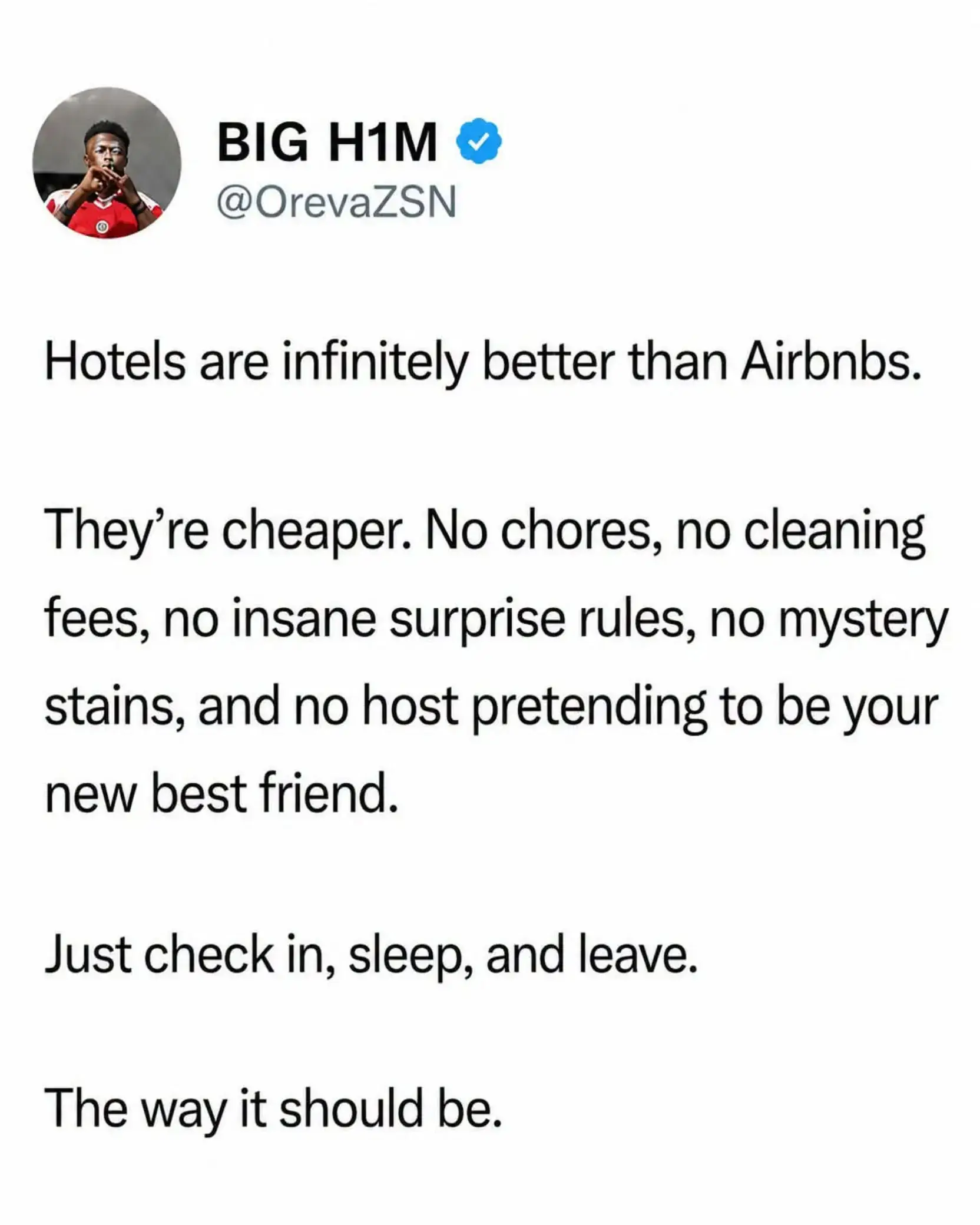
BIG H1M @OrevaZSN
@ethanscarellc
8.4K followers · usually 824 views a post
Views
167.9K
Likes
2.4K
Comments
348
Shares
90
Why it worked
The post taps into a common frustration with the Airbnb experience, presenting a clear and concise argument for the superiority of hotels in a relatable way.
Summary
The post argues that hotels are superior to Airbnbs due to their simplicity, predictability, and lower cost. It highlights the absence of chores, cleaning fees, and host interactions as key advantages of hotels.
Structure
- 1Introduction: Hotels are better than Airbnbs.
- 2Reason 1: Cheaper, no hidden fees or rules.
- 3Reason 2: No awkward host interactions.
- 4Conclusion: Simple check-in, sleep, and leave.
On-screen text
BIG H1M
@OrevaZSN
Hotels are infinitely better than Airbnbs.
They're cheaper. No chores, no cleaning
fees, no insane surprise rules, no mystery
stains, and no host pretending to be your
new best friend.
Just check in, sleep, and leave.
The way it should be.
Original caption
Hotels win for simplicity, predictability, and professionalism. Airbnb wins only when you want space, uniqueness, or long stays. The friction —chores, cleanup rules, and performative friendliness—is not imagined; it’s baked into Airbnb’s model. Hotels are built for frictionless, transactional stays, and most travelers want exactly that. 1. Check in → sleep → leave. No emotional labor, no social dance, no “tell me about your trip!” from a host. 2. Professional standards. Daily cleaning, fresh towels, working locks, fire safety, ADA compliance. 3. Clear expectations. You don’t get surprise rules like “Please strip the beds” or “Don’t use the AC below 74°F.” 4. No hidden chores. You’re not asked to take out trash, start laundry, or wash dishes. 5. Accountability. If something is wrong, hotels fix it immediately. Airbnb hosts vary wildly. Airbnb became less hospitality and more amateur property management, and travelers feel that shift. Airbnb used to be “stay in someone’s cool loft.” Now it’s often: 1. A mini-lease disguised as a vacation. Long lists of rules, check-out chores, and penalties. 2. Hosts outsourcing cleaning to guests. Some require dishes, laundry, trash removal—despite charging cleaning fees. 3. Inconsistent quality. You might get a beautiful home… or a place with broken blinds and mystery stains. 4. Social expectations. Hosts who want to chat, give life advice, or act like your new best friend. 5. Surveillance. Cameras outside, noise monitors inside, and messages like “Just checking in 😊.” 6. Fees that rival hotel prices. Cleaning fees, service fees, pet fees, early check-in fees. Airbnb’s biggest flaw isn’t the chores—it’s emotional labor. Hotels are designed to be emotionally invisible. Airbnb often requires you to manage someone else’s expectations, rules, and personality. That’s exhausting when all you want is a place to sleep. #AirBnB #Hotels
More from @ethanscarellc
More breakout videos from this creator.