Loading video…
All breakouts
7.9KText-HeavyOther hookEducation
Hook
FINAL WHISTLE
@ethanscarellc
8.4K followers · usually 824 views a post
Views
6.5M
Likes
312.8K
Comments
6.4K
Shares
17.8K
Why it worked
The story is a powerful and inspiring medical miracle that evokes strong emotions and curiosity, making it highly shareable.
Summary
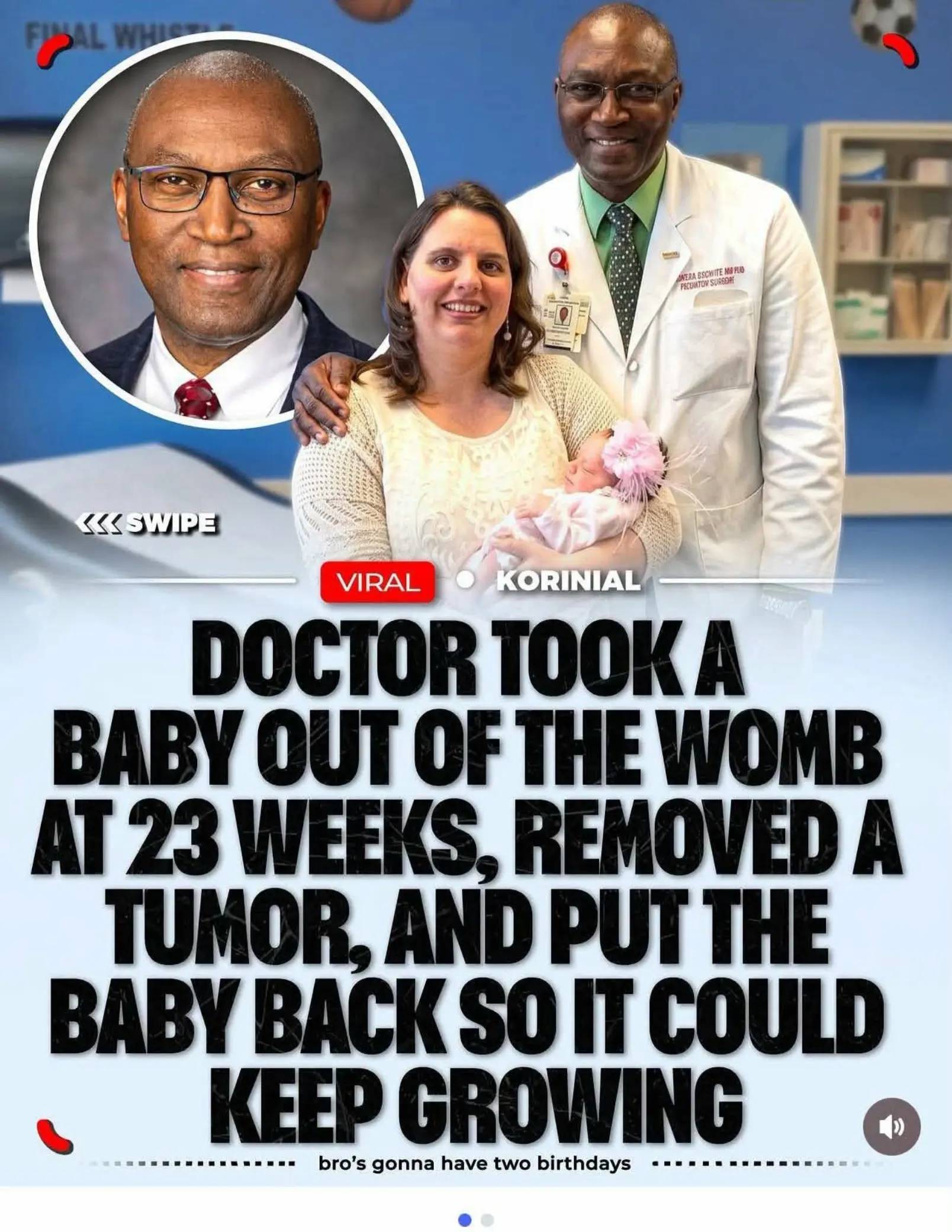
This post tells the story of a doctor who performed a complex surgery on a fetus at 23 weeks gestation to remove a life-threatening tumor. The baby was partially delivered, the tumor was removed, and the baby was returned to the womb to continue developing.
Structure
- 1Introduction of the medical feat
- 2Explanation of the baby's condition and the surgery
- 3Successful outcome and continued development
- 4Commentary on the baby's unique situation
On-screen text
FINAL WHISTLE
<<<< SWIPE
VIRAL
KORINIAL
DOCTOR TOOK A
BABY OUT OF THE WOMB
AT 23 WEEKS, REMOVED A
TUMOR, AND PUT THE
BABY BACK SO IT COULD
KEEP GROWING
bro's gonna have two birthdays
Original caption
At 23 weeks gestation, doctors discovered a sacrococcygeal teratoma, a huge tumor growing from the baby’s tailbone. It was stealing blood flow and causing heart failure. Without intervention, she would have died. Surgeons at Texas Children’s Hospital — led by Dr. Oluyinka Olutoye — performed a partial delivery: They opened the uterus. Brought the baby partially out while keeping her attached to the placenta. Removed the tumor. Returned her to the womb and closed the uterus. She continued developing normally until birth at 36 weeks. Open fetal surgery is one of the most delicate procedures in medicine. Surgeons operate on a fetus the size of your hand, with blood vessels thinner than threads. The baby must stay connected to the placenta the entire time — that’s the only way she survives the operation. The tumor was nearly as large as the fetus itself, and the surgery lasted hours. But it worked. She was literally born twice — once for surgery, once at full term. Fetal surgery is becoming more common for certain conditions: 1. Heart tumors and valve blockages (Cleveland Clinic). 2. Spina bifida repairs (Lurie Children’s Hospital). 3. Gastroschisis corrections (Texas Children’s Hospital). 4. Intestinal defects repaired in utero (BBC / The Telegraph). These procedures are still extremely rare and only done when the baby will not survive without intervention. This kind of surgery is exactly why fetal medicine is controversial in political debates — because it shows how early viability can be pushed with advanced care. But medically, the takeaway is simple: A fetus at 23 weeks can undergo major surgery, heal, and continue developing normally. #TXChildrenHospital #DrOluyinkaOlutoye #SacrococcygealTeratoma
More from @ethanscarellc
More breakout videos from this creator.