Loading video…
All breakouts
281Text-HeavyOther hookEducation
Hook
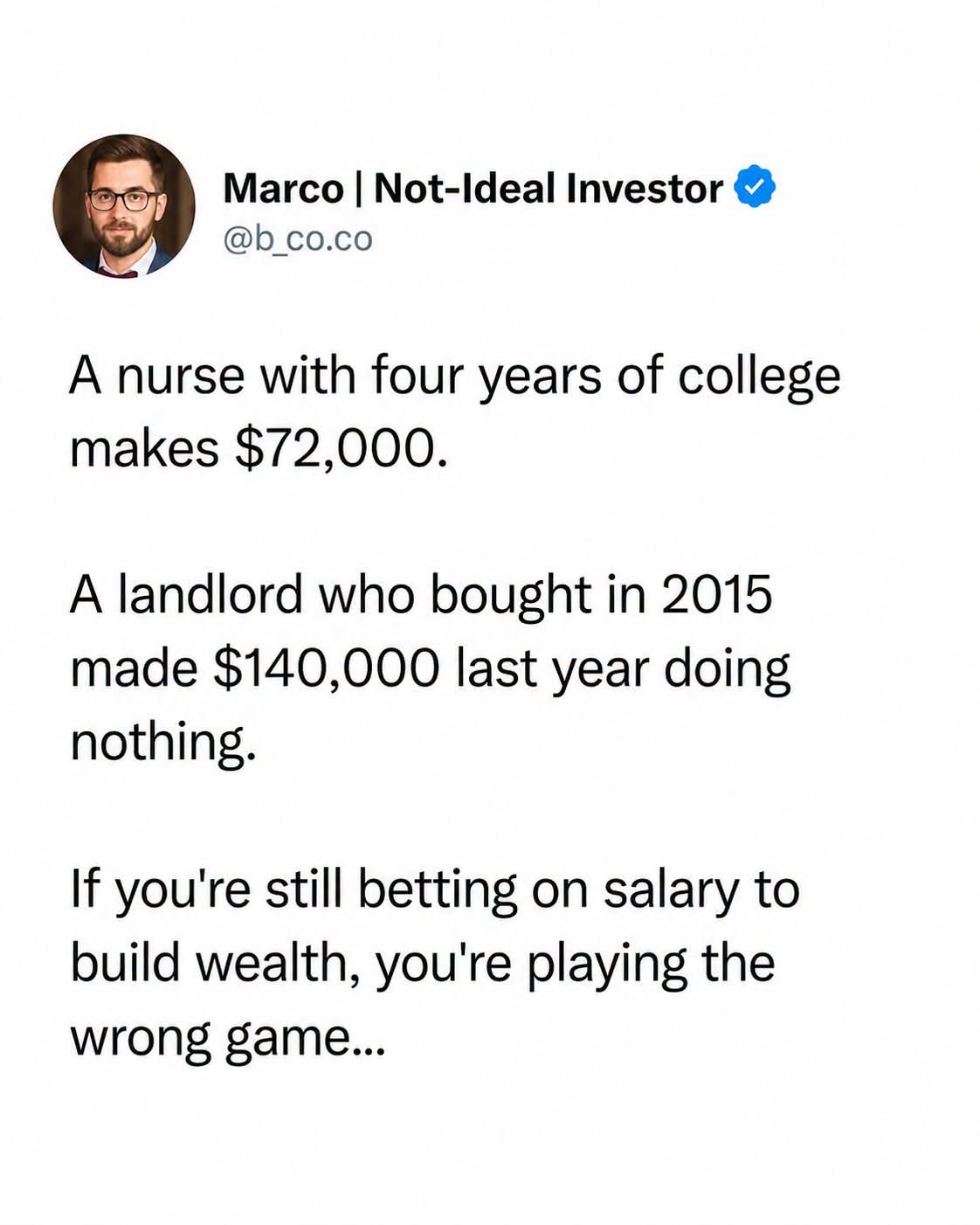
Marco | Not-Ideal Investor @b_co.co
@ethanscarellc
8.4K followers · usually 824 views a post
Views
199.3K
Likes
1.0K
Comments
494
Shares
232
Why it worked
The post uses a stark, relatable contrast between two common financial paths to highlight a provocative point about wealth creation. The clear, simple language and the 'us vs. them' framing make it easily shareable and debatable.
Summary
The post contrasts the earnings of a nurse with a college degree ($72,000) against a landlord who bought property in 2015 and made $140,000 passively. It argues that relying solely on salary to build wealth is a losing strategy in the modern economy, emphasizing ownership as the key to wealth creation.
Structure
- 1Introduction of the poster and their handle.
- 2Comparison of a nurse's salary to a landlord's passive income.
- 3Assertion that salary-based wealth building is the 'wrong game'.
- 4Concluding thought on wealth being built through ownership.
On-screen text
Marco | Not-Ideal Investor
@b_co.co
A nurse with four years of college
makes $72,000.
A landlord who bought in 2015
made $140,000 last year doing
nothing.
If you're still betting on salary to
build wealth, you're playing the
wrong game...
Original caption
If you’re relying on salary alone, you’re competing in the slowest, most capped wealth‑building lane in the modern economy. Wealth is no longer primarily built through wages — it’s built through ownership. And the nurse vs. landlord example is the cleanest illustration of that shift. A nurse earning $72K is doing everything “right” by traditional standards — stable job, essential skill, good income. A landlord who bought in 2015 made $140K last year without clocking in, because rents rose, property values appreciated, mortgage interest was deductible, inflation lifted asset prices, and tenants paid down the loan. That’s $140K in passive gains vs. $72K in active labor. This is the structural shift people don’t want to admit. If you rely on wages alone, your income is capped, your time is capped, your upside is capped, and your wealth is capped. 1. Wages grow slowly Average wage growth is 3–4% annually. Asset growth (real estate, equities) often outpaces that by 2–3× over long periods. 2. Assets compound; labor doesn’t Your job resets every year. Your assets snowball every year. 3. Inflation punishes workers but rewards owners When prices rise, workers lose purchasing power; owners gain equity and rental pricing power, and inflation is a transfer mechanism from labor to capital. 4. Tax code favors owners Owners get depreciation, write‑offs, capital‑gains treatment, 1031 exchanges, and interest deductions. Workers get… W‑2 withholding. 5. Time favors assets, not hours The landlord’s property works 24/7. The nurse works 40 hours. This is labor vs. capital — and capital wins every decade. If you rely on ownership, your income scales, your time decouples, your upside compounds, and your wealth accelerates. This is labor vs. capital — and capital wins every decade. The landlord didn’t “earn” $140K — the system delivered it. That’s the part people hate hearing. #LabourVsCapital #TaxCodes #Ownerships #Entrepreneurs
More from @ethanscarellc
More breakout videos from this creator.