Loading video…
All breakouts
5.3Talking HeadStory Open hookOther
Hook
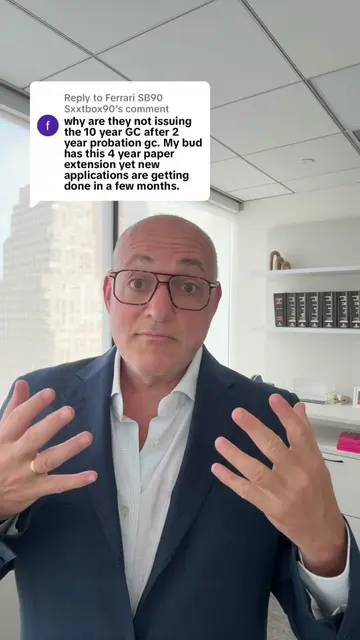
TRUMP ENDED HAITIAN TPS. 350,000 PEOPLE CANT BE DEPORTED
@bradbernsteinlaw
825.2K followers · usually 51.9K views a post
Views
272.5K
Likes
16.6K
Comments
1.1K
Shares
4.9K
Why it worked
The video tackles a politically charged and complex immigration issue with a clear, concise explanation that breaks down the logistical and legal hurdles to mass deportations. The use of on-screen text to emphasize key statistics and concepts makes the information easily digestible and shareable.
Summary
The video explains why ending TPS for Haitians does not immediately lead to mass deportations. It highlights the logistical challenges, including the dangerous situation in Port-au-Prince, the limited capacity of alternative airports, and the sheer volume of people requiring deportation hearings and asylum processing. The speaker concludes that the process is a matter of math, airport security, and immigration law, not just politics.
Structure
- 1Introduction: Trump ended TPS, but 350,000 Haitians can't be deported immediately.
- 2The reality of deportations: Slow pace, logistical issues, and the war zone in Port-au-Prince.
Original caption
TRUMP ENDED HAITIAN TPS. THAT DOES NOT MEAN 350,000 PEOPLE CAN BE DEPORTED TOMORROW. The Trump administration won the legal authority to terminate Temporary Protected Status for approximately 348,000 Haitians. But ending TPS did not magically create 348,000 final deportation orders, thousands of immigration judges, secure airports in Haiti, or enough deportation flights to carry everyone there. What happened immediately was the loss of TPS protection and TPS-based employment authorization. That means employers must remove Haitian workers from their payrolls unless those workers can present another valid work permit. Deportation is a completely different process. The United States had recently been sending approximately one deportation flight per month to Haiti, generally carrying a little more than 100 people. Port-au-Prince remains inside an FAA-restricted danger area after armed groups fired on aircraft. As a result, most deportation flights have been routed through the smaller airport in Cap-Haïtien. The administration reportedly wants to increase the pace to at least two flights per week, totaling approximately 250 people per week. Even at that expanded rate, transporting 348,000 people would take nearly 27 years. That calculation is an illustration of scale, not a prediction. The government can add flights, some people may leave voluntarily, and not every former TPS holder is legally removable. But it demonstrates why ending TPS and physically deporting hundreds of thousands of people are two very different things. Legally, former Haitian TPS holders fall into different categories: • Some already have final removal orders and may be ICE’s easiest initial targets. • Some have pending immigration court cases. • Some have asylum applications or another form of immigration relief pending. • Some have another valid status or employment authorization. • Others would ordinarily need to be placed into removal proceedings before an immigration judge. Many of those proceedings could take years. The immigration court system already has millions of pending cases, including more than two million pending asylum matters. Can Haitians apply for asylum, withholding of removal, or protection under the Convention Against Torture? Potentially, yes, but none of those protections is automatic. General violence, instability, hunger, or gang control in Haiti does not automatically establish asylum eligibility. An asylum applicant normally must prove an individualized fear of persecution connected to race, religion, nationality, political opinion, or membership in a particular social group. Withholding of removal requires an even higher probability of qualifying persecution. Convention Against Torture protection requires proof that the person is more likely than not to be tortured, with the involvement or acquiescence of government officials. This is why I am not telling every Haitian to rush out and file a weak affirmative asylum application simply because TPS ended. For someone without another lawful status, a denied affirmative application may be referred directly to immigration court. But waiting is not automatically safe either. Maintaining TPS can sometimes excuse asylum’s one-year filing deadline as an extraordinary circumstance. The person must still file within a reasonable period after TPS ends. Waiting too long could jeopardize asylum eligibility. Arrest, detention, expedited proceedings, and the execution of an existing removal order are also real risks. Brad Bernstein 45 Broadway 15th Fl NY NY 10006 www.lawsb.com 1-212-227-8933 #ImmigrationLaw #haiti #tps #immigrationlawyer #hatiantiktok
More from @bradbernsteinlaw
More breakout videos from this creator.