Loading video…
All breakouts

91.6Text-HeavyContrarian hookFinance
Hook
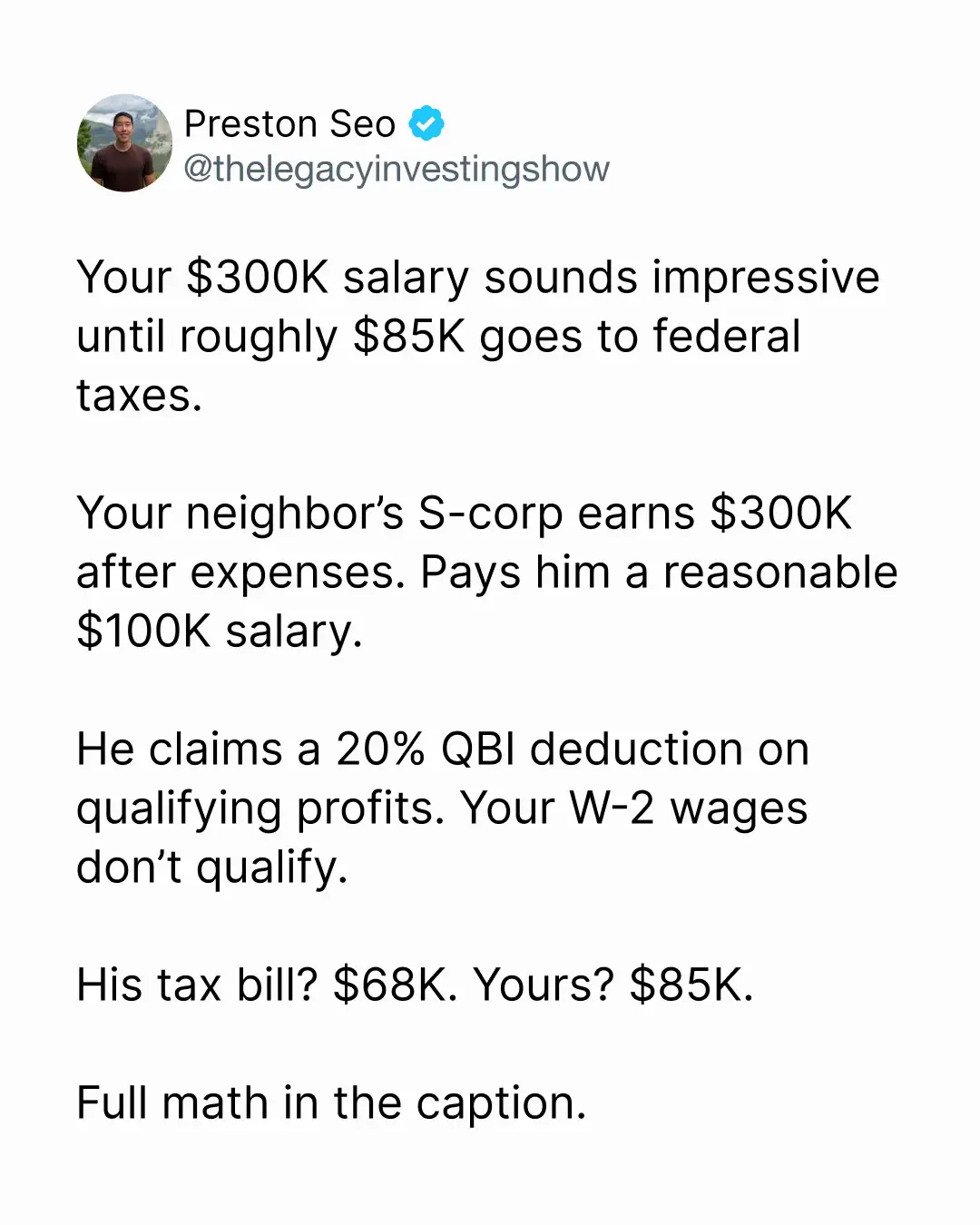
Owning a small business is still the best tax deal in America.
@thelegacyinvestingshow
2.5M followers · usually 1.8K views a post
Views
157.8K
Likes
2.6K
Comments
22
Shares
776
Why it worked
The post provides high-value, actionable financial information with specific numbers and a clear, logical structure that makes complex tax concepts feel accessible and immediately useful to entrepreneurs.
Summary
The creator outlines eight specific tax deduction strategies for small business owners in 2026, providing a hypothetical example of how they can total over $170,000 in savings. The post concludes with a disclaimer that this is educational content and not professional tax advice.
Structure
- 1Hook stating the value of small business tax deductions
- 2List of 8 specific tax strategies with calculations
- 3Hypothetical scenario demonstrating the total savings
- 4Disclaimer and call to action to save and share
Call to action
Save this. Send it to someone who just started an LLC.
On-screen text
Preston Seo @thelegacyinvestingshow Owning a small business is still the best tax deal in America. You can create $170,000+ in tax deductions in 2026. Here are my favorite 8 strategies: I own the entire street behind me #1 Business expenses. Ordinary, necessary business costs are deductible: Phone (the business share) Professional dues Work travel, education, legal fees $5,000 of these cuts your taxable business income by $5,000. About $1,200 less tax at a 24% bracket. #2 Employment taxes and the S-corp. Sole proprietors pay 15.3% self-employment tax on 92.35% of their profit. (Only Social Security is capped.) With an S-corp, you pay yourself a salary the IRS would call reasonable. Payroll taxes hit only that. The rest can come out as distributions, which skip those taxes. Say your business clears $150,000 before your pay, and a reasonable salary is $70,000. Sole proprietor: ~$21,200 in self-employment tax. S-corp: ~$10,700 in payroll tax on the salary. That's about $10,500 less in Social Security and Medicare. (Before payroll and CPA costs.) #3 Retirement and health accounts. SEP IRA: up to $72,000 in 2026. Sole proprietors can put in up to 20% of net earnings, after half their self-employment tax. Or 25% of salary through an S-corp. Family HSA: $8,750 in 2026 with a qualifying high-deductible plan. About $2,100 less tax at 24%. #4 Small-business HRAs (QSEHRA). Your business reimburses employees' health costs, tax-free if they have qualifying coverage. 2026 limits: $6,450 individual, $13,100 family. For businesses under 50 full-time equivalents with no group plan. Not for S-corp owners over 2%. #5 Section 179. Write off equipment, computers, and vehicles the year you place them in service. 2026 limit: $2,560,000 (up from $1,220,000 in 2024). Heavy SUV (6,001 to 14,000 lbs GVWR, over 50% business use): Up to $32,000. Bonus depreciation can add more... #6 Hiring family members. Pay your kids a fair wage for real work, and your business deducts it. A single child with only wage income can earn $16,100 in 2026 with no federal income tax. Under 18 in a parent's sole proprietorship? No Social Security or Medicare taxes either (not S-corps). #7 QBI deduction. Eligible businesses can deduct up to 20% of qualified business income. It's now permanent. $100,000 of QBI (after expenses and retirement contributions)... Means up to a $20,000 deduction, subject to income limits. About $4,800 less tax at 24%. #8 Home office. The space must be used regularly and only for business. And be your main place of business (or meet another IRS test). You deduct part of your mortgage interest or rent, utilities, insurance, and repairs. Two ways to do it... Simplified: $5 per sq ft, up to 300 sq ft. $1,500 max. Actual expense: a 150 sq ft office in a 1,500 sq ft home is 10%. 10% of $36,000 in yearly home costs could mean a $3,600 deduction. Subject to the home-office rules. So how does $170,000+ happen? One example: a married couple filing jointly. Their S-corp clears about $547,000 after staff costs, before owner pay and these deductions. A reasonable $288,000 salary. One employee on the QSEHRA. One kid on payroll... Business expenses: $5,000 SEP IRA: $72,000 Family HSA: $8,750 QSEHRA (employee): $13,100 Heavy SUV: $32,000 Kid's wages: $16,100 Home-office reimbursement: $3,600 QBI on the final $100,000: $20,000 Total: $170,550 in business and personal deductions for 2026. Not every strategy fits every business, and the rules change every year. Savings shown assume a 24% federal bracket, before state tax and QBI effects. Talk to a tax pro first. Education, not tax advice. Save this. Send it to someone who just started an LLC.
Original caption
Owning a business doesn't lower your taxes by itself. How you set it up does. My favorite 8 strategies, with 2026 numbers: 1. Business expenses 2. S-corp salary plus distributions 3. SEP IRA ($72,000 cap) and family HSA ($8,750) 4. QSEHRA ($6,450 individual / $13,100 family) 5. Section 179 ($2,560,000, heavy SUV $32,000)
More from @thelegacyinvestingshow
More breakout videos from this creator.