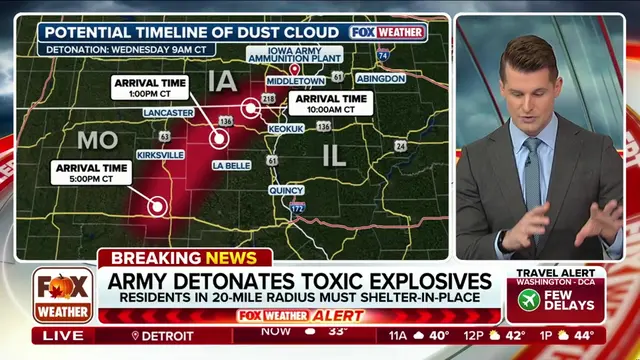
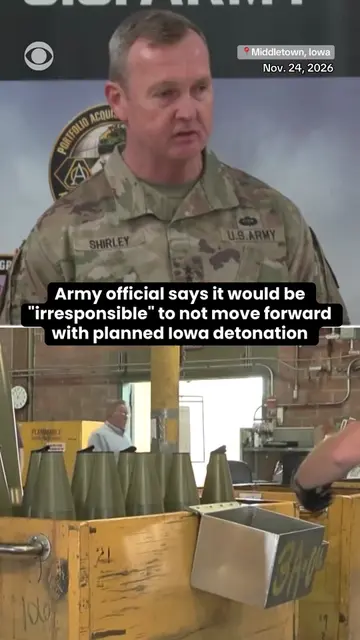
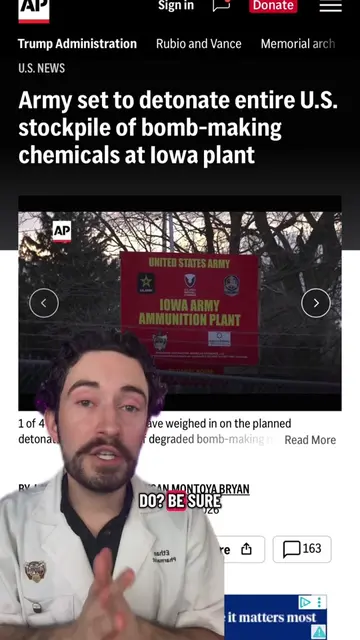
Let's keep this discussion going. After a lot of back and forth, the United States Army is proceeding with this controlled detonation of more than 9,000 pounds of that lead azide at the Iowa Army Ammunition Plant tomorrow. Let's bring in Illinois Congressman from the 17th District, Eric Sorensen. Congressman, great to have you with us here on FOX Weather. I know you, of course, from your past life as a TV meteorologist, and now you're in your third term serving in the United States Congress. So a unique perspective here of both the politics and the atmospheric science. What's your read here? I'm not sure if you heard our report. It does feel as though you got a number of bad choices and the Army, the Army has to take care of this. Yeah, I've been, you know, I also sit, I'm the only meteorologist in the Congress, but I also serve on the House Armed Services Committee. So I've gotten to know General Shirley at Army Sustainment Command. And in fact, I had a briefing on the meteorology surrounding this just last night. What they have done there is made sure that the temperatures inside those compartments remains above freezing. So even though the air temperature got down to 20 degrees last night, inside where this lead azide is, is still about 50 degrees. And so it lowers the risk of a spontaneous detonation. But going forward, the deterioration of this compound means that the only thing that is left on the table is to make sure that there is a controlled detonation, but then lowering the risk for people, making sure that everything is done to try to contain that blast. Yeah, and some of the meteorology is how we got to this point with the maintenance or lack thereof that happened with some of this material. Lead azide, as we've discussed, made up of nitrogen and lead. The nitrogen, no trouble, it's inert, but that lead dust is toxic. The Army has meteorological criteria, which sounds like you were briefed on. Is there a best set of weather conditions for this to take place? Do we have close to that for tomorrow morning? Well, like we want to make sure that the winds are as light as possible so that anything that is in the air does not disperse as far as the map indicates. And so lighter winds mean that that lead, it's a heavy metal, so a lot of this will fall down right at that location. However, I have been in communication with not just the Army, but not just elected leaders, but the incoming Congresswoman, Christina Bohannon. She was concerned because this is going to be her future district, and she said there are Christmas tree farms that are in the planned path. And so what does this mean for some business owner that's trying to sell their Christmas trees here around Christmas time and now there's some lead in the air? So it is making sure also that farmers are aware of all of the things that they need to do if there's cattle, calf operations that are outside, that they're taking the precautions, and then of course, children, pregnant mothers, that sort of thing. Everybody's taking the precaution. The good news here, Ian, is that the winds are going to be light. You know, as far as atmospheric conditions, man, I'd love to see, you know, a low stratus overcast, maybe even some drizzle to help give us some condensation nuclei for those lead particles to bring it right down to the ground. Um, but I think tomorrow morning probably is the best scenario that we've seen over the course of the past week. Is he still got it in you? That weather bug never leaves you. I can hear it. Talk about the cold front that's coming from the north. See, but I have to ask you, and I know as this is a tough situation. You're talking about the lighter winds, which yes, that leads to less dispersion of these toxic particles. Yes, but for the areas immediately surrounding the explosion, we're going to have a greater density of those. So still some concerns settling on the ground and in some of the waterways. What kind of long-term monitoring do you want to see in the aftermath of this? And how long does that have to happen? Look, I mean, there's one community that is close to this, this in my congressional district, Macomb, Illinois. I've talked with the mayor, um, who was working with the university, Western Illinois University, to see if there was testing available to make sure that we can tell our constituents that they are safe. Um, you know, look, I mean, this is where, of course, it's important for those of you on FOX Weather. You're telling the information so that people can decide what that risk is. You know, and, and that's where, as a former meteorologist, you know, we were taking a very complex thing, but helping people understand how it works. We need to now do this more than ever when it comes to the science, for instance, of what's going on in Iowa. What happens there in Middletown, Iowa with the winds as they're coming in from the north, but what are the implications for people so that they can make good decisions? Um, one of the things about this, uh, Army installation, uh, is it's five miles by six miles wide. So, you know, in a controlled detonation, the hope there is that the high bulk, the majority of the lead will just fall in place at the Iowa Army Ammunition site, um, which is some 30 square miles. This is, this, um, the Army installation itself, if you look at it on a Google Map, it is much bigger than, you know, the city of Davenport, Iowa, which is 55 miles away. Good. So you have most of that confined right there on site where they have the resources to clean this up, areas immediately adjacent, you get the monitoring and that needs to happen as you said, to keep people in the know and informed with a tough situation that needs to be resolved. That's some excellent context right there from Congressman and meteorologist, Eric Sorensen. We thank you for being with us on FOX Weather this afternoon. Thank you, Ian. Happy Thanksgiving. You too. Happy Thanksgiving.