Loading video…
All breakouts
3.5Text-HeavyListicle hookEducation
Hook
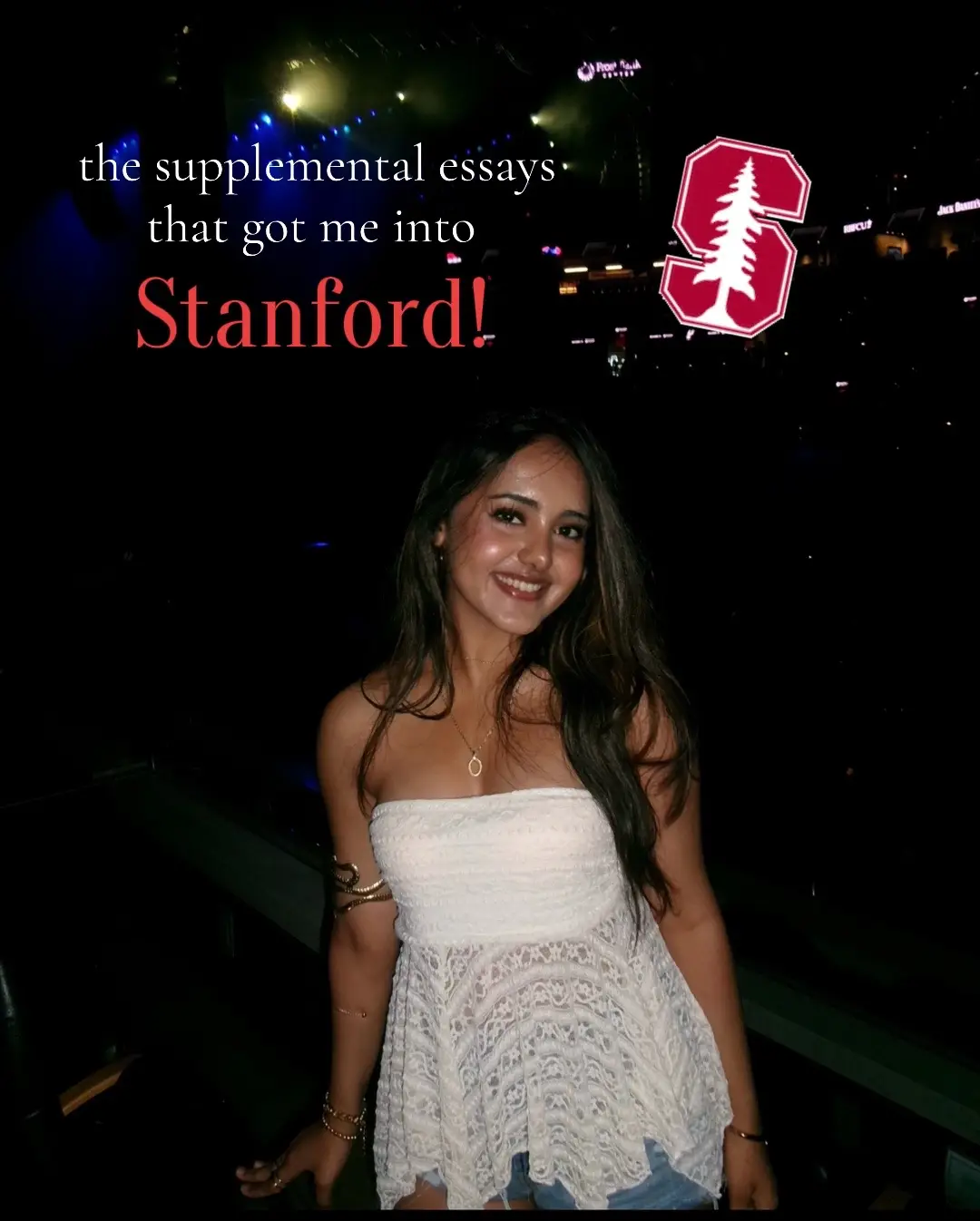
the supplemental essays that got me into Stanford!
@diyaamnk
1.4K followers · usually 20.3K views a post
Views
70.2K
Likes
7.0K
Comments
27
Shares
353
Why it worked
The creator shares personal, high-stakes content (college application essays) that resonates with a similar audience, offering a glimpse into a successful application process.
Summary
This TikTok slideshow features a young woman sharing the supplemental essays that helped her gain admission to Stanford University. The content includes the text of several essays, covering topics like public health interventions, historical moments in psychiatry, societal challenges, personal values, and summer activities.
Structure
- 1Introduction of topic: Stanford supplemental essays
- 2Essay 1: Eating disorder prevention program
- 3Essay 2: Witnessing the unveiling of DSM-III
- 4Essay 3: Societal challenge of procrastinating prevention
- 5Essay 4: Five important things to the creator
- 6Essay 5: Activities during the last two summers
Product placement
Stanford University: (b) merely APPEARS — a university logo is visible in the background. Removing it would not change what happens in the video.
On-screen text
the supplemental essays
that got me into
Stanford!
The Stanford community is deeply curious and driven to learn in and out of the classroom.
Reflect on an idea or experience that makes you genuinely excited about learning.
(230/250 words)
Four hours. In just four hours, we can prevent 63% of future eating disorder cases.
While organizing my school's first eating disorder intervention, I was struck by the
simplicity. With four one-hour group discussions, this empirically supported program
achieved what years of traditional treatment approaches struggled to accomplish.
Could the solution to this public health crisis really be so simple?
I had to find out. I emailed Dr. to learn how I could implement the intervention at my
own school. But as I trained alongside other interns, a challenge repeatedly surfaced: high
schools struggled to adopt the program. I ran into similar barriers when I tried to facilitate:
Schedules were tight. Teachers were overwhelmed. And, getting students to discuss the "thin
ideal" was harder than I thought.
Four hours, I learned, were deceptively complex in practice. I shifted my focus on how the
program could be realistically implemented. Sitting through classes, I suddenly saw a pattern:
nearly every lesson was delivered through Google Slides. Could the be delivered
the same way? That question led me to adapt the intervention into a four-lesson curriculum,
translating its script and activities into slideshows and Kahoot games.
At Stanford, I'm eager to continue exploring the challenges of prevention and intervention,
working alongside Dr. to ensure those four hours are sustainable and accessible in real
schools and communities.
What historical moment or event do you wish you could have witnessed?
(43/50 words)
In 1980, the DSM-III was unveiled as psychiatry's new Bible. With one stroke, the blurred
human continuum of mental illness was confined within neat categories. I want to witness that
paradox, clarity built on omission, to find the gaps within its rigid boundaries.
What is the most significant challenge that society faces today?
(48/50 words)
Procrastinating prevention. Early intervention saves lives, but our energy is spent fixing disasters
we could have stopped. Even when we notice warning signs, we act only when collapse leaves
no other choice. The science is clear: prevention is easier and more cost-effective. It's the cure
we have forgotten.
List five things that are important to you.
(43/50 words)
FaceTiming my grandpa, his familiar "Baba here," shrinking the 14,000 miles between us, the
serenity of pixelated Minecraft music while I study, opening the fresh pages of a new journal,
creating handmade birthday gifts, watching someone learn to believe in themselves again.
How did you spend your last two summers?
(46/50 words)
2024: Co-developed ANAD's School Ambassador Program. Supported 30 chapters across 18
states. Increased leg press to 210 lbs.
2025: Researched disparities in cancer treatment. Distributed 988 Lifeline bookmarks to
libraries. Trained to become a Body Project facilitator and led PRIORITIES intervention groups.
New PR: 340 lbs.
Original caption
i read so many books on how to write college essays, and even now there are still so many things i’d change. but i remember how much reading accepted essays helped me when i was applying, so i hope sharing mine helps someone else too! good luck :))) #stanford #collegeadmissions #stanforduniversity #collegeacceptance #universityacceptance
More from @diyaamnk
More breakout videos from this creator.