On-screen text
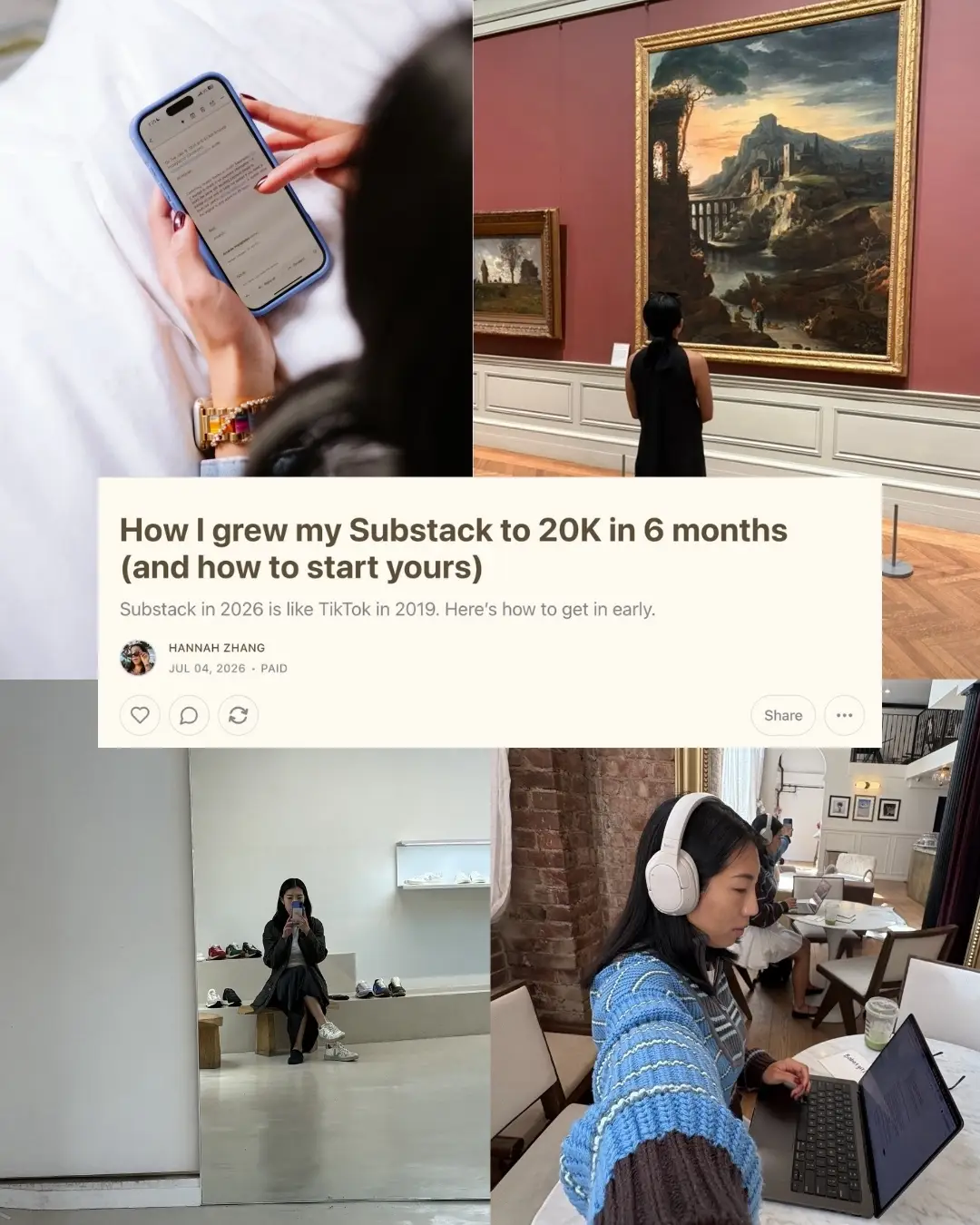
How I grew my Substack to 20K in 6 months
(and how to start yours)
Substack in 2026 is like TikTok in 2019. Here's how to get in early.
HANNAH ZHANG
JUL 04, 2026 • PAID
NONLINEAR NEWS
Substack in 2026 is like TikTok in 2019.
20K on Substack feels like 200K on Instagram.
The platform crossed 5 million paid subscriptions last year, up 67% year over year, More than 50 writers now make over $1M a year from paid subscriptions alone. When TikTok was stuck in its US legal limbo, Substack put up a $200M fund just to poach creators off it. Charli XcX started a Substack last November and pulled in around 12,000 subscribers in a single day.
The money from just "writing words" adds up. A New York Magazine salary survey this March found that an anonymous fashion Substacker making $275,000 a year, most of it from brand partnerships, vs. a NY Times bestselling author in the same survey made only $49,000. Emily Sundberg's Feed Me has 150,000+ readers and the New York Times estimated she pulls in over $400,000 a year from subscriptions (when she only had 60,000 readers), before any brand money.
HannahZhang
NONLINEAR NEWS
In an AI world, Substack feels like the analog of digital.
We're a couple years into the AI slop flood, so the internet is full of generated content that all sound the same. People are tired of short-form content on top of that, to the point that "brain rot" went from a meme to a term in the Oxford dictionary. The reaction has been a swing back toward analog and in-person. CNN ran a piece this January on people "committing to the analog lifestyle" out of AI fatigue, film photography is in a full revival, and run clubs and dinner clubs are more popular than ever.
Substack feels like the analog of the digital world: a real person's voice, long-form, an audience you own (for the most part, and for now) instead of rent from an algorithm. In a feed full of AI slop, a human writing like a human is what stands out. It feels like blogging in the 2010s, except with built-in distribution and less cringey photos.
Substack offers something for everyone. On one end you have Lenny's Newsletter, a product and tech focused audience, over a million subscribers and more than $1M a year. On the other you have Maybe Baby and Morning Person, much more personal and culture focused. There's room for almost anything in between.
HannahZhang
NONLINEAR NEWS
My story with Substack
I had a newsletter before this one that was a weekly list of jobs that my assistant helped curate because I wanted an email list but didn't want to do any work. It drove some growth but no trust, because a jobs list is a utility. Nobody learned anything about me from it.
I started writing seriously around the end of last year. Since then it's become my favorite creative practice and the most trust-building thing I do with my audience. Someone has to consciously decide to sit down and read a long thing I wrote. That's a completely different relationship than someone double-tapping a reel. I've also gained over 2,000 subscribers from Substack alone and even had a post get over 1,000 likes!
It's also the channel that gives me the most clarity behind the scenes on the business and brand I'm building, so I'm probably underestimating the other ripple effects it has on helping me grow.
HannahZhang
NONLINEAR NEWS
Who should start a Substack
The simple answer first: you should start one if you like to write, or want to become a better writer. If you'd rather make videos, go make videos. A newsletter you don't enjoy writing becomes drudgery fast.
But let me get more specific, because "do you like to write?" is too broad to be useful. Start a Substack if:
• You were on the school newspaper, or wanted to be.
• You wrote fanfic at 1am on a school night.
• You maintained a blog that no one read but you still loved writing.
• You're an introvert with a lot of thoughts and opinions, and you want a way to put yourself out there that doesn't involve a camera (at least not at first).
• You actually like to journal.
• You get a little thrill from writing an exceptionally well-worded email.
• You're building something you want to share the behind the scenes story of what you're building.
• You want to get better at writing and thinking clearly, which sharpen each other.
• You have tactical, long-form, how-to knowledge that doesn't fit into shorter formats.
HannahZhang
NONLINEAR NEWS
How to start
1. Define your brand and position yourself
First, get clear on your brand. Know what's behind the writing before you write a word: a personal brand, a newsletter brand, or your business or product's brand. The principles are the same for all three. If you're not sure what yours is, I've written a lot about positioning and personal branding before, including a free starter kit and this Substack post, so I won't repeat all of it here.
Then, get specific about who you're writing for. Before you decide what goes on your About page, get clear on one very specific person. Start broad, like "ambitious people in their 20s and 30s exploring paths outside corporate," then narrow all the way down to a single person: "Alex, an Ivy League grad and product manager building her personal brand outside her 9-5."
HannahZhang
NONLINEAR NEWS
2. What to write without forcing yourself into a niche
If you're reading this, you're interested in creating content, and you've probably looked at doing it on other platforms. Which means you've likely heard the term "content pillars."
Here's a secret. I had content pillars for maybe the first six months I made content. Now I roughly hold them in my head, I don't have them written down, and I don't always stick to them.
But for Substack especially, I have none, not even in my head. I always have a lot of ideas and I'm always mapping things out, and none of it rolls up into neat "pillars".
HannahZhang
NONLINEAR NEWS
3. How to write something people actually read
To write well on Substack, you have to be part journalist, part essayist. The journalist part is the craft that gets the right person to click and read all the way down. The essayist part is the voice and the substance, and it's the harder one to get right.
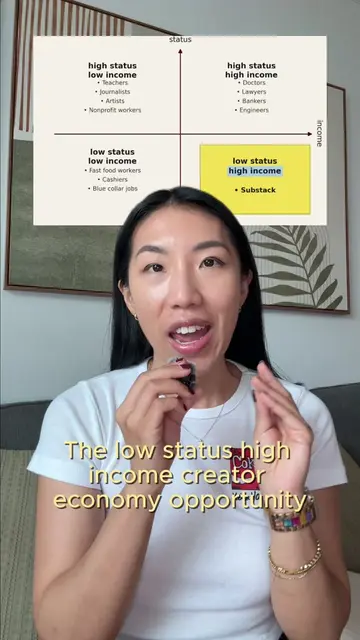
The journalist part: nail the headline first. Write your title and subtitle before anything else. It's your hook, the same job the first line does in a reel or a LinkedIn post. Would this make your "Alex" click? Is there a clear promise or a curiosity gap? Am I using distinct words she doesn't see everywhere (a few of mine are "low status, high income" and "nonlinear")? I'll have AI spit out 10 title options, pick the best, and tweak the wording. Substack lets you A/B test titles, and I always do.
HannahZhang
NONLINEAR NEWS
4. How to grow without waiting to go viral
The #1 thing that has grown my Substack is consistently producing content good enough that people like it, share it, and send it in group chats. You can distribute low-quality content all day and rack up views, but it won't convert anyone into someone who wants to keep reading. It's dead on arrival.
That said, don't sit around waiting to "go viral on Substack." Substack is a little different from LinkedIn or Instagram. It has some built-in distribution, and the platform is getting more algorithmic, especially through Notes. But at its core it's long-form, and the posts themselves don't travel as far on their own. After six months of writing, I've had exactly one post crack 1,000 likes natively.
HannahZhang
NONLINEAR NEWS
5. How to make money (the 4 ways)
1. Paid subscriptions:
The most direct one, and the thing you're paying for if you're reading this far! Substack lets you put some or all of your posts behind a paywall, set a monthly and annual price, and it handles the billing. My own approach is to keep most of what I write free and gate only a handful of high-value guides, because for me Substack is mostly about building trust and engagement. Even doing very little paid content, I make over $1,000 a month from paid subscriptions.
The math on paid subscriptions is friendlier than people think: 3,000 subscribers, a 5% conversion rate, $10 a month, and you're at $1,500 a month.
HannahZhang
Parting words...
Growth doesn't happen overnight on any social media platform, especially not Substack.
I imported a scattered email list into Substack over a year ago and sent out a weekly jobs list to mostly crickets for months.
I started writing consistently every week last November. It took me almost a year to get here.
Jot out your welcome page this week. Write your first essay and treat it like what it was meant to be - an attempt. And iterate from there.
go to nonlinearnews.com to read the full post!
HannahZhang