Loading video…
The creator

@mathandcobb
Álvaro Lozano-Robledo · 263.8K followers · 6.2M likes
Promotes 1 product. Create free account to see more.
Usual views
8.6K
Outliers
18
Viral hits
3
Outliers and viral hits: their videos on Overshot, all time.
We didn’t find a product being promoted in this video. Its hook, format and structure below still show why it took off.
Browse products winning on TikTokThe video uses a high-stakes, technical 'breaking news' hook about a famous mathematical conjecture, which immediately captures the attention of math and programming enthusiasts.
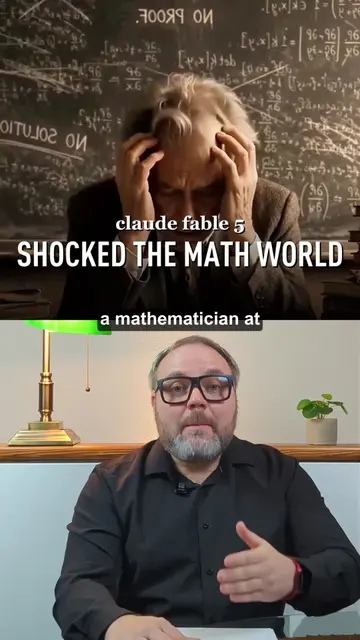
The creator explains a recent incident where a false proof of the Collatz conjecture was verified by the Lean theorem prover due to a bug in its kernel. He discusses how the bug was identified and fixed, and reflects on the implications for the Lean community.
The Collatz Conjecture was FALSE, formally verified false in Lean, for 2.5 days in July. The "proof" was not a proof, it was just an exploit of a bug in the Lean kernel. Let's go over what happened! #math #mathtok #ai #lean #collatzconjecture
Promotes 1 product. Create free account to see more.
Outliers and viral hits: their videos on Overshot, all time.
Breaking news, the Collatz conjecture was false.
Introduction to the false Collatz proof
Explanation of the Lean kernel bug
Details on the verification process and the bug fix
Speculation on the role of AI in finding the vulnerability
Closing thoughts on the Lean community and project
The video mentions Lean, a programming language and proof assistant, but it is the subject of the educational content, not a product being sold.

Playing this video’s own audio, so you’ll hear the creator over the sound.