Loading video…
All breakouts
132Text-HeavyOther hookEducation
Hook
Jon Brooks @jonbrooks
@ethanscarellc
8.3K followers · usually 956 views a post
Views
110.8K
Likes
422
Comments
728
Shares
24
Why it worked
The post tapped into a current economic trend and demographic shift, presenting a clear and concise argument that resonated with a broad audience concerned about housing markets and generational differences.
Summary
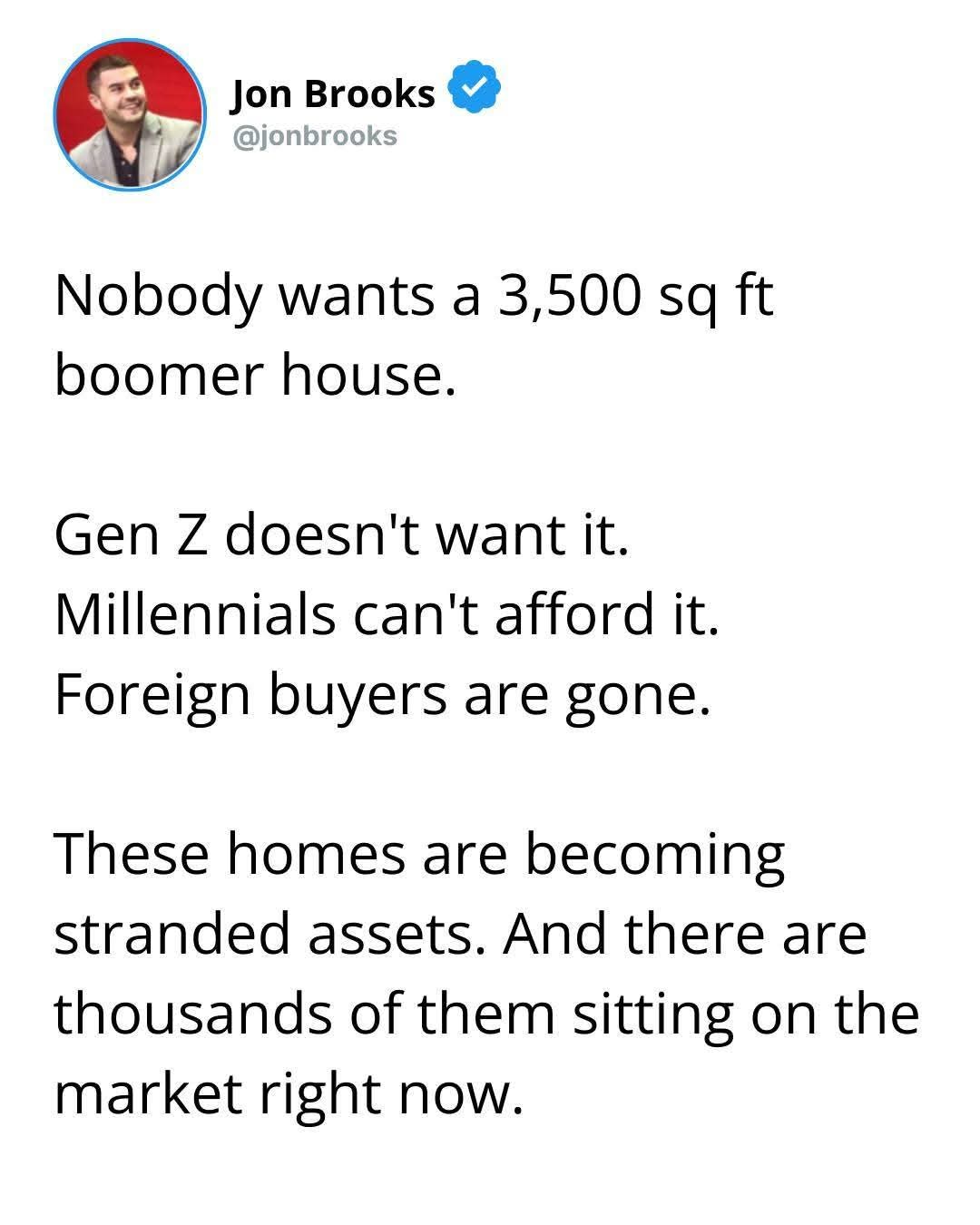
The post argues that large, "boomer" style houses are becoming undesirable and unsellable. It explains that Gen Z doesn't want them, millennials can't afford them, and foreign buyers are gone, leading to these homes becoming stranded assets.
Structure
- 1Introduction of the problem: nobody wants large "boomer" houses.
- 2Reasons why: Gen Z doesn't want them, millennials can't afford them, foreign buyers are gone.
- 3Consequence: these homes are becoming stranded assets.
- 4Scale of the problem: thousands are sitting on the market.
On-screen text
Jon Brooks
@jonbrooks
Nobody wants a 3,500 sq ft
boomer house.
Gen Z doesn't want it.
Millennials can't afford it.
Foreign buyers are gone.
These homes are becoming
stranded assets. And there are
thousands of them sitting on the
market right now.
Original caption
Demand for oversized suburban homes is collapsing because the groups who used to buy them either don’t want them, can’t afford them, or no longer exist in the same numbers. Supply is rising as boomers age out of homeownership, leaving a mismatch that the market can’t absorb. Gen Z’s preferences are fundamentally different: They prefer walkable, urban, amenity-rich environments. They don’t want long commutes. They don’t want high-maintenance homes. They don’t want to furnish or heat/cool 3,500 sq ft. They value flexibility, not “forever homes.” To them, a giant suburban house feels like a liability, not an achievement. Millennials are the largest homebuying cohort, but: 1. Wages didn’t keep up with home prices 2. Childcare costs exploded 3. Student loans remain heavy 4. Mortgage rates doubled 5. Down payments are harder to save 6. Inflation hit everything from insurance to utilities A $900k–$1.2M boomer house is simply out of reach for most. Even high earners hesitate because the carrying costs are enormous. Foreign capital used to be a major demand driver for large suburban homes, especially: Chinese buyers, Canadian buyers, Middle Eastern buyers, Latin American buyers But: Capital controls tightened. Geopolitical tensions rose. U.S. real estate became less attractive. Interest rates made cash deployment less appealing. Some states passed restrictions on foreign ownership. That demand evaporated. A stranded asset is something that used to have high value but no longer has a viable buyer base. Large suburban homes fit that definition in many metros: 1. Boomers are aging out and selling. 2. Millennials can’t afford them. 3. Gen Z doesn’t want them. 4. Foreign buyers are gone. 5. Investors don’t want illiquid, high-maintenance properties. 6. Families are smaller — fewer kids, fewer multigenerational households. So you get thousands of listings sitting stale, especially in: Phoenix suburbs, Las Vegas suburbs, Dallas exurbs, Atlanta exurbs, Midwest commuter belts, and Florida non-coastal interior markets. These homes were built for a demographic reality that no longer exists. The problem isn’t just price — it’s function.
More from @ethanscarellc
More breakout videos from this creator.