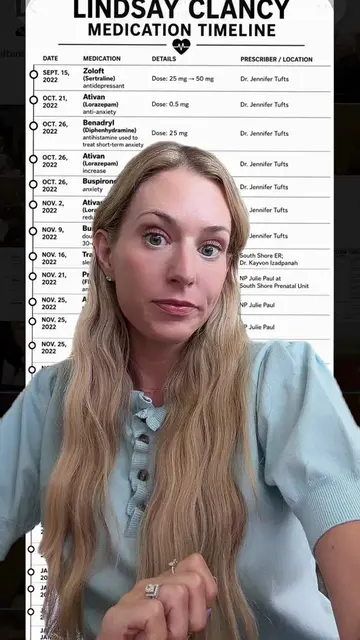
This is not the baby blues. This is not the baby blues. I'm a forensic scientist and a former CSI and in a lot of videos about Lindsay Clancy, I have seen comments in my comment section, including some from women saying that Lindsay wasn't experiencing psychosis, she just had the baby blues or she was having a hard time after pregnancy. Let's look through the lawsuit and the legal documents together so we can understand what was actually happening to Lindsay. Now, we know that Lindsay had three children. Ultimately, she killed them all. After her first pregnancy, she did okay. She experienced some anxiety but was generally normal. Things went a little bit stranger after her second birth, where after the second child, Lindsay was elated and had increased energy. Patrick described that she had manic behavior for multiple days. In October 2020, she had an episode of decluttering to simplify her life, obsessively cleaning and discarding items. She said she felt "amazingly on top of things." Her thoughts raced, and she couldn't get out of bed. She was also experiencing extreme insomnia, averaging only three hours per night, and having racing thoughts. Nurse Paul prescribed Prozac on November 21, 2022. After merely four days on Prozac, Lindsay reported that the medication intensified her insomnia. She immediately informed her providers and the Prozac was discontinued. This was the second antidepressant that had caused activation and worsening insomnia—a critical red flag for bipolar disorder that the providers failed to recognize. On November 25, 2022, Nurse Paul prescribed three different medications: Ativan, Remeron, and Klonopin. On November 26, 2022, after taking Remeron, Lindsay experienced dissociation—perceiving the world around her as unreal, distorted, and distant. She was unable to determine what was real. She became disoriented, forgetful, confused, and disconnected from her own body. She was unable to drive and unable to be alone. Lindsay reported these alarming symptoms to her providers on November 28, 2022, noting that she was still struggling, sleeping only three to four hours, and feeling disoriented and forgetful. On November 29, 2022, Lindsay began treating with Nurse Jolietta. Lindsay reported that she was "anxious and frightened about what is happening" and that she blamed herself. Nurse Jolietta correctly considered a bipolar presentation and prescribed Seroquel, an antipsychotic and mood stabilizer. After starting Seroquel, Lindsay's condition took a dramatic turn for the worse. She developed suicidal ideation and began experiencing what she described as "intensive thoughts"—which were actually auditory hallucinations. The voice said, "I will not be the same. I want to die." Lindsay openly communicated her escalating internal turmoil to her husband, her parents, and her providers. She described her emotional state as "emotionless" and "like a zombie," attributing this profound affective blurring to the Seroquel. She lost fifteen pounds in a month, had no motivation, and reported that "it takes all the effort in the world just to breathe." She can't feel love, that her life is becoming a disaster. She said she had no specific plan as to how she would kill herself. On December 2, 2022, Lindsay reported to Nurse Jolietta that she had lost fifteen pounds, had no appetite, was experiencing panic attacks and confusion, and had a lack of attention over the past four days. On December 4, 2022, Lindsay was so frightened by the hallucinations that she called the New Bedford Suicide Hotline seeking help. She was told there was no emergency because she said she had no specific plan as to how she would kill herself. On December 5, 2022, Lindsay met virtually with an ASPIRE Crisis Support clinicians, again seeking help. She was told that she did not meet the criteria for inpatient treatment because she did not have a suicide plan. On December 6, 2022, Patrick attended an appointment with Lindsay and Nurse Jolietta. Patrick connected Lindsay's suicidal thoughts to the Seroquel. He told Nurse Jolietta that "Lindsay is ten thousand times worse since she has taken medication" and asked if they could "get Lindsay off medications and start from scratch to see what is going on." He asked if there could have been some mistake, like using the wrong medications. Nurse Jolietta acknowledged "it is possible." Despite this, Nurse Jolietta continued to increase the Seroquel dosage toward 400 mg per day. On December 13, 2022, Lindsay remained deeply depressed, had no motivation, and still had suicidal ideation. She wanted "this to be all over." On December 15, 2022, Patrick called Nurse Jolietta's office to report that "Lindsay has had a devastating week" and that "it was the worst day for Lindsay. She had HORRIBLE thoughts all day. Lindsay had auditory hallucinations all day, every day. She felt debilitated, not interested in anything, exhausted, and could not get out of bed. The hallucinations were loud and emotional all day, saying, "I will never be the same," "I will never be me again," and "You are damaged. You will never be the same. The only option is to die." On January 3, 2023, the doctor advised Lindsay to stop Seroquel and benzodiazepines and prescribed Trazodone for sleep. On January 4, 2023, Lindsay asked if she could go home for Cori's birthday. Because her thoughts had improved, she was approved for discharge. She's also prescribed another antidepressant, amitriptyline, the fact that she'd previously on antidepressants, she'd have really severe reactions. When she gets at Cora's birthday party, she's really struggling. She can't make sense of what others are saying. The hallucinations are back to her doctor, she's put on Valium and the hallucinations are getting worse. To harm the children and to kill herself. The day before the homicide, January 24th, she meets with her care team again. She tells her doctor that she's more anxious and her doctor makes note that she is flat, anxious, has no motivation, numb, and has to force herself up out of the house. Her sleep and medication efficacy were poor, her insight was poor, and her psychiatric condition was unchanged. Dr. Tuffs increased the amitriptyline to 20 mg per day. That night, Lindsay did not sleep. The next day, January 24th, she murders her three children. I'm running out of time, so I'll have to make another video covering what happens on January 24th. But up until this point, I mean, all the red flags and everybody was just ignoring them. When she gets out of the hospital, she's really struggling. She can't make sense of what people around her are saying. The hallucinations are back to her doctor, she's put on Valium and the hallucinations are getting worse to harm the children and to kill herself. On January 23rd, during her seventeen-minute appointment, Lindsay reported being "a little more anxious" with heart racing and "more AM anxiety." Dr. Tuffs recorded that Lindsay's mood is the same flat/anxious, that she had "no motivation, numb, and "has to force herself up, out of the house." Her sleep and medication efficacy were "poor," her insight was "poor," and her psychiatric condition generally was "unchanged." Dr. Tuffs increased the amitriptyline to 20 mg per day. That night, Lindsay did not sleep. On January 24th, she meets with her care team again. She tells her doctor that she's more anxious and her doctor makes note that she is flat, anxious, has no motivation, numb, and has to force herself up out of the house. Her sleep and medication efficacy were "poor," her insight was "poor," and her psychiatric condition generally was "unchanged." Dr. Tuffs increased the amitriptyline to 20 mg per day. That night, Lindsay did not sleep.