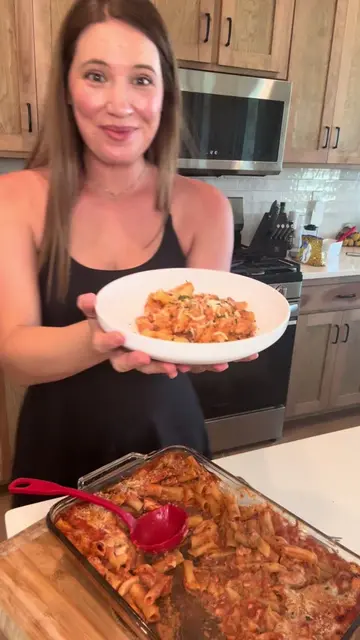
Number two. Pasta that never sees a pot. This one people do not believe until they do it, and then they do it every week. Raw pasta. Straight in the pan dry. No boiling, no draining, no colander in the sink. Into the pan dry. About a cup and a half of short pasta, the penne or the rotini, nothing long. A jar of pasta sauce, about a cup and a half of it. Then fill that same amount again with water, so roughly a cup and a half of water on top of the sauce. That water is not optional. That is what cooks the pasta. Stir it once with a fork so every piece of pasta is under the liquid. Cover it. Four hundred degrees, thirty five minutes covered. Then foil off, cheese over the top, and ten more minutes. It comes out like a baked ziti and you never boiled water. And the pasta soaks up the sauce while it cooks instead of sitting in it, so it tastes more like the sauce than boiled pasta ever does. The one way to get this wrong is not enough liquid. If you are unsure, add a splash more water. Too much and it is a little loose and it still tastes right. Too little and the pasta stays hard, and there is no fixing hard pasta. Use the short shapes. Penne, rotini, shells, elbows. Spaghetti and the long ones do not work because they will not sit under the liquid and the ends that stick out go hard and sharp. And a thing worth knowing. Put a few spoons of ricotta or cottage cheese in dollops on top before the foil goes on, and it turns into something close to a lasagna without a single layer being built. That is the version I make when somebody is coming over. If you have got a handful of spinach, frozen or fresh, push it down in there too. It disappears completely and nobody ever knows. Number three. Chicken thighs over potatoes and carrots. Chicken thighs, bone in, skin on. Not breasts for this. Breasts dry out and thighs do not, and thighs are cheaper, and on a bad week that matters. Bottom of the pan first. Baby potatoes and a handful of the baby carrots out of the bag, the ones for snacking, which you do not cut either. A spoon of that frozen onion. Half a cup of broth or water. Lay one or two chicken thighs skin side up right on top of the vegetables. Salt, pepper, paprika, whatever seasoning you like, rubbed on the skin. Now here is the one that is different. Foil on tight for thirty five minutes, then foil off for twenty five more at four hundred degrees. That longer uncovered stretch is for the skin. Under the foil the chicken steams and the vegetables cook in the broth and the chicken fat. Uncovered, the skin dries out and goes crisp and gold. And all that fat has been dripping down onto the potatoes the whole time. There is nothing on this list that looks more like somebody cooked for you than this one, and you did not touch a knife. A word on the thighs. Two of them is a lot for one person, so buy the pack, cook one or two, and put the rest in the freezer the day you bring them home. They freeze well and they thaw overnight in the icebox. And save every bit of the fat and juice in the bottom of that pan. Spoon it over the potatoes when you plate it up. That is the gravy and it made itself. If the skin is not as brown as you want it at the end, put it under the broiler for two minutes and stand there and watch it. Number four. Pork chops and stuffing. This is the old church supper one and it takes about two minutes to put together. Into the pan goes the stuffing mix, about half the box, and the water the box says for that half, poured right over it. A scoop of that frozen onion mixed through it. Then lay a pork chop on top and season it. Some people put a little cream soup over the chop and some do not. Both are good. Cover it tight. Three hundred seventy five, forty minutes covered, then uncovered fifteen minutes. The stuffing under there soaks up the pork juice as it cooks, which is the entire reason this dish exists. And a boneless chop of a normal thickness is cooked through well before forty minutes, so you are not risking it. Half a box of stuffing is about the right amount for that pan, and the rest of the box keeps in the cupboard for the next time. Use less water than the box tells you, about a quarter less. The box is written for stuffing cooked on its own on a stove. In here the pork is going to give up its own juice into it, and if you use the full amount of water you get a wet layer at the bottom. Apple is the thing that makes this taste like somebody's grandmother made it. A few slices of apple tucked into the stuffing, or a spoon of applesauce stirred through. Pork and apple have been going together for about four hundred years and there is a reason. And this works exactly the same with a chicken thigh instead of the chop if that is what is in the freezer.