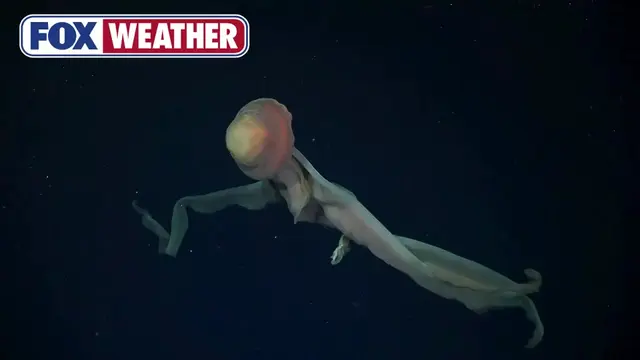
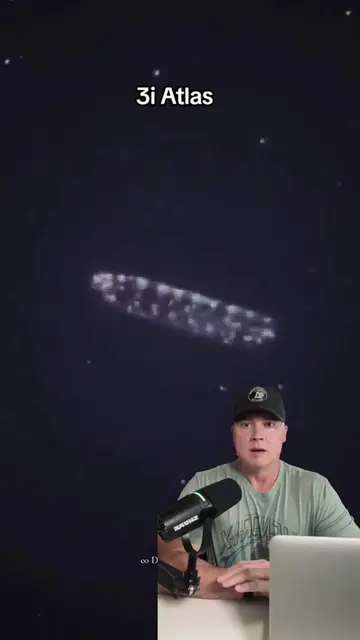
The final frontier might be coming to us. A strange object is speeding through the solar system, and it's leading to more questions than answers. Yeah, but we have the man with the plan with those answers. Professor of Science at Harvard University, Avi Loeb, joins us now to discuss this extraterrestrial object, and great to have you with us as always. Let me jump into it. What's your take on this object? Thanks for having me. Well, comet experts argue that it's a dark comet because there is a non-gravitational force acting on it, something that is not gravity that is pushing it, and they don't see any gas or dust coming off it. So they say it's a comet, but we can't see any signs of a comet, so it's a dark comet. And what we noticed is that this object, in fact, follows the same trajectory as a lost Soviet mission, Phobos 1 from 1988. And in fact, observations of this object indicated that it's very shiny. It reflects half of the sunlight that is impinging on it. It's roughly 10 meters in size, comparable to the Phobos 1 spacecraft, and we calculated that just the reflection of sunlight is giving it the push that is observed. And so everything fits. However, the comet experts, the mainstream of the astronomy community, still believes it's an iceberg, and they want to visit it. So the Japanese Space Agency will land a spacecraft on this object in July 2031. This spacecraft is called Hayabusa 2, and our prediction is that when they land on it and look for all the properties of a very mysterious iceberg that has invisible gas coming from it, they would find out that there is a label made in the USSR on it. This is so fascinating. I just think about what it does it take to be able to, you know, you see this object in space, and then you're able to identify exactly all those details that you just said. And if it was something that discovered in 1998, you said, why are we just now seeing it? Well, it has been monitoring on and off, but now there is this plan to visit it and learn more about it because it's a dark comet. Now, the reason the dark comet concept was invented is because of another visit of an object from outside the solar system called Oumuamua that was discovered in 2017. Again, showed non-gravitational acceleration without any outgassing, no gas or dust around it. So then the comet experts argued Oumuamua is a dark comet, and I said, well, maybe it's the sunlight pushing it. And therefore, maybe it is a technological object because the object had to be very thin, unlike any rock that we are familiar with. And so to me, it would be a teaching moment if we visit this particular object and find that it's technological because it was launched by the Soviets. Maybe Oumuamua was launched by an alien space agency from another star. Oumuamua, and you also mentioned Hayabusa 2. Now, you're saying, and correct me if I'm wrong, when you say this is being propelled, you're saying that the sun's energy could be propelling this these objects? That's how they move. Yes, pushing it, just like consider a sailboat that has a sail, the sail is being pushed by the wind, reflecting off it. And in the same way, when sunlight reflects off an object that is sufficiently thin, you end up pushing it. And in the case of Phobos 1, this spacecraft, there were solar panels that were quite large and relatively thin that would give it the necessary push. That's fascinating. And then I think about this other thing that's pretty fascinating. So you were also tapped by the White House to lead the UAP Council, UAP meaning Unidentified Aerial Phenomena, and you also shared plans to develop this system of specifically designed telescopes. So tell us a little bit about that. Yes, in fact, a couple of days ago, I visited the Pentagon to discuss it. So when there were releases of files, videos of Unidentified Aerial Phenomena, these are objects, some of them look like orbs, glowing balls of light that do not resemble drones or other technological objects manufactured by humans. I came up with the idea a couple of months ago of a new observatory concept where there is a radar system monitoring the sky for these objects. Once an object of interest is identified, the idea is to have a large telescope, roughly a meter in size, steering in the direction of this object and taking a high-resolution image. We can, in principle, with a meter-scale telescope, resolve a green pea at a distance of a few kilometers. We can see, you know, passengers in an airplane. So that will give us a lot of information. But in addition, we'll have a spectrograph taking a spectrum of the object, and that would allow us to figure out its composition. So I came up with the idea, and within a couple of months, we have the funding for it. We are planning to put the first prototype observatory in the old residence of Carl Sagan in Ithaca, New York, and that would be a celebration of Sagan's legacy, but also my hope is to help the Pentagon, the intelligence community, fulfill their mission. You know, we will know if we are dealing with some black project from an adversarial nation that is spying on the US, or it might be something from outside of this world, you know, some alien technology, which would be the biggest discovery ever made by humanity. This is the most fascinating conversation, Avi, that I've had in a while. Okay, this is a little off-script, but I'm sure you've seen it. Have you noticed, you know, recently there was a jellyfish-like flying object we ran it here on FOX Weather yesterday. It was in Alaska. Did you, number one, have you seen that, and what are your thoughts? Yeah, in fact, there were reports already in the videos released by the Pentagon, and by the way, there were 3 billion views over the past 5 months of these videos. There is a huge interest in it by the general public. My tweet on this object that we just discussed received a million views within a day. And so there is huge interest, and the jellyfish objects were also reported before in the Middle East, in other locations where the military observes the sky for national security purposes, and every now and then they see something really unusual. And the type of objects that were reported are either jellyfish like you mentioned, or spherical orbs, these are glowing balls of light, or triangles. And all of these look strange, and I spoke with people at the Pentagon, and I asked them, why don't you assume that these are all human-made technologies? And they say, because, you know, the data is not consistent with that. Now, they don't have sufficient data to tell them that it's alien technology, not human-made. So the question is still open. We need better data, and that's what I'm aiming to get in partnership with them. I mean, it's such a topic of conversation, something like that. The fact that the the tweets and the video has had that many views, it just shows where the public's interest is. Well, this has been such an amazing conversation. It's great to have you back on the show, Professor of Science from Harvard University, Avi Loeb. Thank you for your time this morning. Thanks for having me, and when we have the answer, I'll be glad to speak with you again.