Loading video…
Sound

original sound - distilledscience
Avisha |🧬Scientist Mythbuster · Original audio
0:00–:––
Playing this video’s own audio, so you’ll hear the creator over the sound.
We didn’t find a product being promoted in this video. Its hook, format and structure below still show why it took off.
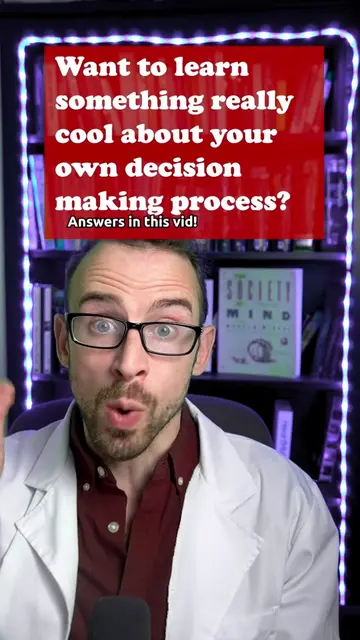
Browse products winning on TikTokThe video leverages a well-known cognitive riddle that challenges common assumptions, creating an engaging hook. It then provides a satisfying explanation and connects the riddle's solution to desirable traits like rational decision-making, making the content relatable and shareable.
This video explains the bat and ball riddle, a cognitive reflection task, and how it reveals a person's ability to suppress impulsive responses and make rational decisions. It highlights that those who correctly solved the riddle were more likely to make better financial choices, contrasting the results from a Princeton study with the video's audience.
Replying to @Avisha |🧬Scientist Mythbuster Do you agree with the initial premise, or do you think it’s more what I said at the end? I scored 25,000 of your comments across my "world's shortest IQ test" series (TikTok, Instagram, and Facebook) against the original research: Frederick, S. (2005), "Cognitive Reflection and Decision Making," Journal of Economic Perspectives 19(4). DOI: 10.1257/089533005775196732 What the study found: only about a third of people get the bat and ball right, the average score was 1.24 out of 3, and MIT students managed 2.18. People who miss don't miss randomly, they almost all give the same "intuitive" wrong answer. Strangest of all, the people who got it wrong rated the question as EASIER than the people who got it right. What you did: 🦇 Bat and ball: 85% correct this round, with only 12% saying ten cents. When I first posted this series to a colder, broader audience, it was 71% correct and 24% fell for the gut answer (n = 15,448). Same question, twice the trap rate. Audience is everything. ⚙️ Widgets: 88% correct (study samples ranged from roughly 25 to 48%) 🌱 Lily pads: 92% correct (about 32% in the study) 📊 Your average: 2.74 out of 3. You beat MIT. (Self-reported, and I warned you it would be tricky. The study handed it over cold: "Below are several problems that vary in difficulty.") 🎭 The weird part replicated too: commenters who answered wrong called it easy, commenters who answered right called it hard. The money predictions also held. Across 1,392 "would you rather" answers, perfect scorers were more patient (83% waited for $3,800 next month instead of taking $3,400 now), more willing to take the smart gamble (68% took the 15% shot at a million over a sure $500, versus 57% of low scorers), and less likely to take the dumb one (only 29% risked a 3% chance of losing $7,000 to dodge a certain $100 loss, versus 50% of low scorers). Exactly the pattern Frederick measured two decades ago. Platform bragging rights on the bat and ball: Instagram 87%, Facebook 86%, TikTok 83%. Nerds everywhere. Which one caught you? Be honest about the ten cents. 👇
IF YOU'RE SEEING THIS VIDEO...
Introduction to the bat and ball riddle
Revealing the common incorrect answer and the correct answer
Explaining the riddle as a measure of cognitive reflection
Showing how correct answers correlate with better decision-making
Comparing past results with current audience performance
Concluding with praise for the audience's improved performance
Playing this video’s own audio, so you’ll hear the creator over the sound.
Promotes 1 product. Create free account to see more.
Outliers and viral hits: their videos on Overshot, all time.