On-screen text
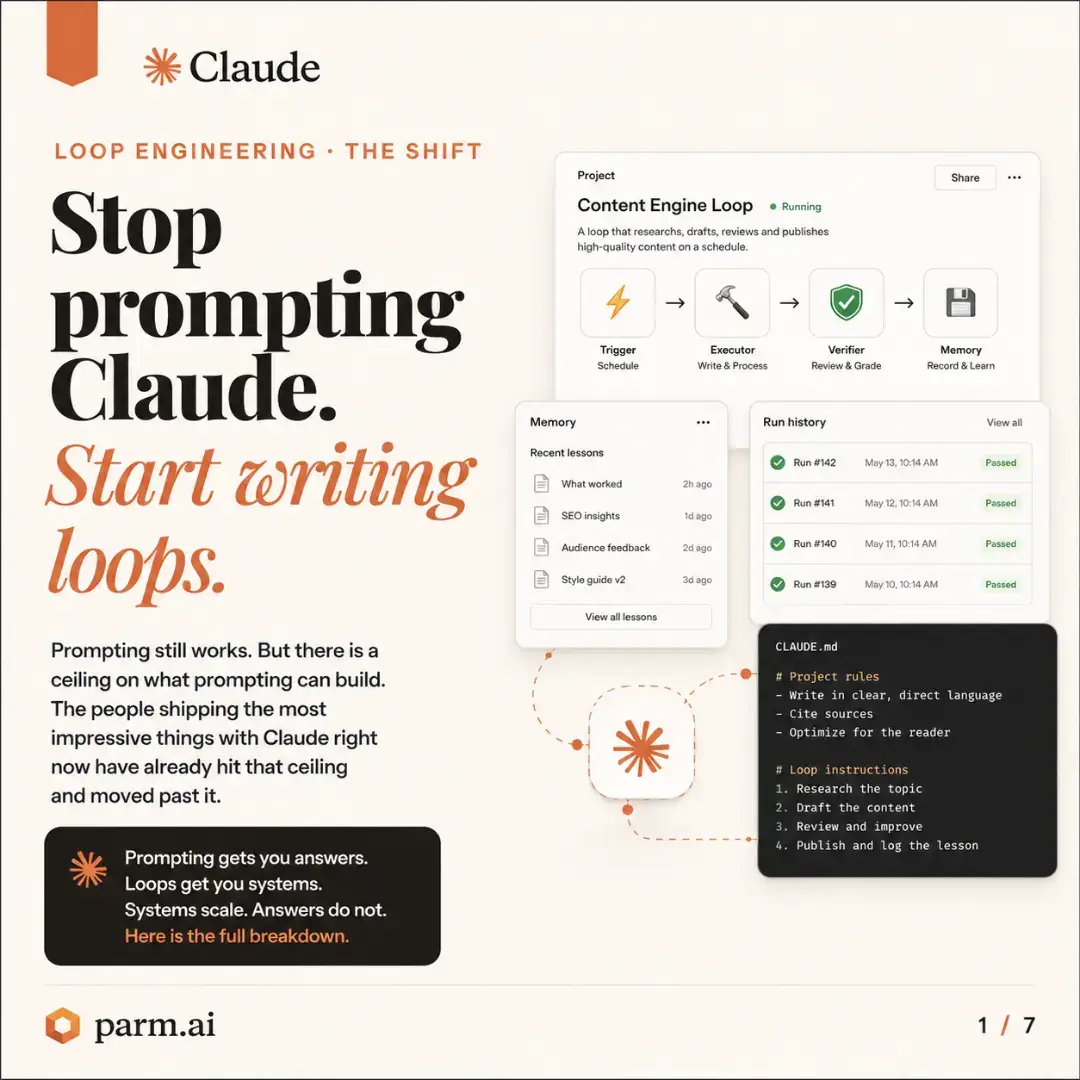
Claude
LOOP ENGINEERING • THE SHIFT
Stop
prompting
Claude.
Start writing
loops.
Prompting still works. But there is a
ceiling on what prompting can build.
The people shipping the most
impressive things with Claude right
now have already hit that ceiling and
moved past it.
* Prompts gets you answers.
Loops get you systems.
Systems scale. Answers do not.
Here is the full breakdown.
parm.ai
1/7
Claude
THE PROBLEM
When You Prompt Claude
— You Are the Loop.
PROMPTING
You type. You wait.
You read the output.
You decide next step.
You type again.
Scales with your attention
Stops when you stop
LOOP ENGINEERING
System triggers. Loop runs.
Executor does the work.
Verifier checks the output.
Memory writes the lesson.
Scales independently
Runs while you sleep
The shift in one sentence
When you prompt - you are the operator.
When you write loops - you are the architect. That is not a small upgrade.
That is a different category of work entirely.
parm.ai
2/7
Claude
WHAT A LOOP ACTUALLY IS
A System That Prompts
Claude on Your Behalf.
You define what the system does.
Then you step back and let it run.
Trigger - what starts a cycle. A schedule, a new file,
a failing test, a webhook. Something happens and the loop begins.
Rules Load - frozen knowledge from CLAUDE.md
and accumulated memory loads in. Cycle 40 knows what cycle 3 learned.
Executor - does ONE bounded unit of work. Not "make progress."
Fix the next failing test. Process the next 10 files. Specific.
Verifier - grades the output in a FRESH context.
Never the same agent. The maker cannot check their own work.
Memory Write - records progress and lessons.
The next cycle is smarter than this one.
Stop Check - done, escalate, park, or go again.
You decide when the loop ends. Not Claude.
parm.ai
3/7
Claude
5 LOOPS WORTH BUILDING NOW
Pick One. Build It This
Weekend.
The Review Loop
Trigger: a new PR. Output is a draft review
posted automatically. No prompt from you required.
Project
Pull Request Review Loop
Running
View run
Claude reviews every PR before a human sees.
Trigger
New PR
Executor
Review PR
Verifier
Grade review
Output
Post review
The Research Loop
Claude monitors a topic, reads new content,
extracts what is relevant, and validates a living
document. You define what matters.
The loop handles the reading.
Project
Knowledge
AI Research Monitor
Running
Updates: Daily at 8:00 AM
View page
Trigger
New content
Executor
Read & extract
Verifier
Validate insights
Output
Update doc
The Content Loop
Claude takes your raw notes or voice memos,
processes them through a structured workflow,
and outputs a draft ready for your review.
Runs on a schedule.
Project
Content Production Loop
Running
Schedule: Every Monday at 9:00 AM
View run
Trigger
Draft content
Executor
Draft content
Verifier
Quality check
Output
Draft doc
The QA Loop
Claude runs your test suite, identifies failures,
attempts fixes, verifies each fix in isolation,
and escalates what it cannot resolve.
You get a report not a task list.
Project
Automated QA Loop
Running
Trigger
Code push
Executor
Run tests & fix
Verifier
Verify fixes
Output
Report results
The Inbox Loop
Claude categorises messages, drafts responses
for known patterns, and surfaces only what
genuinely needs your judgment.
Your inbox becomes a decision queue.
Project
Inbox Triage Loop
Running
Trigger
New email
Executor
Categorise & draft
Verifier
Confidence check
Output
Decision queue
parm.ai
4/7
Claude
THE ONE RULE • NO EXCEPTIONS
The Maker Cannot Check
Their Own Work. Ever.
WHY THIS IS THE MOST IMPORTANT RULE
When a single agent evaluates its own output - it
confidently praises mediocre work. Every time. Without exception.
An independent verifier running in a fresh context with
a skeptical rubric catches what the executor missed.
It has no emotional investment in the output. It just checks.
In one Fable 5 experiment - an independent verifier
achieved 6x more pipeline improvement than self-critique on the same task.
Separate the maker from the checker. Always.
HOW TO IMPLEMENT THIS
1. Executor
Runs the task in
one conversation.
2. Output
Produces the final
artifacts only.
3. Verifier
Runs in a separate
fresh context.
4. Decision
Grades, flags issues,
and records results.
The verifier has never seen the executor's reasoning - only the output. That separation
is what makes the check honest.
parm.ai
5/7
Claude
HOW TO START TODAY
You Do Not Need Code to
Start. You Need These 4 Questions.
THE STARTING POINT
Pick the most repetitive Claude task
in your workflow. The one
you do the same way every time. The
one where you already know what good
output looks like.
Claude Projects
Content Engine Loop
Running
Overview Knowledge Instructions Activity Settings
Loop overview
Trigger
Executor
Verifier
Memory
Mon 9:00 AM
Write & Process
10 files
Review & Grade
quality rubric
Record & Learn
lessons saved
Recent runs
Run #142
May 13, 10:14 AM
Passed
Run #141
May 12, 10:14 AM
Passed
Run #140
May 11, 10:14 AM
Passed
View all runs
Memory
What worked
SEO insights
Audience feedback
Style guide v2
View all lessons
YOU DO NOT NEED CLAUDE CODE TO START
You can run your first loop manually inside Claude Projects using structured conversation flows.
The architecture matters more than the tooling at the start. Get the design right. The automation follows.
parm.ai
6/7
Claude
THE LOOP ENGINEERING SHIFT
Prompting Gets You Answers. Loops Get You Systems.
Prompting - you are the loop. Stops when you stop.
Loops - system runs. You are the architect not the operator.
Executor - does one bounded unit of work. Always specific.
Verifier - always a separate agent. Never self-grade.
4 questions - trigger, knowledge, output, quality check.
Start in Claude Projects. No code required to begin.
THE SHIFT THAT MATTERS
Most people will read this and go back to prompting. That is fine.
But the people who build the next generation of
Claude-powered systems will be the ones who started writing
loops this weekend.
parm.ai
7/7