Loading video…
All breakouts
65.9Talking HeadOther hookHealth
Hook
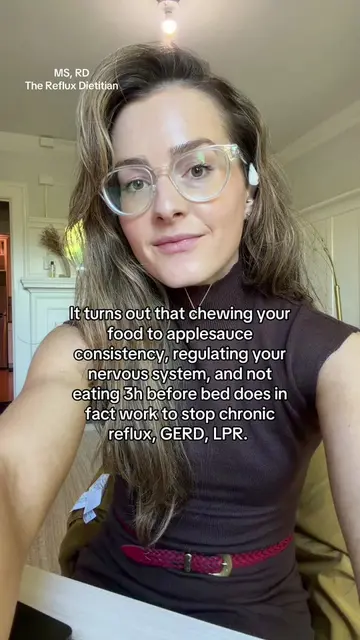
MS, RD The Reflux Dietitian
@mollypelletier.rd
319.2K followers · usually 2.8K views a post
Views
189.1K
Likes
1.4K
Comments
74
Shares
566
Why it worked
The video likely resonated with viewers experiencing acid reflux by addressing a common and frustrating symptom (water causing reflux) and promising a solution, tapping into a relatable health concern.
Summary
The video features a dietitian discussing acid reflux. The on-screen text indicates that even water can cause acid reflux and promises to explain why and what to do about it.
Structure
- 1Introduction of the problem: water causing acid reflux
- 2On-screen text explaining the issue and promising a solution
On-screen text
MS, RD
The Reflux Dietitian
When even water starts
giving you acid reflux
Here's why & what to do ⚡️
Original caption
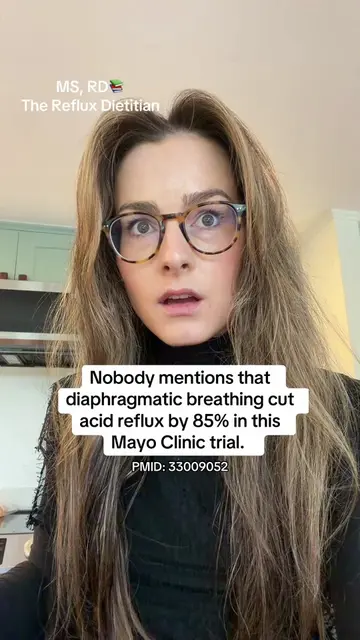
Water is pH neutral. So when a sip leaves your throat burning, it feels like your body has stopped making sense. That fear is real, and it is not in your head. In practice, water burn traces back to one of three root contributors. Rarely the water itself. 1. Underlying inflammation When the mucosa lining your throat or esophagus is already irritated, the tissue is sensitized. Nerve endings that normally sit quiet beneath an intact barrier are exposed. Neutral liquid still makes contact with a raw surface, and a raw surface reads contact as burning. This is barrier mechanics, not a water problem. 2. Visceral nerve hypersensitivity Sometimes the tissue is calmer than the sensation suggests, and the driver is the nerves themselves. Esophageal nerves become hypersensitive and start reading harmless input, like a swallow of water, as pain. Your vagus nerve, the gut-brain communication highway, sits at the center of this. A system stuck in a threat state amplifies sensation. 📚 A prospective study of 269 patients in the American Journal of Gastroenterology (Wong et al., 2023, PMID 36693025) found that esophageal hypervigilance and symptom-specific anxiety may matter more to how LPR symptoms are perceived than reflux burden itself. 3. An under-supported LES Your lower esophageal sphincter is not broken. It is under-supported. A large volume of liquid distends the stomach, and gastric distension is one of the strongest triggers of transient LES relaxation. So the burn is not the water going down. It is what the water displaces coming back up, carrying acid and pepsin with it. What we actually do about it: 🌿 Support the nervous system. Nervous System Snacks, 60 to 90 seconds, sprinkled through the day to build vagal tone and bring that sensitivity down over time. Double the length of your exhale for 6 slow breaths 🌿 The LES Lock. 5 to 10 minutes of diaphragmatic breathing, up to 5 times a day, about an hour after meals. You are training the crural diaphragm that wraps the LES. In a randomized controlled trial (Eherer et al., 2012, PMID 22146488), 4 weeks of breathing training significantly reduced esophageal acid exposure time and improved quality of life, and the patients who kept training cut their PPI use at 9 months. 🌿 Mucilaginous herbs. Slippery elm, marshmallow root, and DGL are demulcents. They form a viscous gel that coats irritated mucosa and buys the tissue contact-free time to rebuild. I use these as a strategic addition during the healing phase, not a standalone fix. 🌿 A temporary low-acid phase. Not forever, and not another item off your list. Pepsin sitting in laryngeal tissue can be reactivated by acidic food and drink, which is why acidic beverages sting even when your diet looks clean. Koufman (2011, PMID 21675582) ran a prospective study of 20 patients with PPI-resistant LPR who removed foods and drinks below pH 5 for two weeks. 19 of 20 improved. Small and uncontrolled, so we treat it as an experiment we run and measure, not a permanent rule. Sip instead of chugging. Small hinges swing big doors. You are not broken, and this is workable. Which of the three is driving your burning changes the entire plan. That is what we map together in a Roadmap Session inside our 1:1 counseling, and you walk away with a personalized protocol built for your case. Head to the 🔗 on my profile for details. #AcidReflux #GERD #LPR #SilentReflux #RefluxRelief
More from @mollypelletier.rd
More breakout videos from this creator.