Loading video…
All breakouts
90.5Talking HeadOther hookHealth
Hook
MS, RD The Reflux Dietitian
@mollypelletier.rd
317.1K followers · usually 3.0K views a post
Views
399.7K
Likes
15.7K
Comments
304
Shares
3.1K
Why it worked
The video likely performed well due to its focus on a common health issue (acid reflux) and offering a simple, actionable solution (diaphragmatic breathing) backed by scientific evidence (Mayo Clinic trial). The creator's expertise as a dietitian adds credibility.
Summary
The video discusses a Mayo Clinic trial showing that diaphragmatic breathing can reduce acid reflux by 85%. The creator, a dietitian, explains that this breathing technique strengthens the LES (lower esophageal sphincter) by utilizing the diaphragm.
Structure
- 1Introduction of the topic: diaphragmatic breathing and acid reflux
- 2Mention of a Mayo Clinic trial with significant results
- 3Explanation of the LES and its relation to the diaphragm
- 4Call to action to read the caption for more information
Call to action
Read the caption for how to start strengthening your LES
On-screen text
MS, RD
The Reflux Dietitian
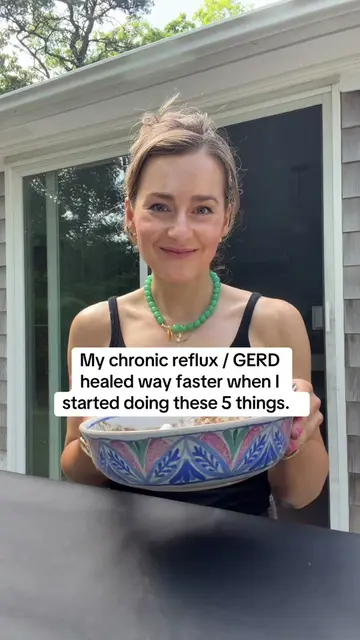
Nobody mentions that diaphragmatic breathing cut acid reflux by 85% in this Mayo Clinic trial.
PMID: 33009052
Read the caption for how to start strengthening your LES ",
Transcript
In a Mayo Clinic trial, people who did belly breathing right after a meal had about 85% fewer reflux events after that meal. Pressure at the valve nearly doubled on the inhale, which is the reason why. I can cite the trial. The more convincing part is watching it work in our practice every day, which is why it's one of the first things we teach. Your LES is the valve at the top of your stomach, and it sits inside your diaphragm. Breathe with your diaphragm instead of your chest and you squeeze t
Original caption
In a Mayo Clinic trial, people who did belly breathing right after a meal had about 85% fewer reflux events after that meal. Pressure at the valve nearly doubled on the inhale, which is the reason why. I can cite the trial. The more convincing part is watching it work in our practice every day, which is why it's one of the first things we teach. Your LES is the valve at the top of your stomach, and it sits inside your diaphragm. Breathe with your diaphragm instead of your chest and you squeeze that valve from the outside. We call it the LES Lock. How to do it: Sit up tall. One hand on your chest, one on your belly. Breathe in slowly through your nose. Your belly hand moves, your chest hand stays still. That's the part most people get backwards. Exhale slowly through pursed lips, longer than the inhale, and let the belly fall. 5 to 10 minutes, starting right when you finish eating. Use it after a meal to blunt that meal's reflux, which is where the 85% comes from. Use it daily and it compounds: in a separate four-week trial, training the diaphragm cut the time the esophagus spent in acid roughly in half, and the people who kept going for nine months dropped their on-demand PPI use by about three quarters. It costs nothing and it takes no food away from you, which is not something I can say about most reflux advice. Halland et al., 2021, American Journal of Gastroenterology, randomized controlled trial, n=33, PMID: 33009052. Eherer et al., 2012, American Journal of Gastroenterology, randomized controlled trial, n=19, PMID: 22146488. Qiu et al., 2020, Annals of Palliative Medicine, meta-analysis, 7 studies, n=210, PMID: 32233626. My 14-Day Reflux Reset Guide is in my bio if you want the full protocol. Follow for more. 💚 #acidreflux #GERD #diaphragmaticbreathing #vagusnerve #refluxdietitian
More from @mollypelletier.rd
More breakout videos from this creator.