Loading video…
All breakouts
6.1Talking HeadOther hookHealth
Hook
MS, RD The Reflux Dietitian
@mollypelletier.rd
310.8K followers · usually 3.9K views a post
Views
19.5K
Likes
374
Comments
12
Shares
52
View velocity
+3.9K views over 11.4d · ~342/day · 10 observations
Why it worked
The video likely resonated with viewers experiencing similar digestive issues by offering practical, simple solutions presented by a credible source (a registered dietitian). The visual of a healthy meal and the creator's relatable presentation likely contributed to engagement.
Summary
The video features a registered dietitian sharing five simple habits she adopted to manage her GERD and chronic gastritis. She is shown eating a meal and discussing the importance of these habits for digestive health.
Structure
- 1Introduction of the topic: 5 simple habits for GERD/gastritis remission
- 2Visual of the creator eating a meal
- 3On-screen text listing the topic
- 4Creator's expression while eating
- 5Continued focus on the meal and creator
On-screen text
MS, RD
The Reflux Dietitian
5 embarrassingly simple things I did to put my GERD and chronic Gastritis in remission
Outlined below
Original caption
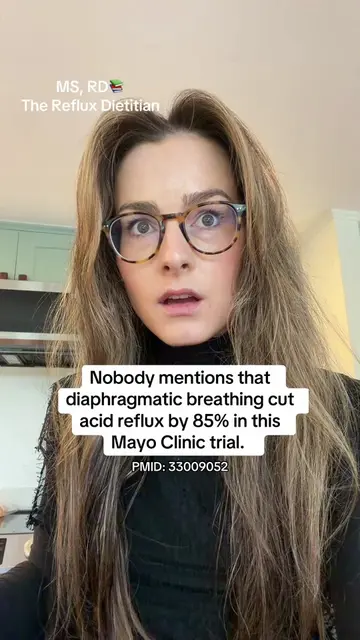
When my gastritis was at its worst, I wanted the fancy fix. What actually moved the needle was five free, almost embarrassingly simple habits. Here they are. 1. The 5+1 Method, before meals. Five slow diaphragmatic breaths and one thing I am grateful for, about 30 seconds before my first bite. It shifts you out of fight-or-flight and into rest-and-digest, so your vagus nerve, motility, and LES can actually coordinate. This is what I teach my clients to do every meal. 2. The 3-hour buffer. I give myself about 3 hours between my last meal and bed. Beverages are fine. In a randomized crossover study, eating close to bedtime caused significantly more nighttime reflux than eating earlier (Piesman 2007, Am J Gastroenterol, PMID 17573791). Keep it flexible, not rigid. 3. Left-side sleeping. Sleeping on your left side keeps the stomach below the esophagus and clears acid faster. A 2023 meta-analysis found left-side sleeping lowered nighttime acid exposure and reflux versus right-side and back sleeping (Simadibrata 2023, World J Clin Cases, PMID 37969463). 4. The LES Lock, after meals. 1 to 5 minutes of diaphragmatic breathing with 360 ribcage expansion right after eating, up to 5x daily. It trains the crural diaphragm that wraps around your LES. In a Mayo Clinic trial, diaphragmatic breathing raised LES pressure (23.1 to 42.2 mmHg) and cut post-meal reflux events from 2.60 to 0.36 (Halland 2021, Am J Gastroenterol, PMID 33009052). 5. Mealtime mindfulness. Slowing down, chewing thoroughly, eating without my phone. More saliva to buffer acid, smoother motility, less pressure pushing upward. Gastritis rarely has a single cause, so finding your root contributors matters too. These five gave my stomach lining the calm environment it needed to settle. Small hinges swing big doors. Save this for your next flare, and follow for more. #gastritis #acidreflux #refluxrelief #GERD #silentreflux guthealth refluxdietitian vagusnerve mealtimemindfulness healing
More from @mollypelletier.rd
More breakout videos from this creator.