Loading video…
All breakouts
15.8Talking HeadOther hookHealth
Hook
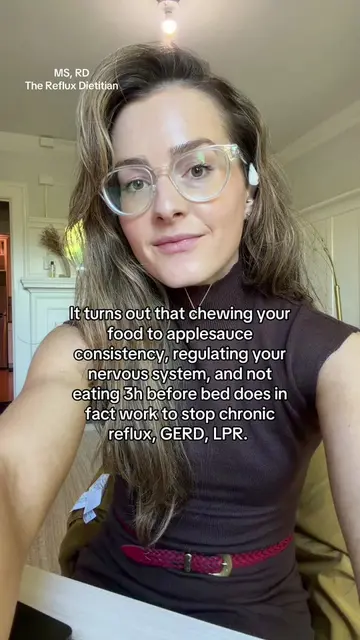
MS, RD The Reflux Dietitian
@mollypelletier.rd
317.1K followers · usually 3.0K views a post
Views
58.3K
Likes
329
Comments
10
Shares
63
Why it worked
The video uses a relatable scenario and a common health misconception to engage viewers. The creator's expertise as a dietitian adds credibility, and the promise of an explanation creates anticipation.
Summary
The video features a dietitian reacting to the common misconception that coughing during a meal is always just acid reflux. She prepares to explain what she wants to tell people in such situations.
Structure
- 1Dietitian reacts to someone coughing and attributing it to acid reflux.
- 2On-screen text explains the common misconception.
- 3Dietitian prepares to share her explanation.
On-screen text
MS, RD
The Reflux Dietitian
When I hear someone coughing
during a meal and they say
"it's just acid reflux"
Here's what I want to tell
them 👇
Original caption
Silent reflux, explained one more time, with the first three things I would do about it. Silent reflux is laryngopharyngeal reflux (LPR): stomach contents traveling all the way up to the throat and voice box. Heartburn is uncommon, which is why it gets missed. It mostly happens upright during the day, esophageal motility is usually normal, and a normal scope does not rule it out. Koufman 2002, Ear, Nose and Throat Journal, PMID 12353431. The reason your throat pays the price is pepsin, the digestive enzyme that travels with refluxate. It sticks to throat tissue, stays stable at neutral pH for 24 hours, and switches back on the next time something acidic comes through. Throat tissue is far more sensitive to it than the esophagus, which is why the same reflux event can feel like nothing in your chest and like a cold that never ends in your throat. Johnston 2007, Laryngoscope, PMID 17417109. Here is what I teach my clients: A temporary low-acid healing phase. Fewer acidic foods and drinks for a window of time, so the pepsin already sitting in the tissue has less to reactivate it. Temporary is the key word. This is a healing phase, not a forever list. The 3-Hour Buffer: stop eating 3 hours before bed. Drinks are fine. Less volume in the stomach overnight means less pressure on the valve and less refluxate reaching your throat while you are flat. The LES Lock: 1 to 5 minutes of diaphragmatic breathing with 360 ribcage expansion immediately after meals, up to 5x daily. The diaphragm wraps around the lower esophageal sphincter, and training it raises the pressure holding stomach contents down. Bite-size, which is what makes it consistent, and consistency is the secret sauce. If this is your throat, my free 14-Day Reflux Reset is in the link in my bio. Follow for more. 💚 Small hinges swing big doors. 🌿 #SilentReflux #LPR #AcidReflux #ThroatClearing #RefluxDietitian
More from @mollypelletier.rd
More breakout videos from this creator.