Loading video…
All breakouts Locked — upgrade to Pro to open.Open on TikTokPro
No preview available · watch on TikTok below
4.0Health
Post
Post by @mollypelletier.rd
@mollypelletier.rd
314.0K followers · usually 4.4K views a post
Views
17.7K
Likes
147
Comments
16
Shares
7
We’re still analyzing this post.
Original caption
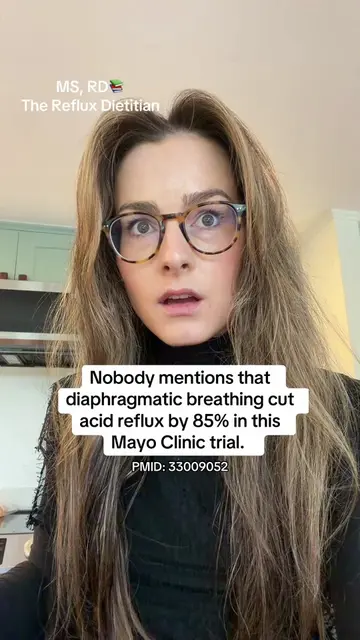
Reflux is a pressure problem. Acid is just what makes it hurt. Lowering acid is all a PPI does. It doesn't tighten the valve at the top of your stomach, and it doesn't change how often that valve opens. Those are the parts that fail. We've had the data for 25 years. Researchers counted reflux episodes before and after omeprazole: 217 before, 261 after. The acid in them fell from 45% to 3%, but the reflux kept happening just as often. Which is why you can look controlled on paper and still feel it every day. What actually moves the mechanics: The LES Lock: 5 to 10 minutes of belly breathing after meals. In a Mayo Clinic trial it nearly doubled the pressure holding that valve shut and cut post-meal reflux events by about 85%. The 3-Hour Buffer: nothing to eat or drink in the 3 hours before you lie down. Eating closer to bedtime than that carried about seven times the odds of GERD. Left-Side Gravity: sleep on your left with the head of the bed raised 6 to 9 inches, so the valve sits above your stomach contents. PPIs have a real place, and any taper is a prescriber conversation. But they were never going to fix a mechanical problem, and you deserved to hear that years ago. Link in bio for the full protocol. 📚 Vela et al., 2001, Gastroenterology, impedance-pH study, n=12, PMID: 11375942. Halland et al., 2021, American Journal of Gastroenterology, randomized controlled trial, n=33, LES pressure 23.1 to 42.2 mmHg, reflux events 2.60 to 0.36, PMID: 33009052. Fujiwara et al., 2005, American Journal of Gastroenterology, matched case-control, n=441, PMID: 16393212. Follow for more. 💚 #acidreflux #GERD #silentreflux #LPR #refluxdietitian
More from @mollypelletier.rd
More breakout videos from this creator.