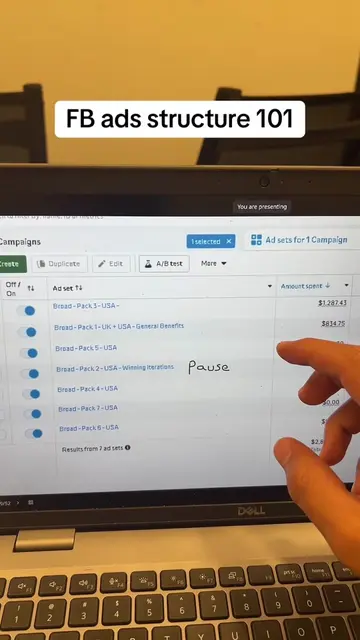
Before you pause your Facebook ads, a lot of you on Facebook ads would tell me, turn this ad off. It's spending the most, but it has the worst ROAS. So why not turn this ad off and force spend to these ads? I'm going to show you quickly why that's a bad idea and how the Facebook funnel actually works. So the first thing you guys have to be aware of is the way Meta allocates spend across different types of creative is very strategic. So let's say you have a video ad and it's a demo ad of your product or it's getting people problem aware and then solution aware. It's obviously going to get the bulk of the spend because it's getting people, it's going to have the lowest frequency and it's kind of an intro to the actual product for the ad. And so of course it's going to get the bulk of the spend. It's probably going to get the lowest conversion rate, but the frequency is going to be low enough, which means if it's in this range, that means it's hitting new audiences. If it's anything above a two, it's starting to retarget people. And so what Meta's really good at doing is they're, they're really good at, let's say somebody sees this ad, they're probably not going to convert, maybe, you know, every once in a while they will convert, but what they will do is they'll retarget that person within the same campaign that you're running, the same ad set, with a different ad that's most likely going to be more retargeting related or warm related. So let's say you have a testimonial ad. It's going to get 3K of spend. It's probably going to get a better ROAS because one, this is their second touchpoint with you and it's speaking to the credibility in terms of why they can trust this first ad and your product in the first place. So you're stacking credibility and it's a funnel, right? These people have likely already seen your ad. It's probably hitting a three, four frequency. And that's why the spend's going to be a lot lower. And then go down to the lowest amount, you're probably going to see an ad that has a really good ROAS, but it's not scalable and I'll show you why. One, it's probably going to get something around like this allocation towards it, right? And the reason why, again, this is probably their third touchpoint now with your actual company. So they've seen this ad, they've seen this ad and now they're seeing this ad. And that's probably why your frequency on this ad's going to be the largest, but your ROAS is going to be the best. So if you were to say, hey, I'm going to pause this ad, let's just X this ad and only run these two because these ones obviously have the better ROAS. Well, what you're not remembering is the frequency on these guys are going to be a lot higher. And so if you try to scale all this spend to these guys, one, you're not going to hit new audiences because of the creative type. Meta knows that this is not introducing people to the actual product. It's not getting problem or solution aware. It's just essentially a warm bottom of funnel ad. And so your frequency is only going to climb and you're going to hit ad fatigue a ton quicker than you would hit ad fatigue on a video ad or an intro ad or an intro static of some sort that's more top of funnel. And so this is how the funnel works. And if you're to pause this ad, that'd be a very, very bad mistake because Facebook takes credit on a last click model, meaning even though they seen this ad first and really this was the start of that, that purchase behavior, Facebook is going to allow this ad after its click to get the actual conversion and the ROAS. So was it this ad that actually got the ROAS or was it this one? Well, no, this one was the start of that relationship and the start of the actual conversion. And so you're going to want to leave ads like this on. Obviously, you can cross check things and sub metrics to make sure that this relationship's actually happening to confirm that you shouldn't turn off a top of funnel ad. But for the most part, that's how the Facebook funnel works. Do not pause an ad and try to force spend into things that are higher spend without understanding the Facebook funnel first.