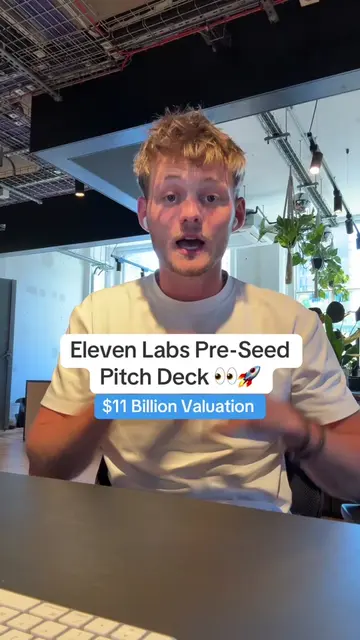
The video effectively breaks down a successful pitch deck, providing valuable insights for founders looking to raise capital. Its visual nature, clear explanations, and focus on key fundraising elements like team, traction, and market opportunity make it highly informative and shareable.
Summary
The video reviews a 14-page seed deck used by a company called Curio to raise $4 million. The presenter walks through each slide, highlighting how the deck effectively communicates the team, problem, solution, market opportunity, competition, differentiation, traction, go-to-market strategy, and funding ask. The deck is noted for its visual appeal and concise explanations.
Structure
1Introduction and funding announcement
2Team slide
3Problem statement
4Solution and architecture
Original caption
Walking you through the pitch deck of one of our portfolio companies that’s has just raised $4m in their seed round 🚀📈 #venturecapital #vc #founder #fundraise #pitch
More from @charlieweaverswright
More breakout videos from this creator.
5
Competitor analysis
6Differentiation
7Traction and metrics
8Go-to-market and pricing
9Market size
10Funding ask and conclusion
Product placement
The video is a walkthrough of a pitch deck for a company named Curio, which is an AI tool for analytics agents. The presenter discusses various slides of the deck, including the team, problem, solution, competition, differentiation, traction, go-to-market strategy, market size, and funding ask.
Call to action
But make sure you save this video for later so you can refer back to it when you're raising and hopefully take some inspiration.
On-screen text
$4M
Seed Deck
querlo
Infrastructure for analytics agents
Seed Round
April 2023
Rami and Javier: We’ve built our careers using AI on data
Rami Abd Habib
Co-Founder & CEO
- Led product at Dreamio across warehouse finance, supply chain.
- Built SQL and Python to alter $100M in finance-unlocked supply chain savings over 8 years.
- Developed teams and services for data-driven product platforms like Friday Finance, based access possible.
Javier Bordia
Co-Founder & CTO
- Built and operated data-critical systems at Databricks, handling data for all of millions of orders.
- Led tech product at Friday Finance, then built the entire tech product.
- Ran both analytics systems and rolled on them to run the business.
Rached by some of the best data leaders:
[Logos of various companies]
THE PROBLEM
Data analysts are the bottleneck of the current data stack
[Diagram of data stack]
THE OPPORTUNITY
We're shifting to a new data stack for the agent first world
[Diagram of new data stack]
THE PROBLEM
Business logic lives in people's heads and Slack threads, not where agents can find it
[Diagram showing Slack threads and definitions]
THE SOLUTION
The infrastructure and context layer the agentic data stack needs
[Diagram of infrastructure and context layer]
[Diagram of product architecture]
How context works in practice
[Diagrams showing workflow steps]
This is really, really good from an investor's point of view.
COMPETITION
Today's tools were built for humans, not agents
[Venn diagram of AI Tools, Notebooks, and Next-to-tool]
And now they talk about their differentiation, specifically titled why Curio wins
WHY CURIO WINS
The last decade was built for humans clicking dashboards. The next one will be for agents writing code.
[Diagrams showing Refine to the new agent data stack, Context that compounds, Code-native, not IP-dependent]
TRACTION
Early partners love the product we released in November
$20k
Average ARR for 20 contracts
$50k
Average contract value
$390k
Contract Annual Revenue
250%
Net revenue retention
23
Design Partners
420+ Good companies from BC to AWS employees
Customer Profile: Development, Equipment and custom system spec
When they first launched their MVP, they had 20
customers and 200+ companies on the waitlist.
Our pilot customers are not worried by the new analytics
product, they are worried about the old analytics product.
ARR: $390K
[Graph showing ARR growth]
GO-TO-MARKET
Top-down sales today, bottoms-up coming next
[Diagram showing pricing tiers and sales models]
MARKET
We enter through self-serve analytics then expand to every data workflow
[Diagram showing SOM and TAM]
And then on the final slide, they highlight they're raising $4M for 24 months of runway to:
[Three boxes detailing use of funds]
Contact: sales@curio.ai
Link: https://curio.ai/seed
Transcript
One of our portfolio companies just raised $4 million. Let me walk you through every single slide from their 14 page deck that they used to raise that round. So, firstly, as always, we start up with a really simple cover page. Next, they jump straight into the team. Now, from Avenger Capitalist's perspective, the team is always like the number one thing that you're looking at at early stage, particularly pre-seeded all the way through to series A. Team is number one. So, they include that right at the beginning. They break down who they are, their blurs and put some logos of the companies they've worked in before. Next, jump into the problem. Now you'll start to get the feeling for this deck. It's very, very visual, less worthy. That's because the problem they're solving is quite technical and the number of funds that they'll be speaking to won't actually be technical or like savvy in this environment. So, visually demonstrating it on the page is just a much easier way for someone to understand what they're building and therefore makes their conversations much more productive. Then they jump into the opportunity. Now, this opportunity slide is actually kind of like market drivers. It's where the market is Now they jump into the problem and they do a really good job of summarizing the part of the problem quite quite simply here. It's just one sentence on what the problem is for a user and then they kind of break down how that problem actually plays out in a real environment. Now they talk about the solution again very visual kind of walking you through the different steps in the product and then how it works. This is actually the architecture behind the product all on one page kind of demonstrating how they process data and what the output is on the other side. Slide 8 is again another slide on how it works, very visual here. This is really, really good from an investor's point of view. Next, they talk about the competitors. Again, not many words here. They just explain what other platforms are doing wrong in one sentence, it's quite holistic. And then they break down using the vent diagram, the different platforms they're competing against and where Qrio this company where they sit in that vent diagram. And now they talk about the differentiation, specifically titled why Qrio wins. They break down the three key reasons in really nice kind of sections in this day. Again, it's visual, but they include a bit more context here, some more words which help the reader understand the detail behind their differentiation. Now, one of the juicy slides they talk about traction. They talk about where their ARR is and where they want to be and a bit more about the journey from sort of when they started. They talk about their design partners, their average contract values all on one slide. It's actually a really good visual but also realistic slide which explains enough. And now they talk about their go to market on slide 12. So they talk about top down sales from where they are now their pricing model, I mean how much they're charging and what their pricing model actually is, you know, how they make money. Now they expand a bit more on the market, they basically communicating and showcasing that it's a $3 billion industry or serviceable, attainable market which they think they can get to right now. But then they expand and say the Tam is actually $200 billion and it's growing. And then on the final slide, they highlight they're raising $4 million for 24 months of runway. Now this business has since raised this money, which is great. Um, and this deck is very visual. It's very clean looking. Um not so many words for out it. You've definitely seen decks which which are more worthy. But I think ultimately it depends on the industry that you're building in and how much you're looking to raise, but make sure you save this video for later so you can refer back to it when you're raising and hopefully take some inspiration.
 2 videos2 creators