Loading video…
All breakouts
17.2Talking HeadProblem Callout hookHealth
Hook
MS, RD The Reflux Dietitian
@mollypelletier.rd
317.1K followers · usually 3.0K views a post
Views
80.3K
Likes
617
Comments
59
Shares
97
Why it worked
The video uses relatable facial expressions and on-screen text to convey a common health misconception, making it engaging and shareable.
Summary
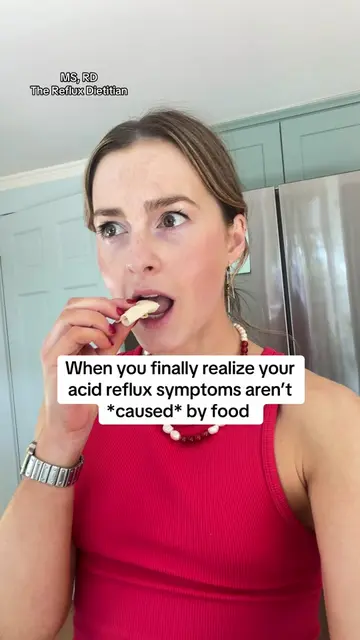
The video features a woman with glasses and a red top, looking surprised and then making a disgusted face. On-screen text suggests that acid reflux is not always an acid problem and is driven by other factors.
Structure
- 1Realization about acid reflux
- 2Expression of surprise
- 3Expression of disgust
On-screen text
MS, RD
The Reflux Dietitian
When you finally realize your acid reflux isn't actually an acid problem,
It's driven by this
Original caption
When you finally realize your reflux was never really an acid problem. 🌿 If acid suppression only half-worked, or stopped working, this is why. Acid is one player, but the mechanics underneath are what keep the whole thing going. Four drivers: A worn-down barrier. The mucosa lining your esophagus and throat becomes under-supported and stays reactive, so every reflux event lands harder than it should. A weak or under-supported LES. That's the valve at the top of your stomach. When it loses tone and coordination, contents travel up even on a plain, "safe" meal. Pepsin. The enzyme that rides up with refluxate settles into your throat tissue and keeps irritating it even when acid is low, then reactivates when things turn acidic again (Johnston et al. 2007, PMID 17417109). This is a big reason acid suppression alone can fall short. A dysregulated nervous system. In fight-or-flight, digestion slows and LES coordination slips, and it loops: symptoms raise your stress, stress feeds the symptoms (Barillari et al. 2025, PMID 40258993). And the repetitive habits keep feeding all four. Eating too much at once raises the pressure on your LES. Eating too close to bed leaves food in your stomach when you lie down (dinner-to-bed under 3 hours carried a much higher GERD risk than 4 or more hours, odds ratio 7.45, Fujiwara et al. 2005, PMID 16393212). It's the pattern around the food, not usually the specific food. Support the barrier, the LES, and your nervous system, and you change the conditions your tissue is trying to heal in. Follow for more daily reflux tips, and grab my free Reflux Revolution guide from the link in my bio. 💚 Small hinges swing big doors. 🌿 #AcidReflux #GERD #LPR #RefluxRelief #GutHealth [reflux not an acid problem, reflux barrier, pepsin LPR, weak LES, nervous system reflux]
More from @mollypelletier.rd
More breakout videos from this creator.