Loading video…
All breakouts
5.8Talking HeadOther hookHealth
Hook
MS, RD The Reflux Dietitian
@mollypelletier.rd
314.0K followers · usually 4.4K views a post
Views
22.3K
Likes
507
Comments
29
Shares
22
Why it worked
The video likely resonated with its target audience by directly addressing common and uncomfortable digestive issues like reflux and GERD, offering a clear solution through the creator's page and resources. The inviting tone and the promise of free help create a strong incentive for viewers to engage further.
Summary
The video features a woman standing outdoors with text overlay. The text discusses acid reflux, GERD, hiatal hernia, and gastritis, and invites viewers to find her page for resources. The creator is identified as "MS, RD The Reflux Dietitian."
Structure
- 1Introduction of the creator and her focus
- 2Text overlay inviting viewers with reflux issues
- 3Mention of free resources available
- 4Creator turns to face the camera with a smile
On-screen text
MS, RD
The Reflux Dietitian
Patiently waiting for everyone
with reflux, GERD, hiatal
hernia and gastritis, to find my
page so they don't have to
suffer anymore.
(and to use my 478 free
resources)
Original caption
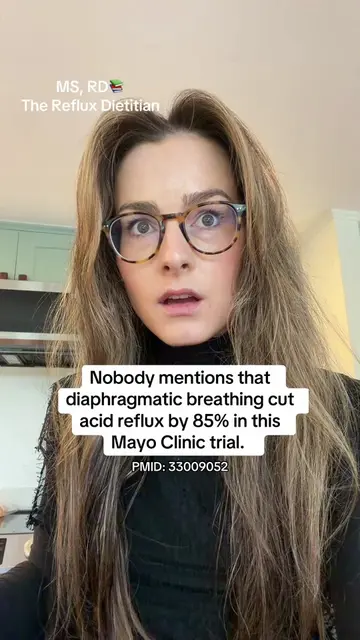
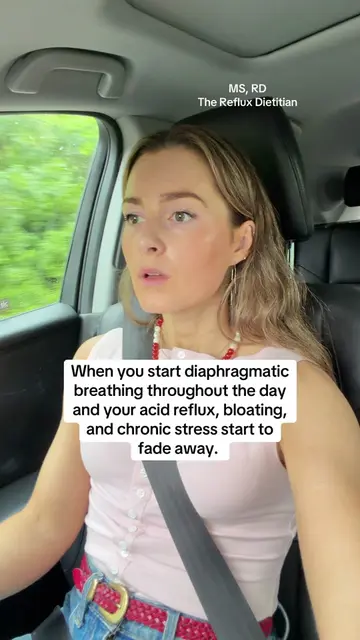
Me, patiently waiting for everyone with acid reflux, GERD, and LPR to find this page so they can strengthen their anti-reflux barrier and lean on their meds a little less. So let’s start here. The barrier that keeps acid out of your esophagus is actually two muscles working together. Your lower esophageal sphincter (LES) and the crural diaphragm that wraps around it, forming your esophagogastric junction (Zdrhova et al., 2023, Dysphagia, PMID 35842548). Here’s the part that gives me hope for you. Your diaphragm is a skeletal muscle, so you can actually train it. For free. Here is what I teach my clients. I call it the LES Lock: 1 to 5 minutes of diaphragmatic breathing immediately after meals, breathing into a full 360 ribcage expansion (not just your belly), up to 5 times a day. In a randomized trial, this kind of breathing raised LES pressure on every inhale (42.2 vs 23.1 mm Hg) and lowered post-meal reflux events (0.36 vs 2.60 per meal) by widening the pressure gap between your LES and your stomach (Halland et al., 2021, Am J Gastroenterol, PMID 33009052). Two more ways to take pressure off that barrier: keep meals on the smaller side so your stomach isn’t pushing up against it, and give yourself a 3-hour buffer between your last meal and bed. Does any of this replace your care team? No. But in a 4-week trial, the people who kept up breathing training reduced their acid exposure time and were using fewer PPIs 9 months later (Eherer et al., 2012, Am J Gastroenterol, PMID 22146488). Always sort out any medication changes with your doctor. Consistency is the secret sauce. Save this for after your next meal, and follow for more. #AcidReflux #GERD #LPR #SilentReflux #RefluxRelief
More from @mollypelletier.rd
More breakout videos from this creator.