Loading video…
All breakouts
18.4Talking HeadOther hookHealth
Hook
MS, RD The Reflux Dietitian
@mollypelletier.rd
317.1K followers · usually 3.0K views a post
Views
83.8K
Likes
2.3K
Comments
33
Shares
455
Why it worked
The video likely resonated with viewers by offering a proactive, actionable solution to a common problem (acid reflux) that goes beyond typical dietary advice. The focus on training a muscle (the LES) provides a novel and empowering approach, tapping into the growing interest in functional health and body mechanics.
Summary
The video discusses strengthening the lower esophageal sphincter (LES) as an alternative to simply removing trigger foods for acid reflux. It suggests that the LES can be trained through diaphragmatic breathing exercises, specifically mentioning the "LES Lock" technique involving ribcage expansion after meals.
Structure
- 1Introduction to strengthening the LES
- 2Explanation of the LES and its connection to the diaphragm
- 3Introduction of the "LES Lock" technique
- 4Description of the technique: diaphragmatic breathing and ribcage expansion
- 5Frequency and duration of the exercise
On-screen text
MS, RD
The Reflux Dietitian
Watch what happens when you start to strengthen your Lower Esophageal Spinctor (Anti-Reflux Barrier)
instead of just removing acid reflux trigger foods and hoping for the best.
Here's how to do it 🥳
Original caption
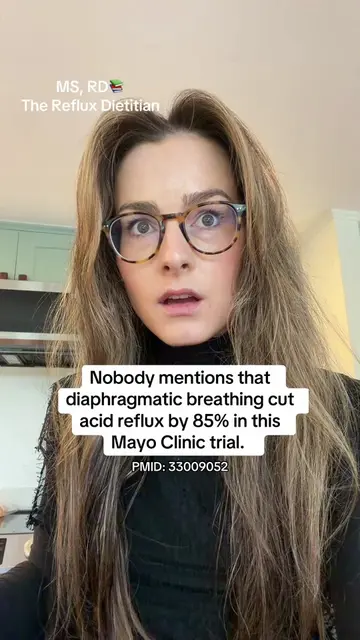
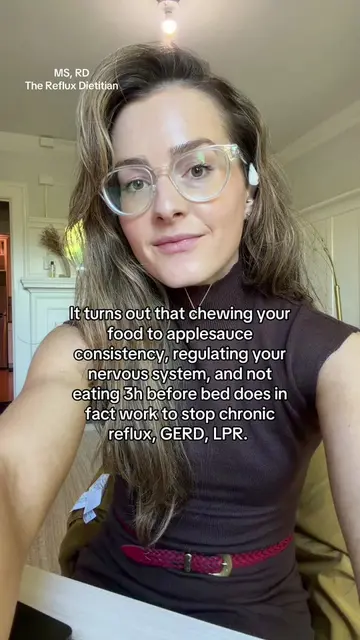
My avoid list kept getting shorter and my reflux kept showing up anyway. What finally moved the needle was training the barrier itself. The lower esophageal sphincter (the valve at the top of your stomach) is wrapped by the crural diaphragm, a skeletal muscle that tightens around the valve on every inhale. Muscles respond to training. This one is no exception. The LES Lock: 1 to 5 minutes of diaphragmatic breathing with 360 ribcage expansion immediately after meals, up to 5x daily. Belly out on the inhale, ribs widen front, sides and back, exhale slower than you inhaled. Here is what I teach my clients, and what I still do myself. In a Mayo Clinic RCT, LES pressure during the inhale measured 42.2 mmHg vs 23.1 without it, and reflux events after eating fell from 2.60 to 0.36. Halland et al. 2021, Am J Gastroenterol, 23 GERD patients and 10 controls, PMID 33009052. In a separate RCT, four weeks of daily practice cut time with esophageal pH under 4 from 9.1% to 4.7%, with no change in controls, and the patients still training at 9 months were using less on-demand PPI. Eherer et al. 2012, Am J Gastroenterol, n=19, PMID 22146488. The second piece is your nervous system. The vagus nerve (your rest-and-digest pathway) helps regulate resting LES tone. Spend the day in fight-or-flight and digestion gets deprioritized, gastric emptying slows, and the diaphragm stays high and tight in the chest instead of moving low. A stressed system asks more of the barrier while giving it less to work with. Slow diaphragmatic breathing with a long exhale is itself a vagal signal, so the LES Lock does two jobs at once. Nervous System Snacks: 1 to 5 minute regulation breaks, 1 to 3 times a day, away from meals. Extended exhales or hand-on-belly breathing. My 3 breathing exercises for reflux are at the link in my bio. Follow for more and share this with someone whose avoid list keeps growing. Small hinges swing big doors. #AcidReflux #GERD #LES #DiaphragmaticBreathing #RefluxRelief
More from @mollypelletier.rd
More breakout videos from this creator.