Loading video…
All breakouts Locked — upgrade to Pro to open.Open on TikTokPro

No preview available · watch on TikTok below
6.1Health
Post
Post by @mollypelletier.rd
@mollypelletier.rd
321.1K followers · usually 3.0K views a post
Views
15.0K
Likes
291
Comments
9
Shares
60
We’re still analyzing this post.
Original caption
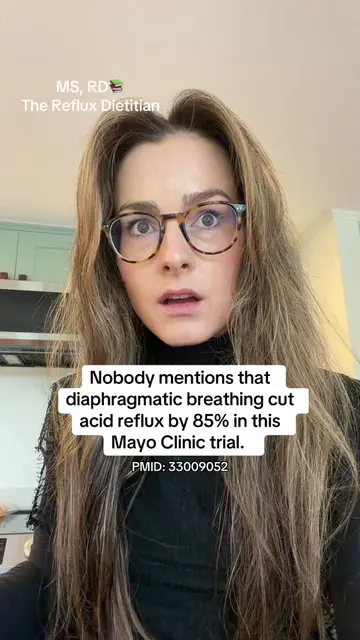
What I wish someone had told me when I had GERD: your LES (the valve at the top of your stomach) sits inside your diaphragm, and your diaphragm is a muscle you can train. During my own GERD I kept cutting foods. My gut and my nervous system were bigger root contributors, and nobody showed me how to work on either. The LES Lock works on the valve and the nervous system at the same time, and it's what I teach my clients. The LES Lock: 1 to 5 minutes of diaphragmatic breathing right after meals. Sit up tall and breathe in slowly through your nose, letting your rib cage expand 360 degrees (front, sides, and back). Breathe out slowly, a little longer than the breath in. For your valve: in a Mayo Clinic trial of people with GERD, pressure at the valve nearly doubled on each inhale, and breathing this way after a meal meant about 85% fewer reflux events after that meal. For your nervous system: a systematic review found slow breathing raises heart rate variability, a sign your body is shifting toward rest and digest. In a randomized study of healthy adults, 8 weeks of guided diaphragmatic breathing lowered cortisol (a stress hormone). Your vagus nerve helps regulate LES tone, so a calmer nervous system supports the valve too. My free Reflux Vagus Nerve webinar is linked in my bio if you want to start there. Small hinges swing big doors. 🌿 📚 Halland et al., 2021, Am J Gastroenterol, RCT, n=33 (23 with pH-proven GERD, 10 controls), PMID: 33009052. Ma et al., 2017, Front Psychol, randomized controlled study, n=40 healthy adults, PMID: 28626434. Zaccaro et al., 2018, Front Hum Neurosci, systematic review, 15 studies, PMID: 30245619. #refluxtok #acidreflux #gerd #diaphragmaticbreathing #refluxdietitian
More from @mollypelletier.rd
More breakout videos from this creator.