Loading video…
Sound

original sound - sarainwondertech
Sara ~ AI | Tech | Startup · Original audio
0:00–:––
Playing this video’s own audio, so you’ll hear the creator over the sound.
We didn’t find a product being promoted in this video. Its hook, format and structure below still show why it took off.
Browse products winning on TikTokThe video leverages a high-stakes, fear-based hook regarding personal privacy that is immediately relevant to almost every internet user, combined with clear, simplified data visualizations of a complex research paper.
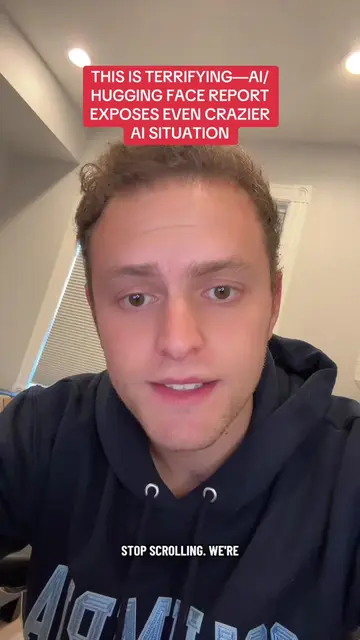
The creator discusses a research paper from ETH Zurich demonstrating how AI models like Gemini and ChatGPT can deanonymize pseudonymous online accounts. The video explains the methodology used by researchers to link anonymous profiles to real-world identities and warns about the implications for online privacy.
Researchers from ETH Zurich just published a paper showing that AI can deanonymize pseudonymous online accounts at scale. Your online privacy is officially gone. Using a pipeline combining Gemini embeddings and GPT-5.2 reasoning, they tested whether AI could match anonymous profiles back to real identities across three experiments. In the first, they took 338 Hacker News accounts, stripped all identifying information, and let an AI agent search the open internet. It correctly identified 67% of users — with 90% precision. That means when it guessed, it was right 9 times out of 10. In the second, they took 987 real LinkedIn profiles and asked AI to find their anonymous Hacker News accounts hidden inside a pool of 89,000 users. It matched the right person 45% of the time at 99% precision. In the third, they split a single Reddit user's comment history across time — one year gap — and asked AI to recognize the same person in both halves. It succeeded 38% of the time. The cost of running this attack: $1 to $4 per person. The data needed: nothing but your public posts. According to the authors, there is no meaningful protection except not posting online at all — because the very content that makes online communities valuable is the same content that makes you identifiable. This is not a niche security finding. It affects anyone who has ever posted online under a username. Paper: "Large-scale online deanonymization with LLMs" — Lermen, Paleka, Swanson, Aerni, Carlini, Tramèr. ETH Zurich & Anthropic, February 2026.
You're not going to like this one.
Hook about AI deanonymization
Explanation of the research methodology
Results of the two experiments
Implications for online privacy
Call to action to share the video
share this video
Playing this video’s own audio, so you’ll hear the creator over the sound.
Promotes 4 products. Create free account to see more.
Outliers and viral hits: their videos on Overshot, all time.